Topic 1 Vocab
Chemical Change
Law of Conservation
Topic 2 Vocab
Energy
100
The smallest piece of an element.
What is an atom?
100
The 5 signs of a chemical change, name 2 of them
1. Color Change
2. Gas Production
3. Production of a Precipitate (Chunky Solid)
4. Temperature Change (internally)
5. Energy Change (heat, light, sound production)
100
In the following reaction, how many atoms of each kind are present on either side of the equation:
CH₄ + 2O₂ → CO₂ + 2H₂O
1 Carbon atom
4 Hydrogen atoms
4 Oxygen atoms
100
Energy of heat
Thermal Energy
100
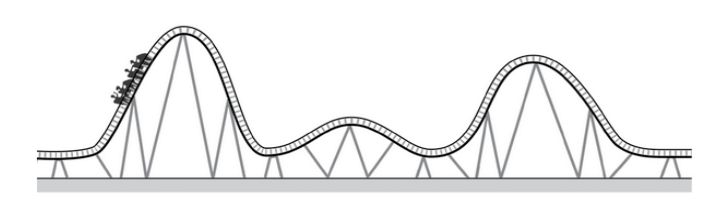
At what point on the track does the car have the greatest potential energy?
The Top of the first and highest hill
200
An arrangement of atoms chemically combined to make a new substance.
What is a molecule?
200
You can always tell a chemical change occured if . . .
a new substance if formed
200
In the following reaction, how many atoms of each kind are present on either side of the equation:
N₂ + 3H₂ → 2NH₃
2 nitrogen atoms
6 hydrogen atoms
200
Explain the difference between endothermic and exothermic reactions
Endothermic Reactions absorb heat
Exothermic Reactions release heat
200
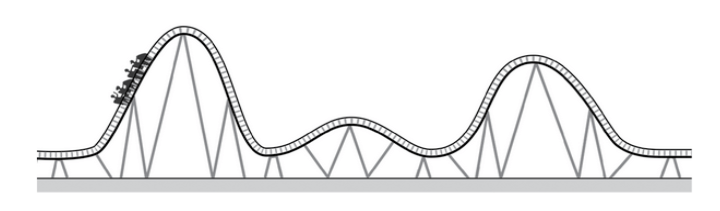
At what point on the track does the car have the greatest kinetic energy?
At the bottom of the first and highest hill, when it is closest to the ground
300
A positively charged particle in the nucleus of an atom
What is a proton?
300
Give two positives of a synthetic polymers?
Strength
flexibility
easy to clean
durability
300
In the following reaction, how many atoms of each kind are present on either side of the equation:
2 H₂ + O₂ → 2 H₂O
2 oxygen atoms
4 Hydrogen atoms
300
The formula for Kinetic Energy
KE = 1/2 x Mass x speed2
300
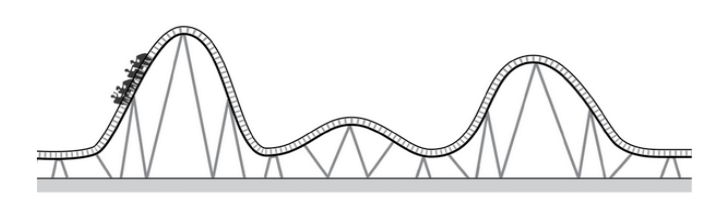
What is the kinetic energy of the ride turned into as the ride goes on. Include at least 2 energy transformations.
Electric, Sound, Thermal
400
A negatively charged particle that orbits the nucleus of an atom
What is an electron?
400
Give two negatives for synthetic polymers . . .
Pollution
does not break down
difficult to dispose of
microplastics causing health concerns
400
Based on this molecule diagram, what is the chemical symbol for Sulfuric Acid.
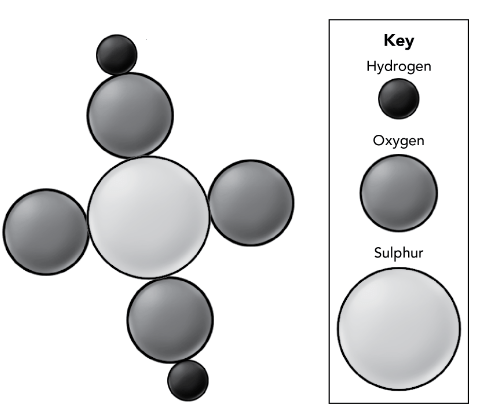
H2SO4
400
Formula for gravitational potential energy
GPE = Weight x Height
400
Sunlight enables plants to use water and carbon dioxide during photosynthesis to make and store sugar. Any animal that eats the plants can convert the sugar into the energy it needs to move from place to place. Which three types of energy are involved in this example?
chemical, thermal, electromagnetic (light), kinetic
500
A neutrally charged particle in the nucleus of an atom
What is a neutron?
500
What is Law of Conservation of Mass?
No atoms are created or destroyed in a chemical reaction. They are only reorganized.
500
Crushing Aluminum cans would be a ________ change (physical or chemical)
Physical
500
Name 2 types of energy and where you would find them in everyday life.
Nuclear Energy
Chemical Energy
Thermal Energy
Electrical Energy
Kinetic
Potential
Where you find them (Answers may vary.)
500
Give an example of energy transformations
Toaster = Electrical > Thermal
Baking Bread = Thermal > Chemical
Power Plant = Kinetic > Electrical
Digesting Food for Work = Chemical > Kinetic
Burning Firewood = Chemical > Thermal
Fan = Electrical > Kinetic
Nuclear Power Plant = Nuclear > Electrical
Battery = Chemical > Electrical
Falling = Potential > Kinetic
600
An interaction between two substances where a new substance if formed.
What is a chemical reaction/chemical change?
600
In the following reaction, the subscript (little number) tells how many _________ per __________
N₂ + 3H₂ → 2NH₃
atoms per molecule
600
The coefficient (big number) tells how many ____________
The subscript (little number) tells how many ____________
molecules
atoms
600
Name the two types of potential energy beside gravitational
Elastic and Magnetic
600
Give an example of energy transformation
Toaster = Electrical > Thermal
Baking Bread = Thermal > Chemical
Power Plant = Kinetic > Electrical
Digesting Food for Work = Chemical > Kinetic
Burning Firewood = Chemical > Thermal
Fan = Electrical > Kinetic
Nuclear Power Plant = Nuclear > Electrical
Battery = Chemical > Electrical
Falling = Potential > Kinetic