Movement in Space
Earth's Movement
The Moon
Celestial Bodies
100
This is Earth's only natural satellite.
What is the Moon?
100
This is the word that describes the movement of Earth as it spins on its axis.
What is rotation?
100
This is the length of one year on the moon.
What is 29.5 days?
100
A shooting star is not a star at all, it's actually this.
What is a meteor?
200
From Earth, this appears to move in an arc across the sky each day, but is never seen at night.
What is the Sun?
200
This is the path that a planet takes as it revolves around the Sun.
What is an orbit?
200
This is the phase of the moon about one week after a New Moon.
What is the First Quarter?
200
A large ball of burning gas and plasma formed of Hydrogen and Helium
What is a star? (I would also accept The Sun)
300
These are named after the Greek word for "wanderer" since they don't follow the same movements as the stars.
What are planets?
300
This is the reason why different regions of the Earth experience changing seasons throughout the year.
What is Earth's tilt on its axis?
300
The combined gravitational pull of the sun and the moon on the Earth's surface water results in this especially high tide two times each month.
What is a spring tide?
300
These are large enough to be rounded by their own gravity and have cleared their orbital paths around the Sun of debris.
What are planets?
400
This is the model of the solar system developed by Ptolemy, with the Earth at the center and planets having circular orbits.
What is the geocentric model?
400
This is the name of the day (not the date) two times a year when there are 12 hours of sunlight and 12 hours of nighttime.
What is the equinox?
400
This single word encapsulates the concept enshrined in Isaac Newton's First Law, and is also the reason why the Moon doesn't crash into the Earth.
What is inertia?
400
A large piece of ice and dust that orbits the sun, and develops a long trail as it nears the sun.
What is a comet?
500
This is the name for the group of 12 constellations that the other planets in our solar system seem to pass through during the year, when viewed from Earth.
What is the zodiac?
500
These are the two factors that determine the strength of an object's gravitational pull.
What are mass and distance?
500
This is the length of a lunar day - the amount of time it takes for the moon to make one full rotation.
What is 29.5 days?
500
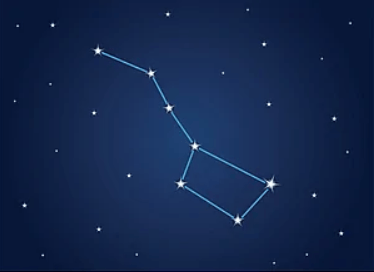
What is the Big Dipper OR Ursa Major? (I would also accept "a constellation.")