Ventilatory Structure & Function
Ventilation & Respiration
Cardiovascular Structure & Function
Cardiovascular System & Exercise
Wild Card
100
The four principal structures of the ventilatory system.
What are larynx, trachea, bronchi, lungs?
100
This causes an increase in ventilation.
What is a decrease in blood pH?
100
Blood transports the following:
I. Proteins
II. Hormones
III. Platelets
A. I and II only
B. I and III only
C. II and III only
D. I, II, and III
What is D. I, II, and III?
100
What changes occur to a boxer's stroke volume and heart rate while punching during a match?
A. Stroke Volume increases, heart rate increases
B. Stroke volume doesn't change, heart rate increases
C. Stroke volume increases, heart rate decreases
D. Stroke volume decreases, heart rate increases
What is A. stroke volume increases, heart rate increases?
100
List one type of blood cell.
What is:
erythrocytes/red blood cells ✔
leucocytes/white blood cells ✔
platelets/thrombocytes ✔
200
What are the functions of the nose during inspiration?
I. To moisten the air
II. The diffuse oxygen from the air
III. To filter the air
A. I and II only
B. I and III only
C. II and III only
D. I, II, and III
What is B. I and III only.
200
This is the action of the diaphragm and the external intercostal muscles during exhalation.
What is relaxation of the diaphragm and the external intercostal muscles?
200
This type of circulation is responsible for the exchange of oxygen between the blood and the lungs?
What is pulmonary circulation?
200
This is how cardiac output is calculated.
What is heart rate x stroke volume?
200
This is where the electrical impulse is generated for contraction in the heart.
What is sinoatrial (SA) node?
300
Total lung capacity is:
What is the volume of air in the lungs after a maximum inhalation?
300
This promotes passive diffusion during inspiration.
What is low partial pressure of O2 in the pulmonary capillaries and high partial pressure of CO2 in the pulmonary capillaries?
300
This action of the heart is responsible for the force of systolic pressure as measured on the walls of the aorta.
What is ventricular contraction?
300
This is how blood pressure responds during a warm-up.
What is systolic blood pressure increases and diastolic blood pressure remains constant?
300
This is transported in the pulmonary artery.
What is deoxygenated blood to the lungs?
400
State the receptor in the aorta which responds to carbon dioxide and pH levels in the blood.
What are chemoreceptors?
400
Distinguish between maximal oxygen consumption during cycling and arm ergometry.
What is cycling produces higher maximal oxygen consumption/VO2max values than arm ergometry?
400
This is the primary role of platelets.
What is blood clotting and preventing bleeding?
400
This is how an increased erythrocyte level benefits an athlete.
What is by increasing the oxygen carrying capacity of the blood?
400
State one component transported by blood.
What is:
Cells (erythrocytes / leucocytes / platelets) ✔
plasma ✔
electrolytes ✔
proteins ✔
gases ✔
nutrients ✔
waste products ✔
hormones ✔
500
The correct order for carbon dioxide moving from the pulmonary artery to the atmosphere is:
What is trachea --> larynx --> nose?
500
Define the term cell respiration.
What is the controlled release of energy in the form of ATP from organic compounds in cells?
500
The diagram shows the heart. State the blood vessels A, B, and C in the diagram.
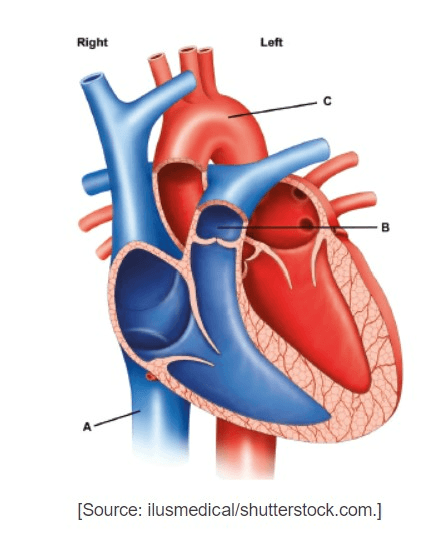
What is A: inferior vena cava, B. pulmonary artery, and C. aorta?
500
Outline cardiovascular drift.
What is:
cardiovascular drift is the gradual increase in HR seen in an athlete doing prolonged ‹steady state› exercise✔
dehydration contributes to cardiovascular drift✔
cardiovascular drift is associated with increased blood viscosity✔
over prolonged periods of exercise stroke volume decreases✔
blood being sent to the skin/vasodilation for cooling reduces stroke volume to active muscles causing HR to increase✔
to maintain cardiac output HR increases✔
exercise in a hot environment exaggerates cardiovascular drift✔
500
Distinguish how cardiac output, stroke volume, and resting heart rate would differ between training and untrained women during exercise.
What is