nth Roots, Radicals and Rational Exponents
Exponent and Radical Properties
Graphing Radical Functions
Solving Radical Equations
Function
Operations
Operations
Inverse
Functions
Functions
100
Simplify:
36^(1/2)
6
100
Multiply:
sqrt3*sqrt7
sqrt21
100
What is the domain and range of the following equation:
sqrt(x+4)-2
D: [-4,oo)
R: [-2,oo)
100
Solve:
sqrt(x+5)=3
x=4
100
Let f(x)=2x+1 and g(x)=3x^2 . Find f+g.
3x^2+2x+1
100
Find the inverse of the following relation.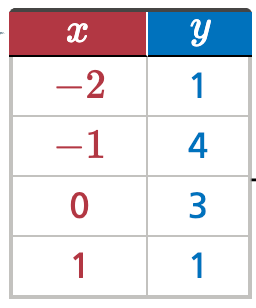
Is the inverse relation a function?
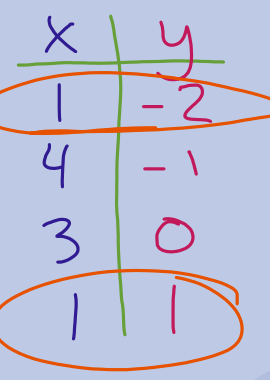
Not a function.
200
Rewrite as a radical:
(4x)^(2/3)
root(3)(16x^2) or root(3)((4x)^2)
200
Divide:
(sqrt45)/sqrt(5)
3
200
What is the Domain and Range of the following equation?
root(3)(x+5)-1
D: (-oo,oo)
R: (-oo,oo)
200
Solve:
root(3)(x-1)=2
x=9
200
Let f(x)=2x+1 and g(x)=3x^2 . Find
f(x)-g(x) .
.
-3x^2+2x+1
200
Find the inverse.
f(x)=3x+5
f^-1(x)=(x-5)/3
300
Rewrite as an exponent:
7root(5)(x^3)
7x^(3/5)
300
Multiply:
sqrt(5)(4sqrt(3)+2sqrt(x))
4sqrt(15)+2sqrt(5x)
300
Describe the transformations from the Parent Function:
2 root(3)(x-4) +5
Vertical Stretch by a factor of 2
Shift Right 4, Up 5
300
25-root(4)x=22
x=81
300
Let f(x)=2x+1 and g(x)=x-5 . Find (f*g)(x) .
2x^2-9x-5
300
Find the inverse.
g(x)=(x+5)^2
g^-1(x)=sqrt(x)-5
400
Rewrite in exponential form:
sqrt(12x^5)
2x^2sqrt(3x)
400
Add:
sqrt18+sqrt8+sqrt50
10sqrt2
400
What is the equation of the parent function sqrt(x) after it has been reflected over the x-axis and shifted up 3 units.
-sqrt(x)+3
400
Solve:
sqrt(3x-2)=x-4
x=9
400
Let f(x)=x-5 and g(x)=x^2-2x-15 . Find
f/g . State any domain restrictions.
1/(x+3)
x!=-3
400
Find the inverse and state the domain and range. f(x)=sqrt(x)+2
f^-1(x)=(x-2)^2
D: [2,oo)
R: [0,oo)
500
Solve the equation:
3x^{\frac{3}{2}}=81
9
500
Find Reduced Radical Form:
1/(sqrt(7)-2)
(sqrt(7)+2)/3
500
What is the increasing interval of the following equation:
-root(3)(x+4)
No increasing interval
500
Solve:
2x=sqrt(17x-15)
x=3,x=1.25
500
Let f(x)=x-4 and g(x)=x^2 . Find (g@f)(x) .
x^2-8x+16
500
Are the following functions inverses?
f(x)=x^3+4 g(x)=root(3)(x-4)
f(g(x))=x and g(f(x))=x .
Yes, they are inverses.