Likelihood & Probability
Theoretical Probability
Experimental Probability
Comparing Theoretical & Experimental Probabilities
100
The set of all possible outcomes is the...
Sample space
100
Given the spinner below, find
P(spinning a multiple of 4)
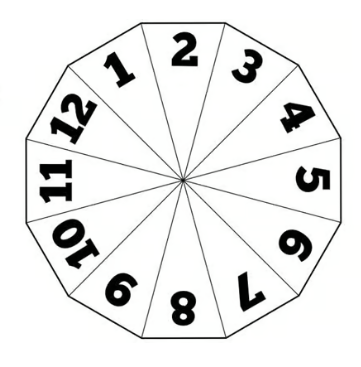
3/12 = 1/4 = 25%
100
The ratio of the number of times an event occurs to the total number of trials is the...
relative frequency
or
experimental probability
100
Mel rolls a die with 6 faces labeled A, B, C, D, E, and F 100 times. She rolls F eighteen times. How does her experimental probability compare to the theoretical probability of rolling F?
The experimental probability of 18% is slightly higher than the theoretical probability of 16.7%, though it is pretty close.
200
The sample space for this spinner is...
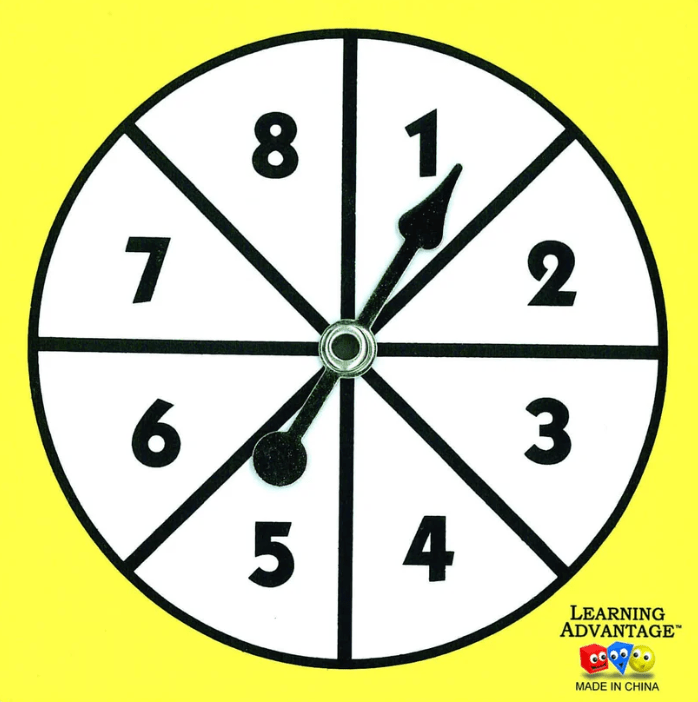
S = {1, 2, 3, 4, 5, 6, 7, 8}
200
Of all 25 marbles in a bag, 3 of the marbles are white. What is the probability that a white marble will be randomly selected without looking? Write your answer as a percent.
12%
200
Grant flipped a coin 80 times. The coin landed heads up 44 times and tails up 36 times. Find the experimental probability of the coin landing tails up.
36/80 = 9/20 = 45%
200
A fair coin is flipped 20 times. It lands tails up 12 times. What is the experimental probability, and how does it compare to the theoretical probability?
Experimental: 60%
Theoretical: 50%
The experimental probability is greater than the theoretical probability.
300
On a fair 10-sided die, the likelihood of rolling a number greater than 4 is
a. impossible
b. unlikely
c. likely
d. neither likely nor unlikely
c. likely
300
The letters A to Z are written on popsicle sticks and placed in a cup letter-side down. If Mr. Abbott chooses a stick at random without looking, what is the probability he will choose the letter J? Write your answer to the nearest whole percent.
1/26 approx 4%
300
The table shows the results of selecting a marble at random from a bag 200 times, replacing it each time. What is the experimental probability of selecting a green marble?
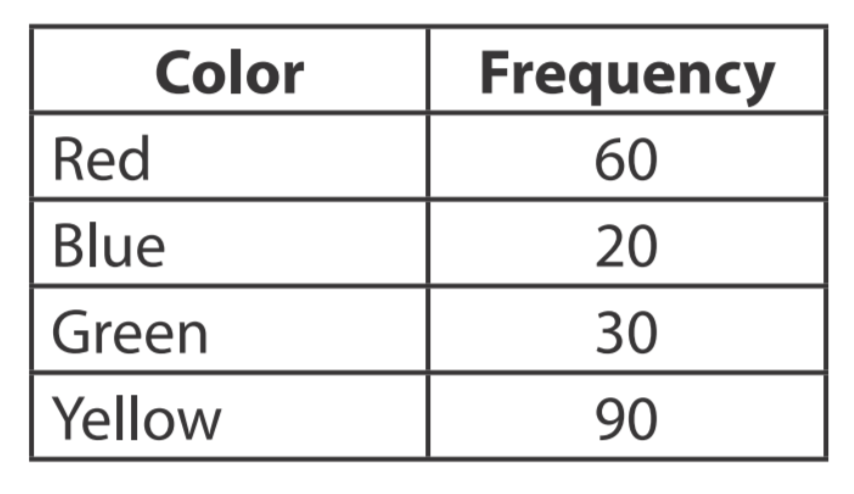
30/200 = 3/20 = 15%
300
Jesse has a bag of 8 marbles:
2 red, 3 yellow, and 3 green.
He draws a marble from the bag, writes down the color, replaces it, and draws again. He repeats this process for 40 trials and records drawing a yellow marble 12 times.
How does the experimental probability of selecting a yellow marble compare to the theoretical probability?
Experimental: 30%
Theoretical: 37.5%
The experimental probability is less than the theoretical probability.
400
A sports anchor states that a team has a 15% chance of losing on Sunday. Which word best describes the likelihood of the team losing on Sunday?
a. certain
b. unlikely
c. impossible
d. likely
b. unlikely
400
A fair, 11-sided die with faces labeled 1 through 11 is rolled. Find P(odd number). Write your answer to the nearest whole percent.
6/11 approx 55%
400
Four people conduct an experiment to find how often a flipped coin lands heads up. The results are shown in the table below:
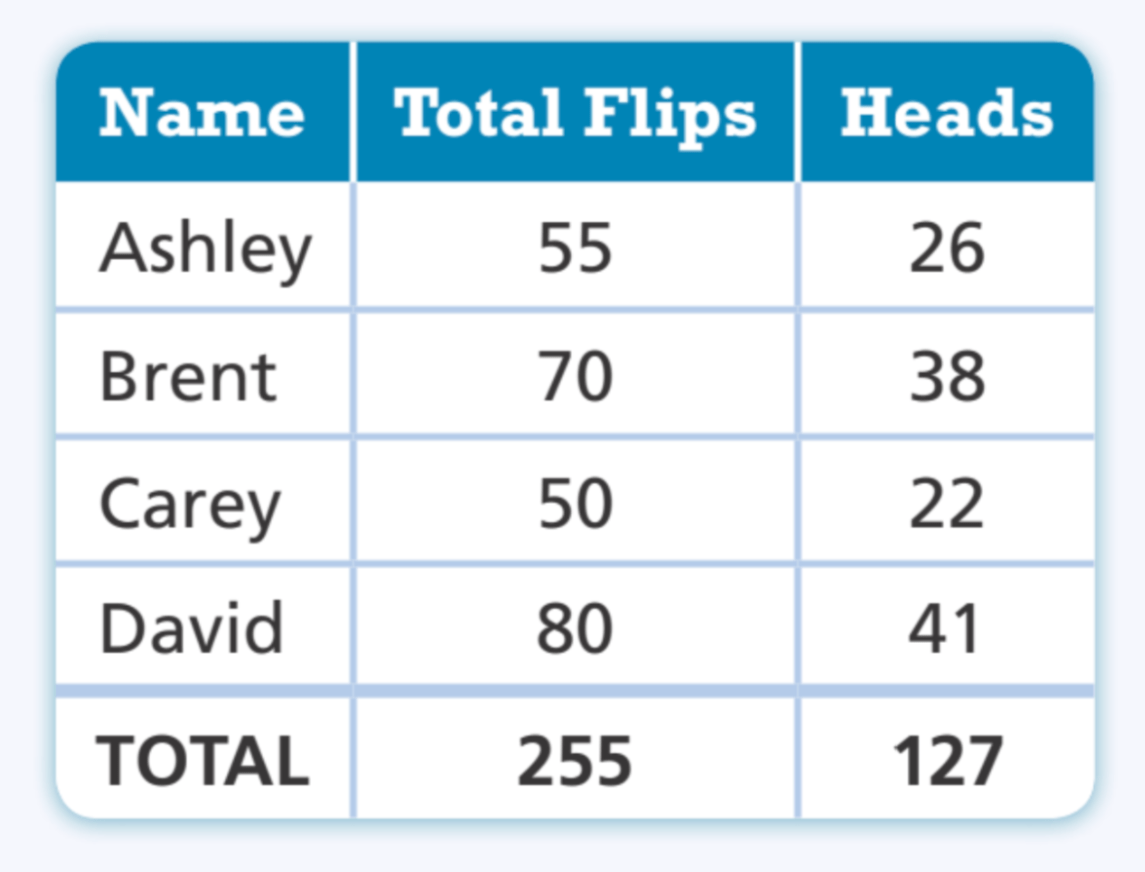
Based on the experimental probability, how many times would you expect the coin to land heads up if the coin is flipped 400 times?
127/255 • 400 approx 199.2
400
Mr. Abbott is planning two projects for his students' final assignment. Each student will have an equal chance of selecting Project A or Project B. Mr. Abbott flips a coin to represent each student's assignment, with heads representing Project A and tails representing Project B.
After 110 flips, there are 58 heads and 52 tails. To the nearest whole percent, what is the experimental probability of Project A?
53%
500
To play a board game, a player spins the pointer of a spinner with eight equal sections numbered as follows:
1, 1, 2, 2, 2, 3, 4, 4
What is the probability of spinning either a 2 or a 4? Write your answer as a percent to the nearest tenth.
62.5%
500
A bag has 20 M&M's as follows:
6 red, 4 brown, 7 green, and 3 blue.
If an M&M is drawn at random, which is more likely to happen, drawing a red M&M or drawing either a brown or blue M&M?
Drawing brown or blue, which has a probability of
7/20 or 35%
500
In a contest, each student in a class draws a number card from 1 to 5 at random out of a large basket. The card is replaced after each student. The outcomes are shown in the table below:
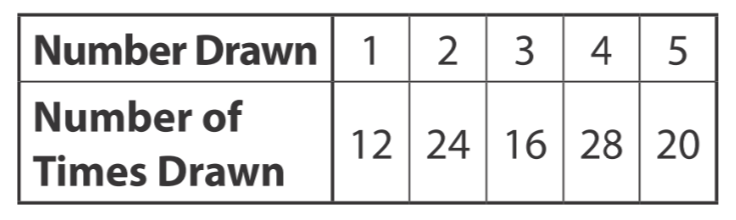
Based on the data, what is the experimental probability of drawing a 4?
28/100 = 7/25 = 28%
500
Boaz has 25 cards with 5 cards of each color. The results of randomly selecting 625 cards are shown below.
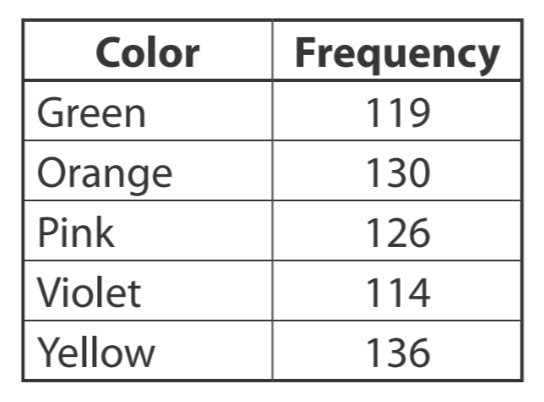
For which color is the experimental probability closest to the theoretical probability?
Pink.
Theoretical: 20%
Experimental: 20.16%