The Heart of the Matter
Seeing Red
Up-n-down
Better living through Pharmaceuticals
Fill 'Em Up!
100
The patient complains of SOB, fatigue, and activity intolerance and she states she has a hx of CAD. You auscultate the lungs and hear crackles. You suspect she suffers from this ailment.
What is left-sided heart failure?
100
This type of Anemia requires lifelong parenteral administration of its replacement and is caused by the lack of gastric secretion of intrinsic factor of the parietal cells.
What is Pernicious (B12)?
100
Your patient complains of pain in his right leg when he walks a moderate distance. Your assessment reveals shiny, hairless lower legs with +1 DP/+1PT palpable.
You are already thinking about discharge teaching based on what is suspected with this patient. What are at least 3 nursing implementations?
Reinforce long-term antiplatelet therapy
Encourage supervised exercise for circulation
Promote daily foot inspection and care
Stress safe, well-fitting footwear choices
No crossing legs!
Teach control of CVD risk factors
Refer to podiatry for wound management
100
Your client with a DVT is placed on this anticoagulant and you are teaching her about performing this lab test at home weekly.
Name the medication.
Name the test that can be performed at home.
What is Coumadin/Warfarin and INR?
100
List at least three safety measures you undertake before administering a unit of PRBCs.
Verify Order
Verify correct product with Blood Bank
•2 RN verification of product
•2 RN verification of right client
•Scan barcodes
Ensure at lease a 20g IV is in place and patent
200
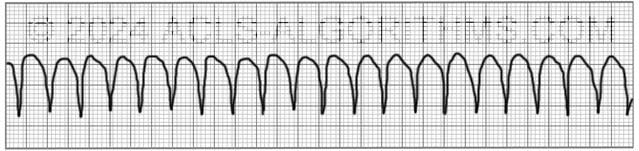
***You see this rhythm on the monitor. You identify the rhythm and this is the FIRST thing (after calling for help) you do as you reach the patient's bedside.
Ventricular Tachycardia (Vtach)
Check for a pulse (will also accept check for consciousness).
200
A patient with this genetic blood disorder is diagnosed with Pneumococcal pneumonia and has orders for oxygen via NC and hydration.
What is Sickle Cell disease?
200
Your patient has a DVT in the left leg. You anticipate your assessment reveals these symptoms to support this diagnosis.
What is unilateral swelling, pain in the calf area (could be silent too), warmth, redness and low grade fever, normal pedal pulses?
200
This type of medication but NOT this type of medication is used to treat Peripheral Arterial Disease.
What are antiplatelets but NOT anticoagulants?
200
List at least 3 signs of a transfusion reaction.
What are:
•Fever
•Pain (Chest and flank pain)
•Changes in vital signs
•Allergic reactions (Hives, itching)
•Decreased urine output
Mentation changes
300
You are providing discharge teaching to your patient newly diagnosed with Coronary Artery Disease (CAD). List some main lifestyle recommendations the patient can do to keep themselves as healthy as possible (at least 3).
Goal: lower LDL cholesterol and improve heart health
Limit saturated fats & cholesterol: red meat, egg yolks, whole milk
Increase complex carbs & fiber: whole grains, fruits, vegetables
Choose healthy fats: nuts, avocado, oils (canola, olive, avocado)
Triglycerides ↑ → reduce alcohol & simple sugars
Omega-3 fatty acids: lower triglycerides, slow CAD progression
– Eat fatty fish (salmon, tuna, mackerel) twice a week
– Supplements may be recommended if the diet is not enough
Exercise at least 30 minutes on most days.
Stop smoking.
300
***You notice hematuria in your patient's foley catheter bag and look to see if her platelets are less than this number due to this sudden observation.
What is <20,000/μL?
300
Your patient is diagnosed with a DVT, suddenly she develops these symptoms, and you recognize this is a medical emergency and call the provider.
What are SOB, dyspnea, chest pain?
300
This type of Thrombocytopenia can be caused by this anticoagulant.
What is Heparin Induced Thrombocytopenia? (HIT)
300
List the fluid/medication you can mix with blood.
What is ONLY NS 0.9%?
400
A patient puts the call light on and complains of chest pain radiating up his neck into his jaw and down his left arm. List some nursing interventions that you would perform emergently.
Position the client at rest, semi-Fowler’s for comfort
Administer O₂ if SpO₂ < 93% or if the patient is dyspneic
Monitor vital signs and ECG during an angina episode
Relieve pain with sublingual nitroglycerin (teach proper use)
Assess pain: onset, duration, location, quality (0–10 scale)
Stay with the patient, provide reassurance, and reduce anxiety.
400
Your patient's grandmother comes to visit your patient who has Leukemia. She asks what the 'sign on the door' means.
What is: "that is neutropenic precautions and that means we need to protect your granddaughter from any infection"?
400
You educate your patient on these interventions to promote venous return for his Chronic Venous Insufficiency.
Wear compression stockings as well as:
•Positioning & Activity: Avoid prolonged standing/sitting; elevate legs; daily walking after healing
•Skin & Wound Care: Moist dressings (film, hydrocolloids, foams, alginates); protect from trauma; moisturize daily
•Nutrition: Adequate protein, vitamin A, vitamin C, zinc; strict glucose control in diabetes
•Infection: Not all ulcers need antibiotics; culture if infection signs present; treat with debridement + systemic antibiotics if needed
400
Explain how you would teach a patient to safely administer this vasodilator medication that is used to treat their chest pain at home.
(And we aren't talking about the 6 rights).
1. Stop activity
2. Take a nitro SL
3. If pain is not relieved in 5 minutes, call 911 and take a 2nd nitro.
400
***Five minutes into a blood transfusion, your patient exhibits these signs of a adverse transfusion reaction and you take these steps emergently.
Name at least 3 things.
Stop the infusion and disconnect from patient.
Monitor VS closely.
Notify provider.
Flush the line with NS.
Send the bag to blood bank.
Document!
500
You receive orders on a new patient:
Obtain CBC, CMP, UA
Administer Hydrochlorothiazide 25mg po daily
Administer Enalapril 20mo po daily
Diet: Hear-healthy; Na <1500mg/daily
Take BP on both arms and record
You suspect the patient was newly diagnosed with this condition:
What is Hypertension?
500
Your patient is diagnosed with iron deficient anemia. The patient complains of these symptoms that support this diagnosis. List at least 3.
What are glossitis, cheilitis, fatigue, activity intolerance, increased heart rate, chest pain, and looking pale.
500
***All vascular problems are these kinds of problems.
What are perfusion problems?
HF → weak pump
PAD → blocked arteries
VTE → blood clot
CVI → valve failure & pooling
500
***These medication classifications are used to treat heart failure (name at least 2)
What are Beta Blockers and Ace Inhibitors or diuretics?
500
Your patient needs 2 units of AB- blood. When the 1st unit arrives, you check the blood and see that it is not compatible to the Type and Match on your patient. This is the type of blood that you received. (Name at least 2 -multiple answers are acceptable).
AB+
A+
B+
O+
(Due to the Neg antigen, they cannot receive anything with a positive antigen).