Vocabulary
Translations
Reflection
Rotation
Congruency
100
Name the three types of rigid transformations.
Translation, reflection, rotation.
100
Translate point A(–2, 4) by the rule (x, y) →
(x + 3, y – 2). What is A′?
(1, 2)
100
The given graph depicts what rigid transformation?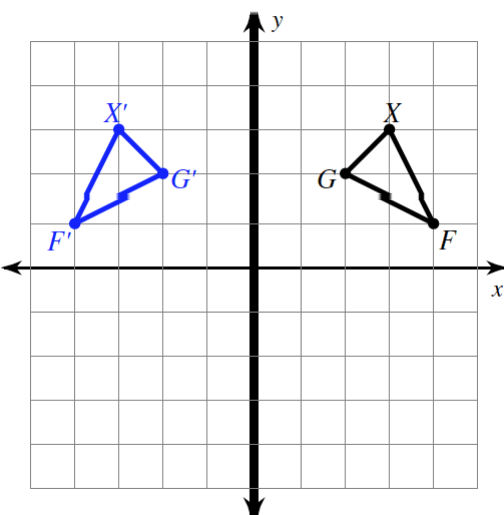
Reflection over the y-axis?
100
Describe the rigid transformation being depicted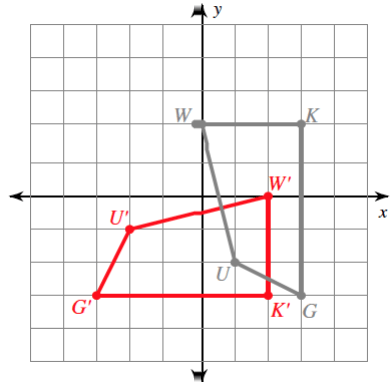
90-degree clockwise rotation about the origin
100
True or False: If two figures can be mapped onto each other using rigid transformations, they are congruent.
True.
200
What is a definition for rigid transformation?
A movement that preserves size & shape.
200
A square with side length 2 units is translated 5 units up. What happens to its area?
The area remains the same.
200
What is the line of reflection?
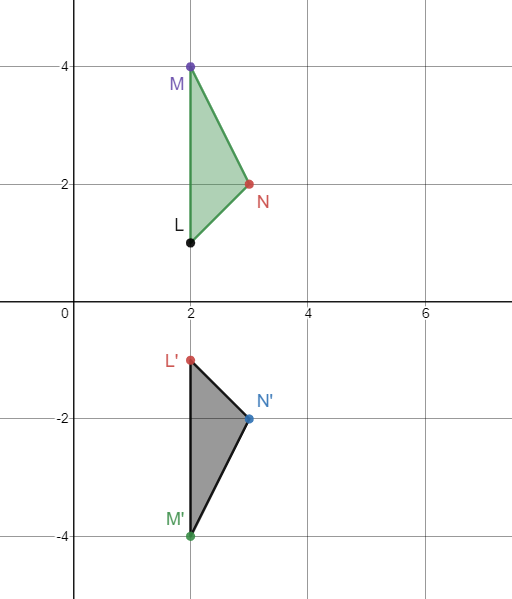
The x-axis
200
A square is rotated 90° counterclockwise, then translated up 3 units, finally rotated an additional 180° clockwise. How much larger is the square after this series of transformations?
The square remains the same size through rigid transformations.
200
Two triangles are congruent. One has sides 3, 4, 5. What are the side lengths of the other triangle?
3, 4, 5.
300
Define congruent figures
Figures with same shape & size.
300
Write an algebraic transformation that moves point P(–5, 0) to P′(2, 7).
(x + 7, y + 7)
300
Reflect point (4, –2) across the y-axis. What is the new point?
(–4, –2)
300
Rotate point (0, 5) 180° about the origin. What is the new point?
(0, –5)
300
A triangle has vertices at (0,0), (2,0), (1,3). Another triangle has vertices (0,0), (–2,0), (–1,3). Describe the transformation(s) that prove the triangles are congruent.
Reflection across y-axis.
400
Name of a line that intersects two parallel lines
Transversal
400
Translate triangle with vertices (1,1), (2,3), (3,1) 4 units right. List new coordinates.
(5,1), (6,3), (7,1)
400
Reflect triangle with vertices (1,1), (2,2), (3,1) across the x-axis. List new coordinates.
(1, –1), (2, –2), (3, –1)
400
The given graph depicts rigid transformations of the pre-image *. This triangle represents a Rotations of triangle * 90-degrees counterclockwise about the origin
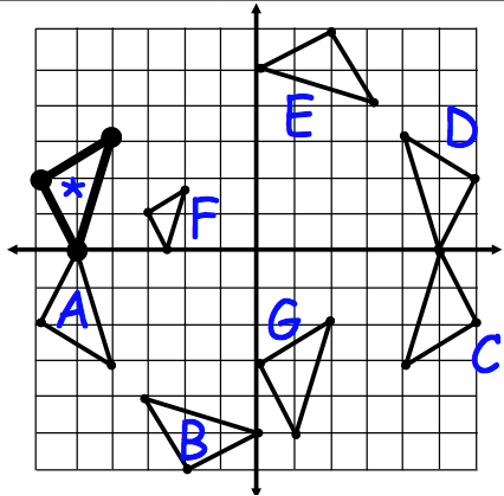
Figure B
400
The second half of this unit focuses on angle pair relationships. What is the other relationship angles have if they are not congruent? (Think about transversals intersecting straight lines and those relationships)
Supplementary
500
Define line of symmetry
a line that divides a figure into two congruent parts so that the reflection of either part across the line maps precisely onto the other part
500
A point was located at (-4, -5). It undergoes a translation and is now located at (1,-8). Write the transformation algebraically
(x + 5, y - 3 )
500
A triangle at (1,2), (2,4), (3,2) is reflected over the y-axis and then translated 1 unit down. Write its new coordinates.
(–1,1), (–2,3), (–3,1)
500
Rotate point (–3, 2) 90° clockwise about the origin.
(2, 3)
500
Give two examples of a angle pair relationships that shows congruence
Vertical Angles
Corresponding Angles
Alternate Interior Angles
Alternate Exterior Angles