Smooth Slides
Mirror, Mirror
Spin Zone
Sizing Things Up
Combo Moves & Symmetry
100
What geometric term describes a rigid motion transformation that slides every point of a figure the same distance in the same direction without changing its size or shape?
What is a translation?
100
What transformation flips a figure over a line, creating a mirror image?
What is a reflection?
100
Unless stated otherwise, in standard geometry, positive degree measures of rotation turn a figure in which direction?
What is counterclockwise?
100
Which transformation alters the size of a figure while preserving its shape and angle measures?
What is a dilation?
100
How many lines of symmetry can be drawn on a regular 5-pointed star?
What is five (5)?
200
Describe the exact verbal movement represented by the translation rule
(x, y) \rightarrow (x - 4, y + 3)
.
What is moving 4 units left and 3 units up?
200
If point B(-2, 8) is reflected over the y-axis, what are the coordinates of B'?
What is
B'(2, 8)
200
What is the coordinate rule for a 180° counterclockwise rotation about the origin?
What is
(x, y) \rightarrow (-x, -y)
200
If a dilation centered at the origin has a scale factor of k = 3, is the transformation classified as an enlargement or a reduction?
What is an enlargement?
200
What type of symmetry does a figure have if it can be mapped onto itself by a rotation of 180° or less about its center?
What is rotational symmetry?
300
If triangle vertex A(-4, 5) is translated 5 units right and 4 units down, what are the coordinates of the image point A'?
What is
A'(1, 1)
300
What is the general coordinate rule for reflecting a point (x, y) over the x-axis?
What is
(x, y) \rightarrow (x, -y)
300
Point A(-4, 6) is rotated 90° counterclockwise about the origin. What are the coordinates of A'?
What is
A'(-6, -4)
300
What are the coordinates of point P(-4, 3) after a dilation centered at the origin with a scale factor
k=1/2
?
What is
P'(-2, 1.5)
P'(-2, 3/2)
300
True or False: Performing a sequence of rigid motions (translations, reflections, or rotations) results in an image that is congruent to the preimage.
What is True?
400
Write the algebraic coordinate rule for a translation that moves any figure 5 units left and 2 units down.
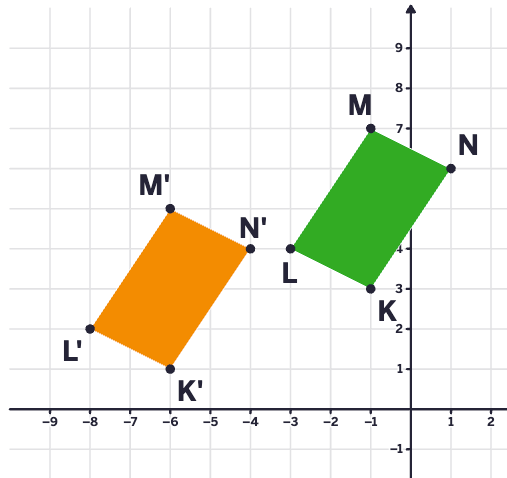
What is
(x, y) \rightarrow (x - 5, y - 2)
400
Point C(7, 1) is reflected over the line y = x. What are the coordinates of the image C'?
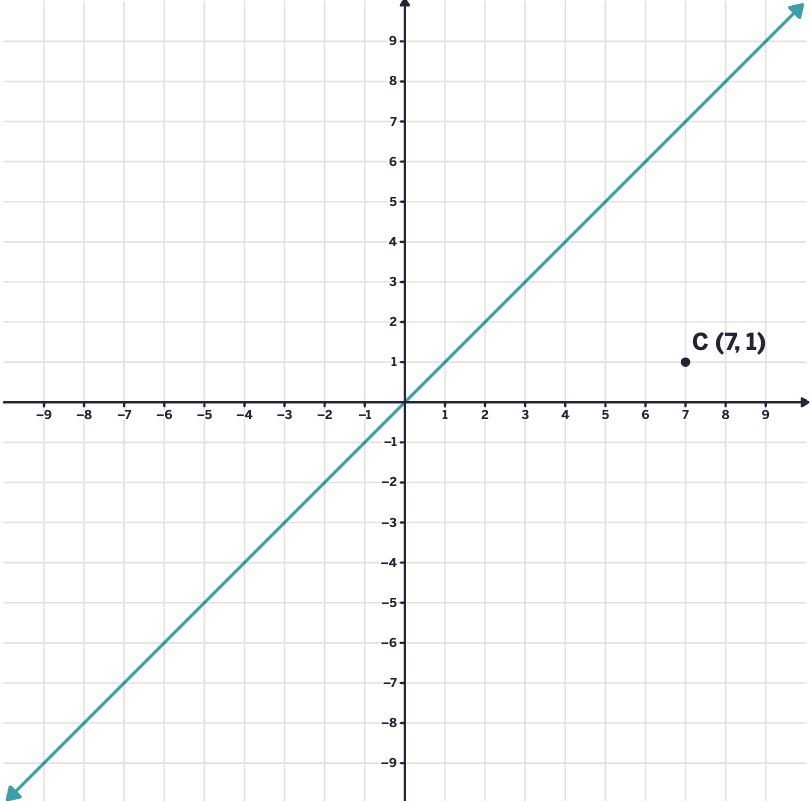
What is
C' (1, 7)
400
Point B(-2, -8) is rotated 270° counterclockwise about the origin. What are the coordinates of B'?
What is
B'(-8, 2)
400
Triangle ABC is dilated about the origin to form Triangle A'B'C', as shown in the graph. What is the scale factor k of this dilation?
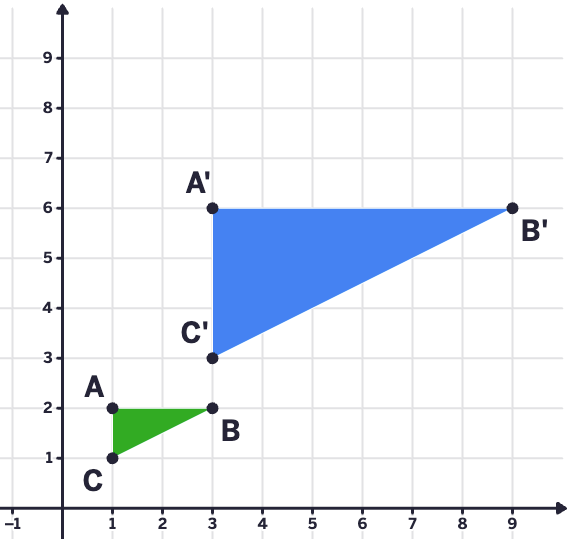
What is k=3?
400
Triangle ABC shown on the graph undergoes a glide reflection: first a translation of
(x, y) \rightarrow (x + 5, y)
, followed by a reflection over the x-axis. What are the final coordinates of point A''?
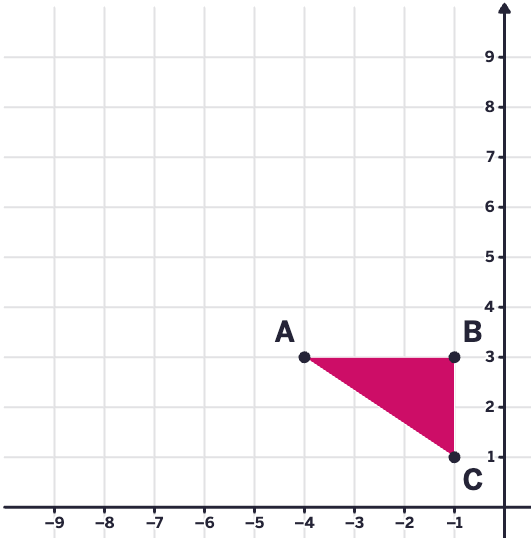
What is
A''(1, -3)
500
Point $P$ is translated using the rule
(x, y) \rightarrow (x - 8, y + 4)
to obtain the image point P'(-3, -10). What were the coordinates of the original preimage point P?
What is
P (5, -14)
500
Point D(5, -3) is reflected over the line y = -x. What are the coordinates of D'?
What is
D'(3, -5)
500
Point C(-7, 1) is rotated 180° counterclockwise about the origin to C', and then C' is rotated another 90° counterclockwise about the origin to C''. What are the coordinates of C''?
What is
C''(1, 7)
500
Triangle ABC with vertices A(-3, 4), B(2, 1), and C(-1, -2) is dilated with a scale factor of k = -2. What are the final coordinates of image vertex A'?
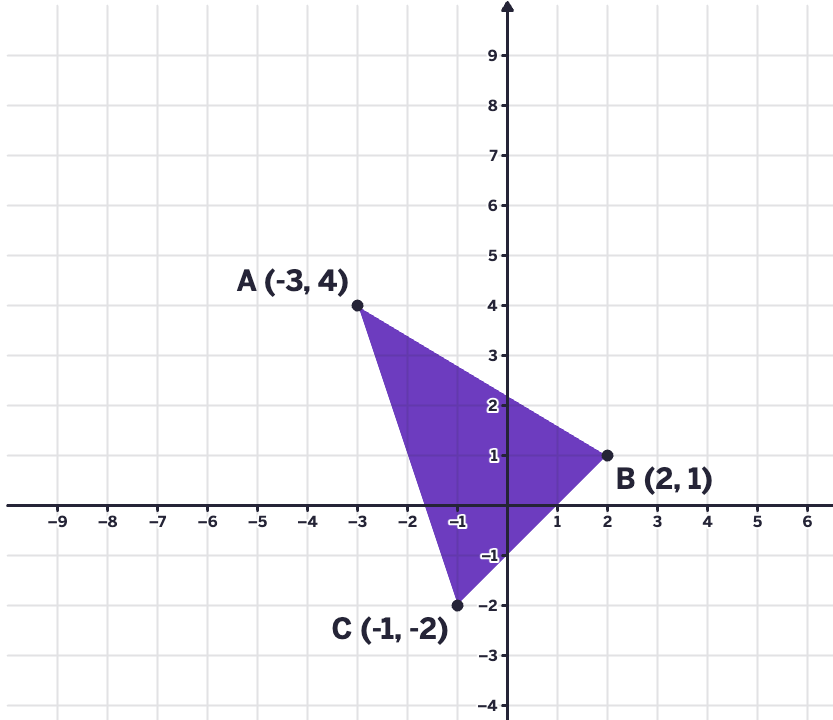
What is
A'(6, -8)
500
Triangle PQR with vertices P(2, 3), Q(5, 3), and R(2, 1) undergoes a two-step composition: first a reflection over the y-axis, followed by a 90° counterclockwise rotation about the origin. What are the final coordinates of point P''?
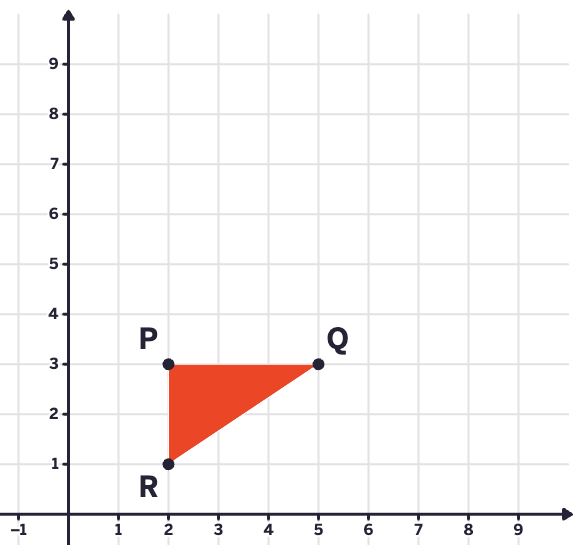
What is
P''(-3, -2)