Definitions
Translations
Reflections
Rotations
100
An operation that maps a geometric figure (preimage) onto a new figure (image)
transformation
100
Describe the translation.
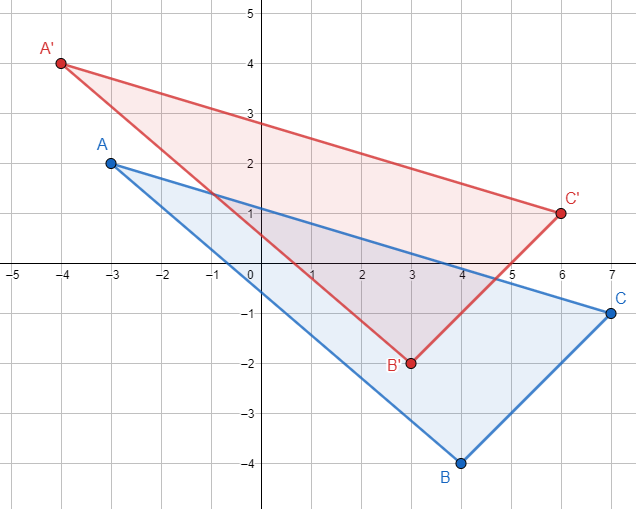
Left 1, up 2.
100
Describe the reflection.
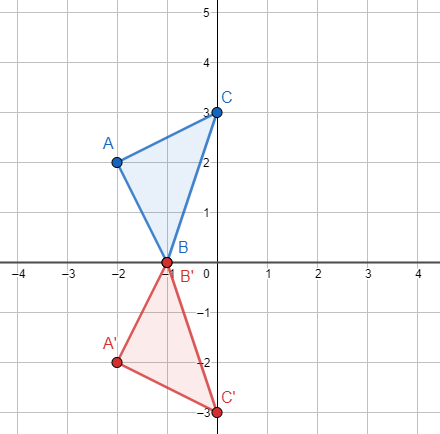
Reflection over the x-axis.
100
Describe how A was rotated.
90° clockwise OR 270° counterclockwise
200
Name the transformations that do not change the shape and size of the original figure.
translation, reflection, rotation
200
Write the coordinate notation for a translation left 10 and down 7.
(x,y)->(x-10,y-7)
200
K(-4,6) is reflected across the y-axis. Find K'.
K'(4,6)
200
A(5,10) is rotated 180° clockwise about the origin. Find A'.
A'(-5,-10)
300
Which shape is the image? Blue or green?
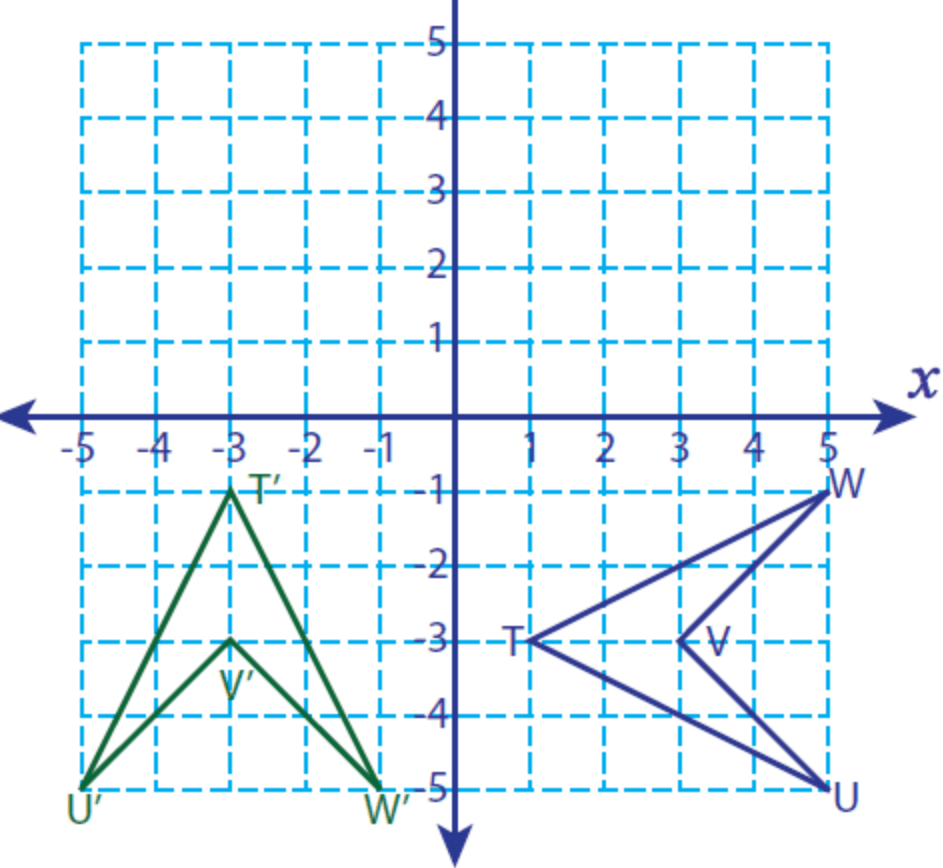
green
300
Write the coordinate notation for the translation shown.
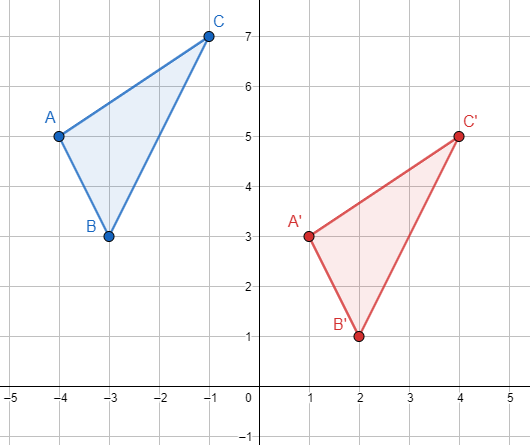
(x,y)->(x+5,y-2)
300
E(-20,30) is reflected to E'(-20,-30). Describe the reflection.
Reflection over the x-axis.
300
B(-7,0) is rotated 90° clockwise about the origin. Find B'.
B'(0,7)
400
What is the notation (symbol) used to differentiate the preimage from the image?
a prime (such as A')
400
∆ABC has the vertices A(3, 3), B(2, -1), C(-2, 4). Graph the translation of ∆ABC after translation of 5 units left and 2 units up.
The image should have the coordinates with A'(-2, 4), B'(-3, 1), and C'(-7, 6)
400
∆ABC is reflected across the y-axis. Find the coordinates of ∆A'B'C' .
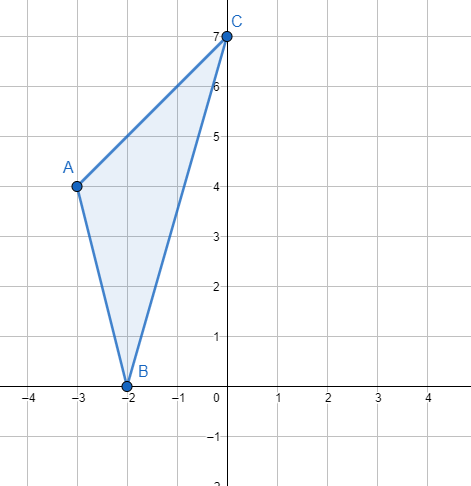
A'(3,4)
B'(2,0)
C'(0,7)
400
C(-14,-6) was rotated to C'(6,-14). Describe the rotation.
90° counterclockwise about the origin
500
What is called the number to describe how much a figure changes when dilating?
a scale factor
500
∆ABC has the vertices A(3, 3), B(2, -1), C(-2, 4). What is the coordinates of vertices of ∆A"B"C" after translation using rule (x, y) -> (x + 1, y - 5), then (x,y) ->(x - 1, y - 1)?
A"(3, -3), B"(2, -7), C"(-2, -2)
500
Write the equation of the line of reflection.
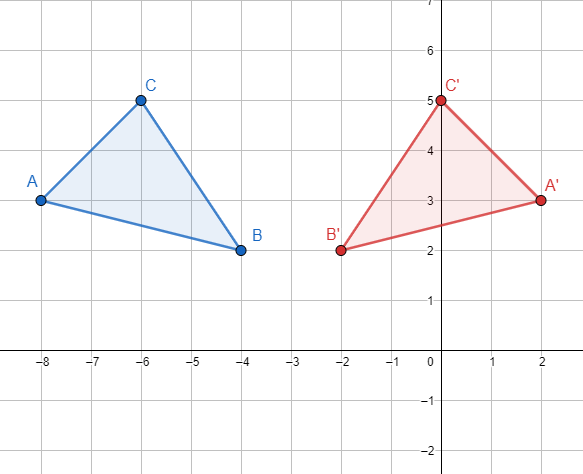
x=-3
500
Describe the rotation in 2 ways. 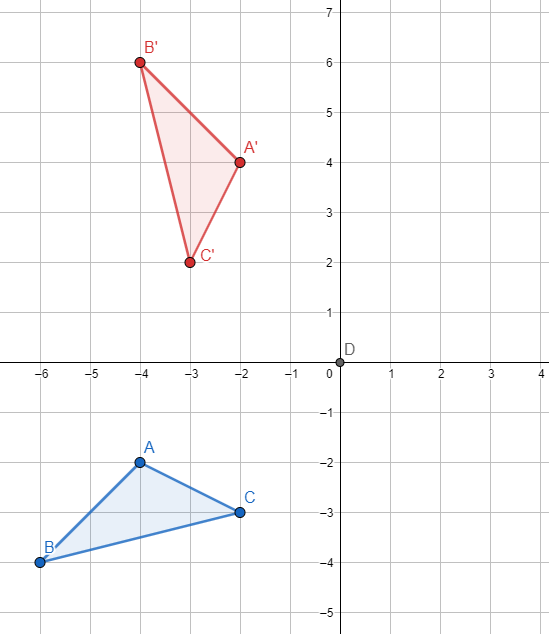
90° clockwise AND 270° counterclockwise about the origin.