Fundamental
Identities
Sum/Diff
Sum/Diff Cont'd
Two is better
Half IT
1
Determine the length of y=ln(secx) between
0≤x≤π/4
.
Answer: cot x - tan x
1
Verify:
cot x + 1 = csc x(cos x + sin x)
Start with the right side: csc x(cos x + sin x)
Rewrite csc x as 1/sin x
(1/sin x)(cos x + sin x)
Distribute: cos x/sin x + sin x/sin x
Simplify: cot x + 1
1
Find exact value: cos 15°
Answer: √
(sqrt(6)+sqrt(2))/4
1
Find exact value: sin 75°
Answer:
(√6+√2) /4
1
Find sin 2θ if
cosθ=3/5, sinθ=-4/5
Answer:
-24/25
1
Find cos 15°
Answer:
(sqrt6 +sqrt2)/4
2
Given
tan θ = -3/4
in QII, find sin θ
Answer: 3/5
2
Verify:
tan²x(1 + cot²x) = 1/(1 - sin²x)
Start with left side: tan²x(1 + cot²x)
Use identity: 1 + cot²x = csc²x
Substitute: tan²x * csc²x
Rewrite tan²x = sin²x/cos²x and csc²x = 1/sin²x
(sin²x/cos²x)(1/sin²x)
Cancel sin²x → 1/cos²x
Use identity: sec²x = 1/(1 - sin²x)
2
Find exact value:
cos((11π)/12)
Answer:
-(√6+√2)/4
2
Find exact value:
tan((7π)/12)
Answer:
-2-√3
2
Find tan 2θ if
tanθ=-4/3
Answer:
24/7
2
Find the exact value of tan 22.5°
Answer:
sqrt2 - 1
3
Simplify:
(1 + cot²x)/(1 - csc²x)
Answer: -sec²x
3
Verify:
(sec x + tan x)/(sec x - tan x) = (1+sin x)/(1-sin x)
Start with left side
Rewrite sec x = 1/cos x and tan x = sin x/cos x
Factor out 1/cos x from numerator and denominator
(1 + sin x)/(1 - sin x)
3
Find cos(A+B) if
cosA=3/5, cosB=5/13
Answer:
33/65
3
Rewrite: tan(45° + θ)
Answer:
(1+tanθ)/(1-tanθ)
3
Write
cos(4x)
in terms of sin x
Answer:
8sin^4x -8sin^2x +1
3
Given
cos x=2/3
, x in Q-IV, find
sin(x/2)
Answer:
sqrt6/6
4
Write cos x in terms of tan x
Answer:
±1/sqrt(1+tan²x)
4
Show:
sin²x + cos²x = 1
Let
sin x = a/c
and
cos x = b/c
then
sin^2 x = a^2/c^2 and cos^2 x = b^2/c^2
Now
"substituting, we get" a^2/c^2 + b^2/c^2 =1
"Multiply both sides by" c^2
a^2 + b^2 = c^2
Verified by the Pythagorean Theorem
4
Rewrite: cos(180° - θ)
Answer: -cos θ
4
Find sin(A+B) given
sinA=4/5, cosB=-5/13
Answer:
16/65
4
If
tan theta=2
find the exact value of
tan 2theta
Answer:
-4/3
4
If
cos theta =7/25
and in Q-IV, find the exact value of
sqrt((1+cosθ)/2)
Answer:
4/5
5
Given that
sin x = -5/8
, find sec x.
Answer:
(8sqrt(39))/39
5
Show:
1 + tan^2 x = sec^2 x
1 + sin^2 x/cos^2 x
cos^2 x/cos^2 x +sin^2 x/cos^2 x
(cos^2 x + sin^2 x)/cos^2 x
1/cos^2 x = sec^2 x #
5
Suppose that
sin(-4/5)
,
cos y =7/12
, and both are in quadrant IV. Find cosx+y.
Answer:
(21-4sqrt(95))/60
5
Verify:
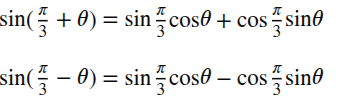
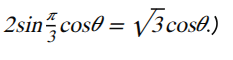
sin(pi/3 +theta)+sin(pi/3 - theta)=sqrt3 cos theta

5
Verify
(sin( 2theta))/(1+cos(2theta)) = tan theta
on the right side
(2sin theta cos theta)/(1+2cos^2theta -1
then
(2sin theta cos theta)/cos^2 theta
This ends up being
sin theta/cos theta = tan theta
5
Simplify:
sqrt(2 +sqrt(2+2cos(4theta)
Answer:
2cos theta