Definitions
Soh-Cah-Toa
Random
Trigonometric Functions
Trig. Expressions &
Identities
Identities
100
State the Pythagorean Theorem. On what kind of triangle can you apply it?
Pythagorean Theorem: a2+b2=c2
It can only be applied on RIGHT triangles.
100
Find cos(x) if sec(x)=3
cos x= 1/3
100
Find one positive and one negative angle coterminal to 112°
112° + 360°=472°
112° - 360°=-248°
100
State whether the value is positive or negative.
"cos 75°"
positive
100
Simplify the trig. expression
2cos2x - cos x - 1
cos 2x-cos x
200
Define "Quadrantal Angles"
Standard position angles that have their terminal side on one of the axes.
200
Find cot(x) if tan(x)=0
undefined
200
Convert the radian measure to degree measure. DO not use calculator.
5π/3
300°
200
Let (-3,4) be a point on the terminal side of θ. Find sinθ, cosθ ,tanθ.
sinθ= 4/5
cosθ= -3/5
tanθ= 4/-3
200
Factor the trig expression:
sec2θ -1
(secθ -1)(secθ +1)
300
Define "Coterminal Angles".
Angles that have the same initial and terminal sides.
300
A surveyor is standing 115 feet from the base of the Washington Monumental. The surveyor measures the angle of elevation to the top of the monument as 78.3 degrees.
tan 78.3=y/115
y=555 ft.
300
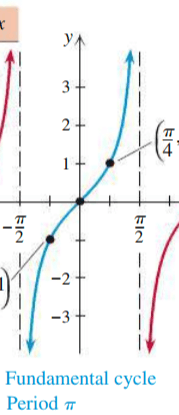
Graph one cycle of y=tan(x)
Period:
Domain:
Range:
Asymptotes:
Period: π
Domain: (−π/2,π/2)(-π/2,π/2)
Range: (−∞,∞)(-∞,∞)
Asymptotes: x=−π/2,x=π/2
Graph:
300
Sinθ=-4/5 and tanθ<0, find cosθ and cscθ.
cosθ= -3/5
cscθ= 5/4
300
Verify the trig. identity
(1-sin2x)(1+tan2x)=1
cos2x(1+(sin x/cos x)2)
cos2x((cos2+sin2)/cos2x)
cos2x(1/cos2x)
1=1
400
What are sine values?
These values are symmetrical across the y-axis
400
Find the exact value of tan x if cos x=-(2/3) and x is not in quadrant III.
tanx=−√5/2
400
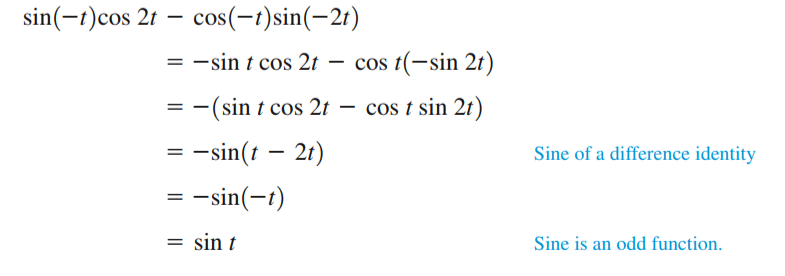
Prove the identity.
sin(−t)cos(2t)−cos(−t)sin(−2t)=sint
400
Evaluate: sin 2𝜋/3
√3/2
400
Verify the trig. identity
tanx+cotx=secx cscx
(sinx/cosx)+(cosx/sinx)
(sin2x+cos2x)/(cosx sinx)
(1/cosx sinx)
(1/cosx)(1/sinx)
secx cscx= secx cscx
500
What is the side opposite to the right angle in a triangle called?
The hypotenuse
500
Find sin(x) if tan(x)=3/4
sinx=3/5
500
A circle has a radius of 4 inches. Find the length of the arc intercepted by a central angle of 240°.
240(𝜋/180)=4𝜋/3
S=4(4𝜋/3)=16.75 in.
500
Let (2,5) be a point on the terminal side of θ. Find the six trig. functions.
sinθ= (5√29)/29
cosθ= (2√29)/29
tanθ= 5/2
cscθ= (√29)/5
secθ= (√29)/2
cotθ= 2/5
500
Verify the trig. identity
(sin x/1+cos x)+(cos x/sin x)=csc x
(sin2x + cos x+cos2x)/(1+cos x)(sin x)
(1+cos x)/(1+cos x)(sin x)
1/sinx = csc x
csc x= csc x