Area
Perimeter
Data Analysis
Geometry
Lines
METRIC MEASUREMENT
100
100
What is the area of a rectangle with a length of 6 units and a width of 3 units?
👉 Answer: 18 square units
🧠 Annotation:
Area = length × width → 6 × 3
100
100
What is the perimeter of a rectangle with side lengths 8 units and 3 units?
👉 Answer: 22 units
🧠 Annotation:
2(8 + 3) = 22 OR add all sides
100
100
Use the data below:
Which value appears most often?
👉 Answer: 
🧠 Annotation:
Count frequency (3 times)
100
100
Which type of lines form a 90° angle?
a. parallel
b. curved
c. perpendicular
d. diagonal
👉 Answer: c (perpendicular)
🧠 Annotation:
Perpendicular lines intersect to form a right angle (90°).
100
100
Which lines never intersect?
👉 Answer: parallel lines
🧠 Annotation:
Parallel lines stay the same distance apart
100
100
Which unit would you use to measure the length of a pencil?
a. kilometer
b. meter
c. centimeter
d. liter
👉 Answer: c (centimeter)
200
200
What is the area of a rectangle with a length of 7 units and a width of 2 units?
👉 Answer: 14 square units
🧠 Annotation:
7 × 2 = 14
200
200
A rectangle has a perimeter of 20 units. Two sides are 6 units and 4 units.
What is the missing side length?
👉 Answer: 4 units
🧠 Annotation:
6 + 4 + 6 + ? = 20 → ? = 4
200
200
Use the data below:
How many more data points are  than
than  ?
?
👉 Answer: 1 more
🧠 Annotation:
3 vs 2 → difference = 1
200
200
A circle is divided into 12 equal parts.
What is the measure of one angle?
a. 15°
b. 30°
c. 45°
d. 60°
👉 Answer: b (30°)
🧠 Annotation:
360° ÷ 12 = 30°
200
200
Which lines intersect to form right angles?
👉 Answer: perpendicular lines
🧠 Annotation:
Perpendicular = 90° intersection
200
200
Which unit would you use to measure the amount of water in a bottle?
👉 Answer: milliliters or liters
300
300
Which rectangles have an area of 12 square units?
a. 3 by 4
b. 2 by 6
c. 1 by 12
d. All of the above
👉 Answer: d (All of the above)
🧠 Annotation:
All are factor pairs of 12
300
300
Which rectangle could have a perimeter of 24 units?
a. 6 by 6
b. 8 by 4
c. 5 by 7
d. All of the above
👉 Answer: d (All of the above)
🧠 Annotation:
Check each by adding all sides
300
300
Use the data below: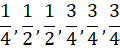
Which value appears twice as often as  ?
?
👉 Answer: 
🧠 Annotation:
1/4 appears once → twice = 2 → 1/2 appears twice
300
300
Which angle is closest to 90°?
a. 45°
b. 60°
c. 100°
d. 85°
👉 Answer: d (85°)
🧠 Annotation:
85° is only 5° away from 90°
300
300
Draw two parallel lines and two perpendicular lines.
👉 Answer: student drawing
🧠 Annotation:
Parallel → no intersection
Perpendicular → meet at 90°
300
300
How many centimeters are in 1 meter?
👉 Answer: 100 cm
400
400
Explain how to find the area of a rectangle.
👉 Answer:
Multiply the length by the width
🧠 Annotation:
Students should connect to arrays/rows
400
400
Explain the difference between area and perimeter.
👉 Answer:
Area measures the space inside a shape; perimeter measures the distance around it
400
400
Use the data below:
Which value is least common? Explain.
👉 Answer: 
🧠 Annotation:
Only appears once
400
400
Draw an angle that measures about 60°.
👉 Answer: student drawing
🧠 Annotation:
Students should draw an acute angle less than 90°
400
400
Explain the difference between parallel and perpendicular lines.
👉 Answer:
Parallel lines never meet; perpendicular lines meet at 90°
⚠️ Misconception:
Students say “they both cross”
400
400
Convert: 2 meters = ___ centimeters
👉 Answer: 200 cm
🧠 Multiply by 100
500
500
Create a rectangle with an area of 20 square units.
👉 Answer:
Examples: 4 × 5, 2 × 10
🧠 Annotation:
Students must understand there are multiple solutions
500
500
Create a rectangle with a perimeter of 30 units.
👉 Answer:
Examples: 10 by 5, 8 by 7
🧠 Annotation:
Students must test combinations
500
500
Create a data set where  appears most often.
👉 Answer:
Example: 
500
500
Explain how you can determine the size of an angle without a protractor.
👉 Answer:
Use benchmark angles (90°, 45°, 180°) and estimate
500
500
Give a real-world example of parallel lines and perpendicular lines.
👉 Answer:
Parallel: railroad tracks
Perpendicular: corner of a book
🧠 Annotation:
Students connect geometry to real life
500
500
Kyndal has 3 liters of juice. She pours it into cups that hold 250 mL each.
Will she have enough to fill 10 cups? Explain.
👉 Answer: Yes
🧠
3 L = 3000 mL
3000 ÷ 250 = 12 cups