Resource Location Patterns
Resource Formation
Resource Formation, the Sequel
RR Vocabulary
Will That Stay or Go?
Batteries
Groundwater Problems
100
Minerals typically form in what type(s) of rock?
Minerals form rocks so they are formed in all types of rock: Sedimentary, igneous, and metamorphic.
100
Coal is formed from ________ matter.
Plant matter
100
Oil and natural gas are made of ancient plants and this specific aquatic organism.
Plankton
100
What is a resource?
something that can be used or made into something that can be used
100
Are fossil fuels a renewable or nonrenewable resource?
Fossil fuels are nonrenewable resources.
Fossil fuels take millions of years to form from ancient plant and animal matter, which means they will not form fast enough to refill the global supply.
100
What are the advantages to driving electric cars?
1. Rechargeable batteries
2. No pollution emitted/released from the car
100
What is subsidence?
Sinking of land in an area
200
What type of rock do fuels and groundwater form in?
Sedimentary rock
200
How long does it take for minerals to form? *Tricky question!*
Minerals can take over millions of years to form or can form in a few seconds (lava rock).
200
What is the difference between a confined aquifer and an unconfined aquifer?
Unconfined aquifers can refill with water that seeps down from the land surface through permeable rock.
Confined aquifers can only refill with water that goes around impermeable rock that is trapping the aquifer.
200
What is an ore?
A rock containing a mineral (usually a metal or gem stone)
200
Is WOOD a renewable or nonrenewable resource?
Wood is a nonrenewable resource.
Wood eventually will not grow fast enough to meet the demand, even if new trees are replanted.
200
What are the disadvantages to driving gas-powered cars?
1. Using gasoline assists in taking from the declining global petroleum supply.
2. Burning fuel creates pollution and releases greenhouse gases into the atmosphere.
200
What is the definition of overdrafting?
Pumping out fresh groundwater from an aquifer faster than the aquifer can replenish/refill
300
What is the location pattern for volcanoes?
Volcanoes typically are found near or along tectonic plate boundaries, and sometimes near water.
300
Main Idea: Where do resources form?
Resources form where the conditions (materials, geoscience processes [tectonic activity, volcanoes, etc.] and environment) are correct for formation.
300
What type of aquifer is this?
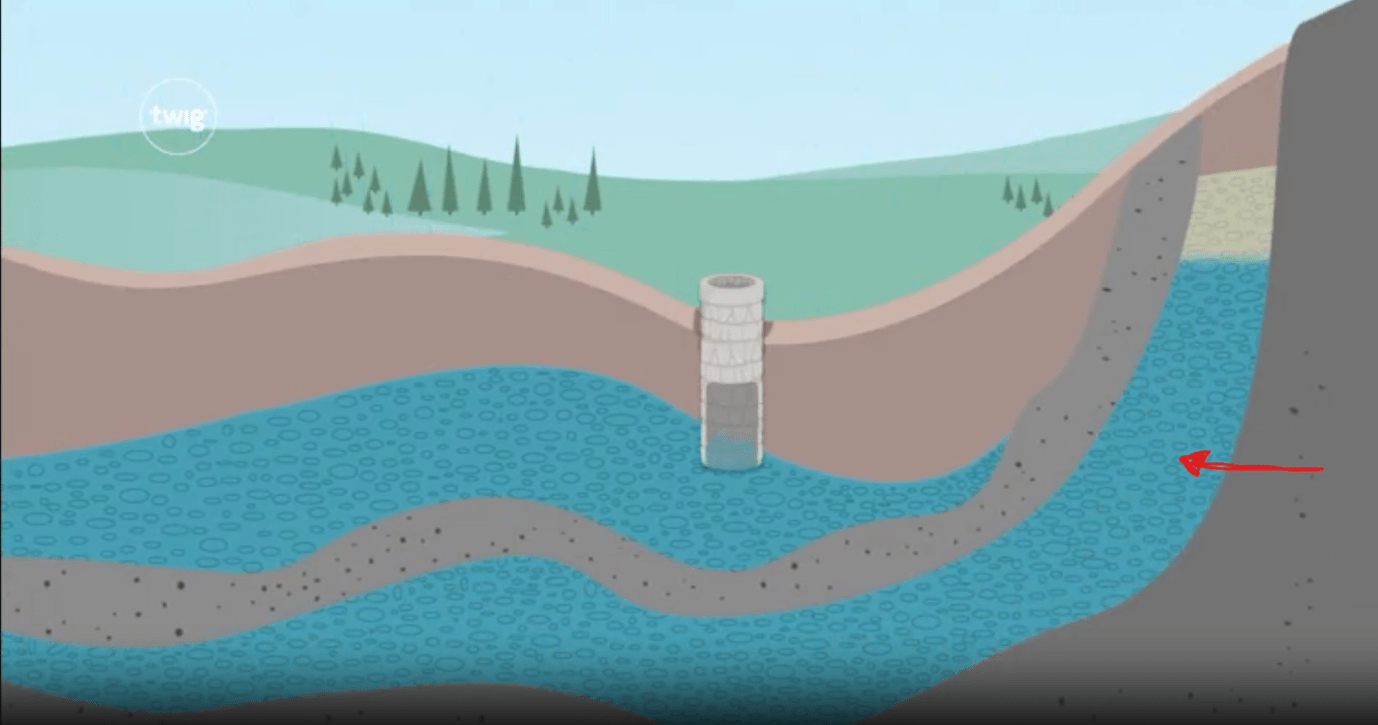
300
What is the difference between magma and lava?
Magma is melted rock BELOW the Earth's surface. Lava is melted rock ABOVE the Earth's surface.
300
Is FRESHWATER a renewable or nonrenewable resource?
Give your claim and evidence.
Freshwater is a non-renewable resource.
1. Due to overdrafting aquifers in certain areas of the world, aquifers are losing their capability to store groundwater.
2. Frequent droughts affecting many parts of the earth might cause the inability for aquifers to refill their groundwater levels.
300
What are the three parts of a battery?
A positive electrode, a negative electrode, and an electrolyte fluid
300
What are some causes for overdrafting the aquifer?
Give three examples as evidence.
Frequent droughts, population increase, drilling new wells, irrigation for crops, crop fertilizer runoff into aquifer
400
What is the location pattern for Oil and Natural Gas?
They are typically where ancient sea beds used to be located, between the ancient landmass locations
400
How is sedimentary rock formed?
1. Sediment settles down on land or in seabed.
2. Pressure from the weight of the top layers over millions of years creates sedimentary rock.
400
What are the steps for Cobalt formation?
1. A star explodes (supernova) and blasts material into the universe.
2. Blasted materials either form with other elements to create a planet or form asteroids containing cobalt and crash on Earth from space.
400
What is permeability?
The capability of a substance to allow fluids (like water) to flow through it
400
Are HONEYBEES a renewable or nonrenewable resource?
Give your claim and evidence.
Honeybees are a renewable resource.
1. Honeybees reproduce naturally and replenish their populations.
2. Honeybees can be managed or multiplied by beekeepers after every pollination season.
400
What minerals are used as electrodes in creating a lithium-ion battery?
Lithium and carbon
400
What are the three major effects of overdrafting the San Joaquin Valley aquifer?
1. Subsidence => Land sinking
2. Permanent loss of groundwater storage in the aquifer
3. Nitrate contamination
500
Why are resources around the world unevenly distributed (lots in some places, little in others)?
Resources may only be found in certain locations because those locations contain the right conditions to form them.
500
What are the steps of coal formation?
1. Plant matter dies (not fully decayed)
2. Sediment covers the plant matter =>
3. Pressure and heat are put on the covered plant matter => hardens into Peat
4. More pressure and heat on peat => hardens into Coal
500
How was Iron formed on Earth?
Iron comes from ancient organic material released from submarine volcanoes. Precambrian mountains formed from those volcanoes eroded over time, releasing iron into the ocean.
500
What is the ACTUAL name for the term "fracking"?
Hydraulic Fracturing
500
Is SAND a renewable or nonrenewable resource?
Give your claim and evidence.
Sand is a nonrenewable resource.
1. Sand is naturally formed through the weathering and erosion of rocks by wind and water (takes thousands to millions of years).
2. Humans use sand at a rate that vastly outpaces nature's ability to replenish it. [Billions of tons extracted globally (2nd most consumed resource on Earth after water)]
500
How is an electric current produced/made in a battery?
Negative electrons travel from the negative electrode to the positive electrode through the electrolyte.
500
What happens to the land when overdrafting of an aquifer occurs?
Provide the steps for a land experiencing subsidence.
1. Water is overpumped out of the aquifer through wells.
2. The weight of the land put pressure on the clay deposit layers (due to no water cushion).
3. The clay layer deposits are squished and then the land above sinks => subsidence