Name that Polynomial
End Game
Table Talk
Operation: Polynomial
Divide and Conquer
Final Jeopardy
100
What is the degree of 7x⁴ − 3x² + x − 9?
4
100
Describe the end behavior of the graph
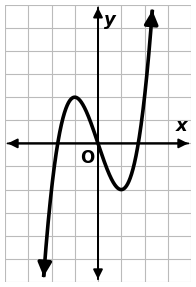
As x → −∞, f(x) → −∞; as x → ∞, f(x) → ∞
100
When scanning a table for real zeros, you look for a sign change in which column? Hint: x or f(x)?
The f(x)-values, not the x-values
100
(3x² + 5x − 2) + (x² − 7x + 6)
4x² − 2x + 4
100
12x⁴ − 8x³ + 20x²) ÷ 4x²
3x² − 2x + 5
200
What is the leading coefficient of 5x² − 8x⁵ + 3?
−8.
Watch for: picking 5 without writing the polynomial in standard form first.
200
Is the degree even or odd? Is the leading coefficient positive or negative?
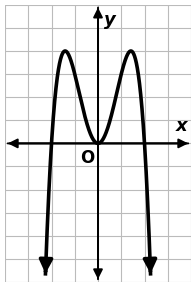
Even degree (end behavior is the same on left and right), negative leading coefficient (f(x) is going to negative infinity aka down)
Watch for: deciding "odd" from the number of bumps.
200
True or false: a sign change from negative to positive shows a zero, but positive to negative does not.
False. Either direction indicates a real zero.
200
(6x³ − 2x² + 4) − (2x³ + 5x² − 3)
4x³ − 7x² + 7.
Watch for: −2x² + 5x² from not distributing the negative.
200
(15a⁵b³ − 10a³b² + 25a²b²) ÷ 5a²b²
3a³b − 2a + 5.
Watch for: dividing exponents instead of subtracting them.
300
Is 4x³ + 2x⁻¹ − 6 a polynomial? Explain.
No. The negative exponent means x is in a denominator.
Watch for: thinking a negative coefficient is the problem.
300
The graph shows g(x). If f(x) = −x⁴ + 2x³ − x + 5, find f(0) − g(0). 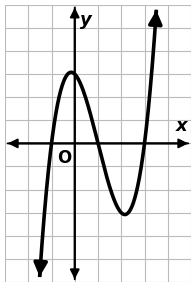
5 − 3 = 2.
f(0)=5, Plug in 0 to get 5.
g(0)=3, On the graph you can see the point (0,3).
Watch for: reading an x-intercept instead of the y-intercept.
300
Between which consecutive x-values does f(x) have a real zero?

Between −3 and −2, between 0 and 1, and between 1 and 2.
Watch for: missing the 1-to-2 interval, where the values go −2 to 1.
300
(2x − 3)(x + 5)
2x² + 7x − 15
300
(x³ + 4x² + x − 6) ÷ (x − 1)
Hint: You can use synthetic or long division here.
x² + 5x + 6
Watch for: Using -1 for synthetic division instead of positive 1.
400
Which is NOT a polynomial? (a) x²/5 + 3x (b) 5/x² + 3x (c) √3·x² (d) 0.4x⁷
(b) 5/x² + 3x, x cannot be in the denominator
Watch for: rejecting (a) or (c). Fractional and irrational coefficients are fine.
400
The graph shows g(x). Compare its end behavior with f(x) = 2x⁴.
Allowed: End behavior table, scientific calculator; Not allowed: Graphing calculator 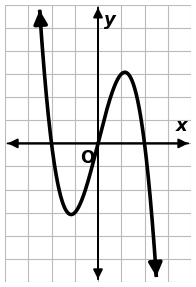
Same as x → −∞ (both → ∞), opposite as x → ∞ (f → ∞, g → −∞)
400
Estimate where the relative maximum and relative minimum occur.

Relative max near x = −1, relative min near x = 3. Watch for: calling x = −2 a max because f(−2) = 0.
400
5x⁴ − 2x³ + 6x² − x + 8) − (3x⁴ + 4x³ − 2x² − 5x + 1)
2x⁴ − 6x³ + 8x² + 4x + 7
Watch for: sign errors on the last three terms.
400
Use synthetic division: (3x³ + 17x² + 6x − 20) ÷ (x + 5)
3x² + 2x − 4.
Watch for: using +5 in the box instead of −5.
500
What is the degree of 8a²b³ + 3a⁴b² − ab?
6, because the term degrees are 5, 6, and 2.
Watch for: answering 4, the biggest single exponent, or 12 from adding every exponent.
500
Which graph is f(x) = x³ − 8x² + 16x? (Hint: Plug in an x value)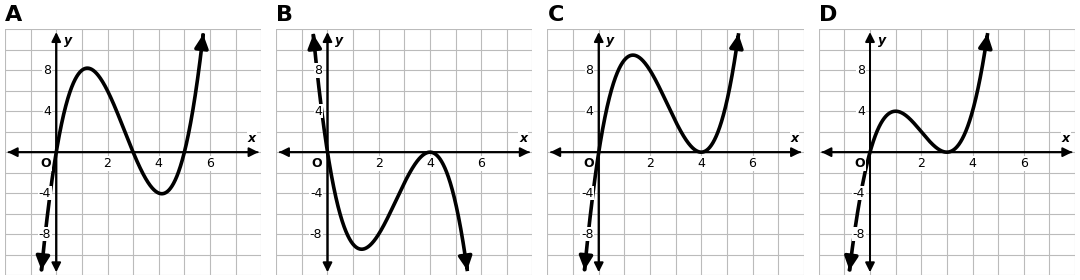
C
f(4)=0 and B is incorrect due to the end behavior
500
Name every interval with a real zero AND estimate where the relative max and min occur.

Zeros between −4 and −3, between −1 and 0, and between 1 and 2. Relative max near x = −2, relative min near x = 1.
500
A rectangular prism measures (x + 3), (x − 1), and (3x + 2) units. Its volume is Ax³ + Bx² + Cx + D. Find A, B, C, and D.
A = 3, B = 8, C = −5, D = −6
500
Simplify (4x³ + 7x² − 5x + 3)(x + 2)⁻¹
4x^2-x-3+9/(x+2)
500
Expand (3a + b)⁴.
81a⁴ + 108a³b + 54a²b² + 12ab³ + b⁴
Partial credit on test: the Pascal row 1, 4, 6, 4, 1 is correct, but the powers of 3 were never applied (3a⁴ instead of 81a⁴).