Vocab
Forces in Earth's Crust
Earthquakes and Seismic Waves
monitoring earthquakes
random
100
The shaking an trembling that results from movement of rock beneath Earth's surface
Earthquake
100
Which fault has the same stucture as a normal fault but the blocks move in the reverse direction?
reverse fault
100
How many types of seismic waves are there? Name them
3 - P waves, S waves, Surface waves
100
The block of rock that lies above a fault is called what?
hanging wall
100
A fold in rock that bends upward into an arch is called a(n)
anticline
200
a large area of flat land elevated high above sea level
plateau
200
In a strike-slip fault, the rocks on either side of the fault slip past each other sideways with little what?
up or down motion
200
What does a seismogram use to record the drum's vibrations?
pen
200
Which of the following can cause damage days or months after a large earthquake?
aftershock
200
t/f: With the range of data available, geologists cannot predict exactly where or when earthquakes will happen
true
300
Name the 3 types of faults
Normal, reverse, strike-slip
300
in a normal fault, the part of the fault that lies below the other part is called what?
footwall
300
What is a modified Mercalli scale?
rates the amount of shaking which is rated by people's observations without using any instruments. How strongly people feel the shaking
300
The rating system that estimates the total energy released by an earthquake is called....
moment magnitude scale
300
The point beneath Earth’s surface where rock breaks under stress and triggers an earthquake is called the
focus
400
An instrument that records and measures an earthquake's seismic waves
seismograph
400
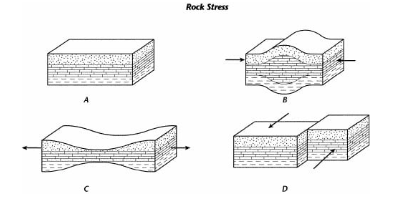
What kind of stress is happening at B, C, D?
B: compression
C: tension
D: Shearing
400
What is the difference between and anticline and syncline?
Both are fold in rock but Anticline arches upward and syncline bends downward
400
The type of seismic waves that arrive at the surface first and move by compressing and expanding the ground like an accordion are called
P waves - Primary waves
400
What kind of risk is shown on the map and how is this risk determined?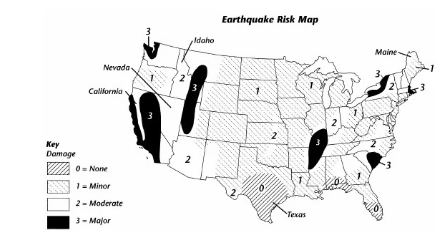
The map shows the risk damage from earthquakes. Geologists determine earthquakes risk by locating where faults are active and where past earthquakes have occured.
500
Name the three types of stress and tell me what they do
Tension; plates pulling apart
compression: plates coming together
shearing: two plates slip past each other
500
Which type of stress produces reverse faults?
Compression
500
The seismic waves that produce the most sever ground movements
surface waves
500
t/f: the squeezing together of rocks by stress is called shearing.
false; compression
500
how do California and Nevada compare in possible severity of earthquake damage?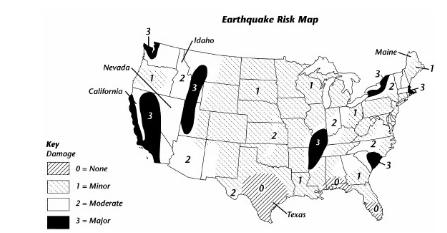
both states could suffer earthquakes causing moderate to major damage