Matter Matters
Density Detectives
Conduct or Insulate?
States & Particles
Classify It!
Science Investigators
100
Anything that has mass and takes up space is called what?
Matter has mass and takes up space.
100
A plastic ball floats on water. Compared with water, this ball has what type of density?
This object is less dense than water.
100
Materials that allow electrical energy to move through them easily are called what?
Conductors allow electrical energy to move through easily.
100
Ice, a pencil, and a desk are all examples of what state of matter?
These are examples of solids.
100
A nail is attracted to a magnet, but a wooden craft stick is not. A nail is attracted to a magnet, but a wooden craft stick is not. The student is comparing what physical property?
The student is comparing magnetism.
100
A student pours water into a graduated cylinder and records that there are 75 mL of water. The student is measuring what physical property?
Volume is being measured.
200
What physical property tells how much matter is in an object?
Mass tells how much matter is in an object.
200
A metal object sinks all the way to the bottom of a container of water. Compared with water, this object has what type of density?
This object is more dense than water.
200
Rubber, plastic, and wood are usually examples of what type of electrical material?
These materials are insulators.
200
Water, juice, and cooking oil are examples of what state of matter?
These are examples of liquids.
200
Copper wire, aluminum foil, a paper clip, and an iron nail can all be placed in the same group because they share what electrical property?
They share electrical conductivity.
200
A student tests whether four substances dissolve in water. What physical property is being investigated?
Solubility is being investigated.
300
What physical property tells how much space an object takes up?
Volume tells how much space an object takes up.
300
Oil and water are shaken together. After several minutes, the oil forms a layer on top of the water. This tells you this about the density of the oil.
Oil is less dense than water.
300
A student tests a copper wire, rubber band, wooden stick, and aluminum foil in a circuit. The buzzer sounds with the copper wire and aluminum foil. These two materials are classified as what?
These two materials are electrical conductors.
300
In what state of matter are particles spread far apart and move freely in all directions?
This state of matter is gas.
300
A brick, rubber eraser, plastic ruler, and wooden block can all be placed in the same group based on what state-of-matter property?
These are all solids.
300
Students place equal amounts of hot water into four identical-sized cups made from different materials. What measurement should be recorded over time to determine which material is the best thermal insulator?
Temperature should be recorded over time.
400
A student places sugar in water and notices that the sugar seems to disappear as it mixes evenly throughout the water. What physical property of the sugar is being tested?
Solubility is being tested.
400
Object A floats on water. Object B sinks in water. Object C stays suspended in the middle of the water without rising or sinking. Of the three objects, which object has approximately the same density as water?
Object C has the same density as water.
400
A student wants to keep hot chocolate warm for as long as possible. The best cup material should have what property so thermal energy does not escape quickly?
The best cup material should be a thermal insulator.
400
The particles in what state of matter are packed closely together and mainly vibrate in place?
This state of matter is solid.
400
A student has these objects:
- steel nail
- paper clip
- rubber band
- plastic spoon
- wooden block
The student can use magnetism and electrical conductivity to divide the objects into groups. But if none of the objects dissolve in water, what property would NOT separate them into different groups?
Solubility would NOT separate them into different groups.
400
A student places Object X in two liquids.
- Object X sinks in Liquid A.
- Object X floats in Liquid B.
Which liquid must be more dense than Object X?
Liquid B must be more dense than Object X.
500
Two objects look exactly the same and have the same volume, but Object A has more mass than Object B. Object A has more of what physical property?
Density is being tested.
500
A beaker contains oil on top of water. A plastic bead sinks through the oil but stops when it reaches the water. A rock sinks below everything, while a cork floats on the oil.
Put the four materials in order from MOST dense to LEAST dense:
rock – water – oil – cork
rock → water → oil → cork
500
Four cups begin at 100°C.
After five minutes:
- Cup A = 63°C
- Cup B = 81°C
- Cup C = 54°C
- Cup D = 92°C
What cup is made of the best thermal insulator?
Cup D is the best thermal insulator.
500
What particles stay fairly close together but can move and slide past one another, allowing the substance to take the shape of its container?
These are particles in a liquid.
500
An unknown object has these properties:
- solid at room temperature
- magnetic
- good conductor of electricity
- insoluble in water
The object is most likely made from what type of material?
This object is most likely made from metals.
500
Four unknown objects have these properties:
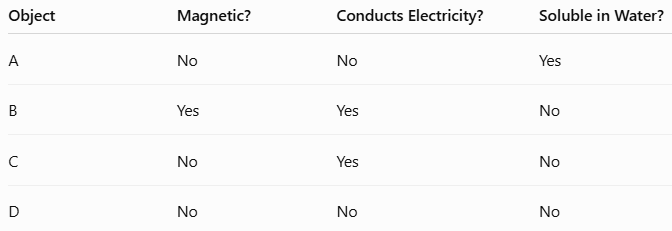
Which object is most likely made of iron?
Object B is most likely made of iron.