Unit 1.1-1.2
Unit 1.3
Unit 1.5-1.6
Unit 1.7-1.8
Big Fish
100
Determine the mass of one molecule of H2CO3 (Unit 1.1).
1.03 x 10⁻²² g
100
Calculate the percent composition of methane, CH4 (Unit 1.3).
Approx 75% C and 25% H
100
Provide the correct number of protons, neutrons, and electrons for an ion of dubnium containing a charge of +5 (Unit 1.5).
105 protons, 100 electrons, 163 neutrons
100
Does Cl have an atomic radius that is larger, smaller, or the same as Cl- (Unit 1.7)?
Larger
100
Copper is made up of two isotopes, Cu-63 (62.9296 amu) and Cu-65 (64.9278 amu). Given copper's atomic weight of 63.546, what is the percent abundance of each isotope (Unit 1.2)?
Cu-63 = 69%
Cu-65 = 31%
200
Copper occurs naturally as Cu-63 and Cu-65. Which isotope is more abundant (Unit 1.2)?
Cu-63
200
A compound consists of 72.2% magnesium and 27.8% nitrogen by mass. What is the empirical formula (Unit 1.3)?
Mg3N2
200
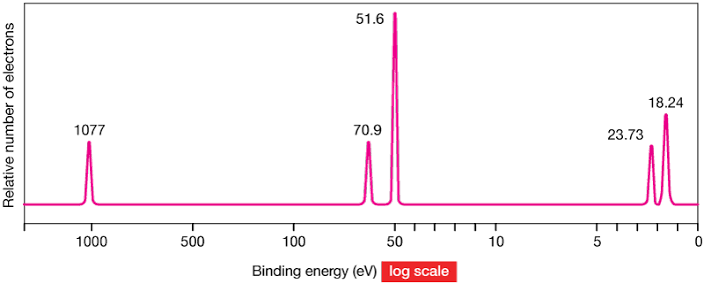
Which element is being represented by the PES diagram above (Unit 1.6)?
Phosphorus
200
An anion forms a compound and adopts a -3 charge when doing so. Which of the following elements would create a compound with this anion that has a 1:1 molar ratio (Unit 1.8)?
Oxygen, Phosphorus, Boron, Beryllium, Tin
Boron
200
A compound is analyzed and found to contain 68.54% carbon, 8.63% hydrogen, and 22.83% oxygen. The molecular weight of this compound is known to be approximately 140 g/mol. What is the empirical formula? What is the molecular formula (Unit 1.3)?
EF = C4H6O
MF = C8H12O2
300
You start with a sample of each compound weighing approximately 256 mg. Rank these compounds from most moles present to least moles present (Unit 1.1)?
SrCl2, magnesium bromide, nitrogen triiodide, SF6
SF6, SrCl2, MgBr2, NI3
300
Determine the percent by weight of water in KAl(SO4)2 x 12H2O (Unit 1.3).
Approx 45.6% H2O
300
Provide the electron configuration for As3- (Unit 1.5)
[Ar] 3d104s24p6
300
Rank the following from smallest to largest atomic radius (Unit 1.7):
P-3, Si+2, Al+2, S-1
Si+2, Al+2, S-1, P-3
300
The first ionization energy for Na is approximately 495 kJ/mol. Which of the following is the most likely second ionization energy for Na and why (Unit 1.5)?
367 kJ/mol, 584 kJ/mol, 690 kJ/mol, 4560 kJ/mol
4560 kJ/mol
400
In a sample of 400 lithium atoms, it is found that 30 atoms are lithium-6 (6.015 g/mol) and 370 atoms are lithium-7 (7.016 g/mol). Calculate the average atomic mass of lithium (Unit 1.2).
6.94 g
400
A compound is known to have an empirical formula of CH and a molar mass of 78.11 g/mol. What is its molecular formula (Unit 1.3)?
C6H6
400
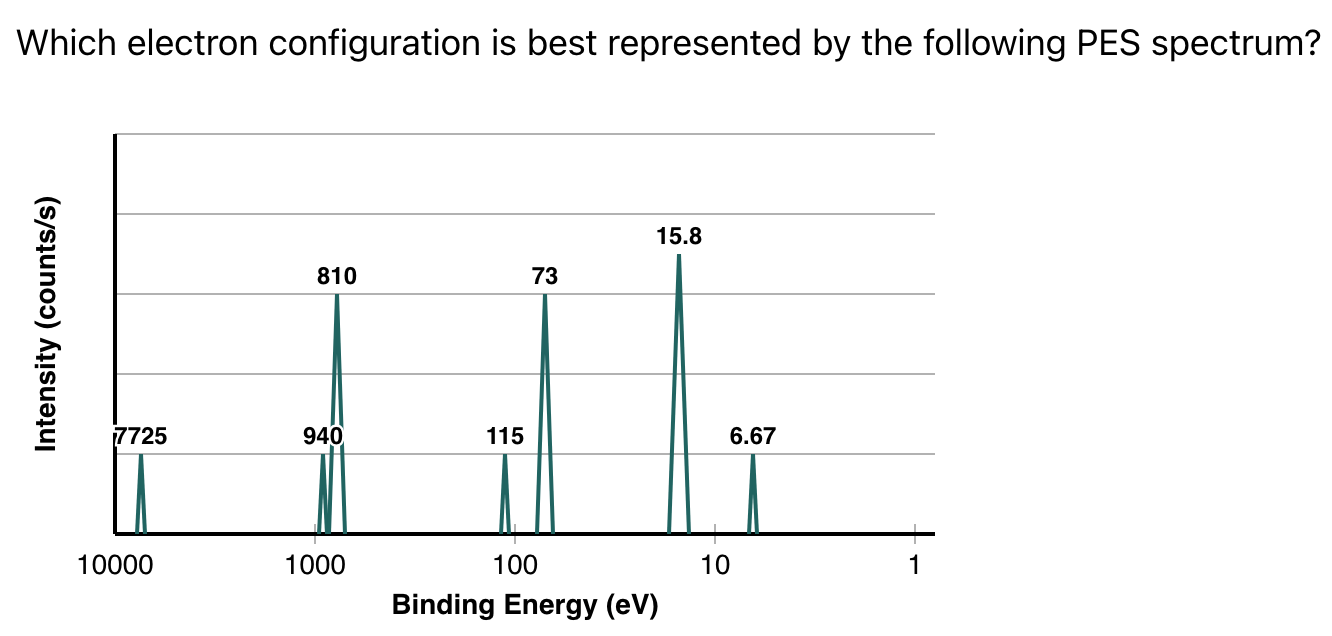 (Unit 1.6)
[Ar]3d74s2
400
A neutral element that has 3 unpaired electrons in a p orbital is most likely to adopt which ion charges (Unit 1.8)? There are 3 possible answers. Provide at least 2 of these answers.
-3 --> p6
+3 --> s2
+5 --> p6
400
An element with the electron configuration [Ne]3s1 would likely form a compound with a 2:1 molar ratio with which of the following groups of elements:
Group 1, Group 2, Group 13, Group 14, Group 15, Group 16, Group 17, Group 18
Provide an example of a compound that would use elements from these 2 groups (Unit 1.7).
Group 16 (ex Na2O)