Ecosystem Basics
Who Benefits?
Food Web Detectives
Energy & Matter
Science Investigators
100
What do we call living organisms interacting with each other and with nonliving parts of their environment?
An ecosystem.
100
What symbiotic relationship represents +,+
Mutualism
100
Which organism is the producer?
Plants
100
Are fungi that break down dead leaves producers, consumers, or decomposers?
Decomposers
100
Scientists put 20 grams of dead leaves in each of two containers. Both have the same soil, decomposers, and temperature. One is kept moist; the other is kept dry.
After two weeks:
Moist container: 9 grams of leaves broke down.
Dry container: 2 grams of leaves broke down.
How many grams of leaves broke down in the moist container?
9 grams.
200
Which is abiotic: a frog, sunlight, algae, or bacteria?
Sunlight
200
A flea gets food from a cat’s blood and causes the cat to itch. Identify the relationship and explain.
Parasitism: the flea benefits and the cat is harmed.
200
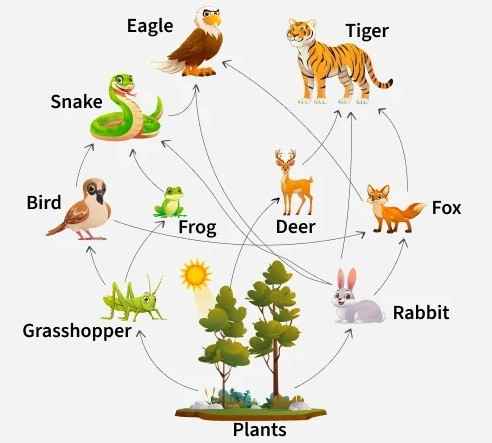
What does the arrow from the frog to the snake tell us?
Energy moves from the frog to the snake when the snake eats it.
200
How can breaking down a dead tree help nearby living plants?
dead tree → soil nutrients → plant
Decomposition releases nutrients into the environment that plants can absorb.
200
Scientists put 20 grams of dead leaves in each of two containers. Both have the same soil, decomposers, and temperature. One is kept moist; the other is kept dry.
After two weeks:
Moist container: 9 grams of leaves broke down.
Dry container: 2 grams of leaves broke down.
In which container did more leaves break down?
The moist container.
300
A pond contains frogs, fish, and algae. Does this list describe a population or a community? Explain.
A community, because it includes different species living in the same area.
300
A bird nests in a tree. The bird gets shelter, and the tree is neither helped nor harmed. What relationship is shown?
Commensalism.
300
In grass → grasshopper → frog → hawk, which organism is the secondary consumer?
Frog
300
Producers contain 10,000 units of energy. Using the 10% rule, about how much reaches primary consumers?
1,000 units
300
Scientists put 20 grams of dead leaves in each of two containers. Both have the same soil, decomposers, and temperature. One is kept moist; the other is kept dry.
After two weeks:
Moist container: 9 grams of leaves broke down.
Dry container: 2 grams of leaves broke down
What question are scientists investigating in this experiment?
How does moisture affect how quickly dead leaves break down?
400
Students grow identical plants with different amounts of water. They keep sunlight, soil, and temperature the same and measure growth. What question can this experiment investigate?
How does the amount of water affect plant growth?
400
A bee gets nectar while pollinating a flower. A tick feeds on a deer’s blood and harms it. How are these relationships different?
Bee/flower: mutualism, both benefit. Tick/deer: parasitism, one benefits and one is harmed.
400
Which predators compete for rabbits? Use the food web to explain.
Eagle, fox, and the snake because they all eat rabbits.
400
Why is less energy available at the top of an energy pyramid?
Organisms use energy for life processes, and much is released as heat. Only some transfers to the next level.
400
Scientists put 20 grams of dead leaves in each of two containers. Both have the same soil, decomposers, and temperature. One is kept moist; the other is kept dry.
After two weeks:
Moist container: 9 grams of leaves broke down.
Dry container: 2 grams of leaves broke down.
A student says leaves broke down faster in the moist container. What evidence supports this claim?
9 grams broke down in the moist container, compared with only 2 grams in the dry container during the same two weeks.
500
A student claims, “Living things depend on nonliving parts of an ecosystem.” Give one producer example and one consumer example that support the claim.
Example: grass needs sunlight and water; a rabbit needs water and oxygen.
500
A small fish eats scraps near a shark. A student calls this mutualism because the fish gets food. Is that enough evidence? What else would you need to know?
No. We need evidence about the effect on the shark. If the shark benefits too, it is mutualism; if unaffected, it is commensalism; if harmed, it is parasitism.
500
A disease causes many grasshoppers to die. What might happen to the frog and eagle populations? Why might hawks still survive even if there are fewer frogs?
Frogs may decrease because they have fewer grasshoppers to eat. Eagles may also decrease because there are fewer frogs, but they can still eat rabbits.
500
Dead plants → decomposers → nutrients in soil → living plants
A student says this model shows energy being recycled. Is the student correct? Explain what is being recycled and how energy enters the ecosystem.
No. The model shows matter being recycled. Energy enters through sunlight, which producers use to make food.
Remember: Matter cycles, Energy flows
500
Scientists put 20 grams of dead leaves in each of two containers. Both have the same soil, decomposers, and temperature. One is kept moist; the other is kept dry.
After two weeks:
Moist container: 9 grams of leaves broke down.
Dry container: 2 grams of leaves broke down.
A student says, “The dry container had no decomposers because fewer leaves broke down.” Is this conclusion supported? Explain.
No. Both containers had decomposers. The results suggest that dry conditions slowed decomposition, not that decomposers were absent.