Is it a Scale Copy?
Scale Copies
Vocab
Map vs Map
Unit Conversions
100
Rectangle A: 2 × 3
Rectangle B: 4 × 6
What is yes, with a scale factor of 2?
100
The number you multiply every length by when a shape is enlarged from 4 cm to 12 cm.
What is 3?
100
The parts of two figures that match up.
What is Corresponding/ Corresponding Parts?
100
The actual length when a scale drawing has a scale of 1 cm to 5 m and the drawing length is 8 cm.
What is 40 m?
100
The value of 6 feet in inches.
What is 72 inches?
200
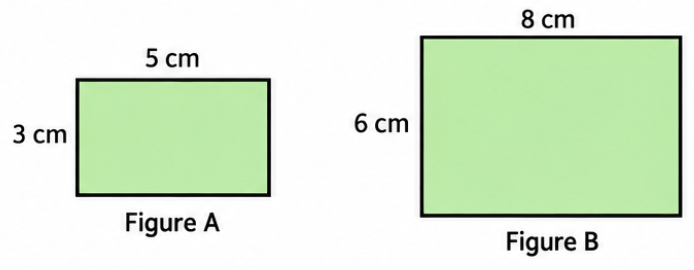
What is no, 3→6 is ×2, but 5→8 is not ×2.
200
The scale factor of a reduction from 28 inches to 7 inches.
What is 1/4?
200
A copy where every side length is multiplied by the same number.
What is a Scaled Copy?
200
The expected change in the scale and drawing when a map changes from a scale of 1 inch to 20 miles to a scale of 1 inch to 5 miles.
What is the number of real-world miles represented by 1 inch decreases so the drawing gets larger?
200
The value of 4.5 meters in centimeters.
What is 450 cm?
300
Triangle A sides: 4, 6, 8
Triangle B sides: 6, 9, 12
What is yes, with a scale factor of 1.5 (3/2)?
300
The copy perimeter of a shape with an original perimeter of 6 cm after a scale factor of 3.
What is 18 cm?
300
The number used to multiply all corresponding side lengths.
What is Scale Factor?
300
The drawing length when the actual length is 30 cm and the scale is 2 to 5.
What is 12?
300
The length of a classroom wall that 15 feet long in inches.
What is 180 inches?
400
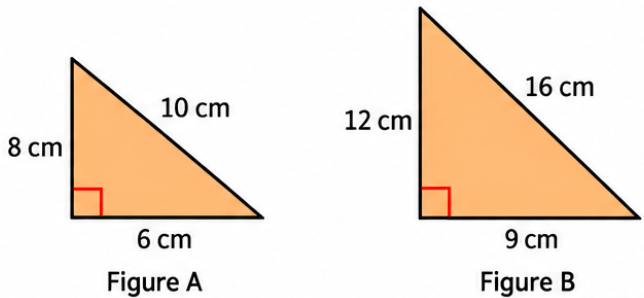
What is no, 6→9 and 8→12 are ×1.5, but 10×1.5 is 15, not 16.
400
The copy area of a shape with an original area of 3 square meters after a scale factor of 5.
What is 75 squared meters?
400
A number you multiply by another number to get 1.
What is the Reciprocal?
400
Two maps show the same neighborhood. Map A uses a scale of 1 cm to 3 m and Map B uses 1 cm to 15 m. Explain why the buildings appear smaller on Map B.
What is each centimeter in Map B represents more actual distance, so less space in the drawing is needed.
400
The length of the drawing with a scale of 1 inch to 3 feet when the actual wall is 21 feet long.
What is 7 inches?