I can 1.1
I can 1.2
I can 1.3&1.4
I can 1.5&1.6
RANDOM I CAN >:D
100
When ice is eventually turned into water, is heat energy added or removed. Describe this in terms of the simple particle diagrams.
Heat energy is added.
The particles will spread out.
100

Is this an exothermic or endothermic reaction? Why?
Endothermic Reaction.
The energy profile of the reactants is lower than the products.
The enthalpy change is positive!
100
What explains why the northern hemisphere experiences summer when the southern hemisphere experiences winter?
The earth is tilted.
100
Why is the inner core solid despite the extremely high internal temperatures?
Extremely high pressure
What is high pressure?
100
What is the difference between heat and temperature?
Heat- Energy that flows from a warmer body to a colder body.
Temperature- Average kinetic energy
200
A 0.1kg block of aluminum was heated to a temperature of 80C. It was then placed into a 0.5kg of water with an initial temperature of 20C. Describe the heat transfer.
What happens to the temperature of the water and the aluminum block?
Heat transfers from the aluminum block to the water.
The temperature of the water increases.
The temperature of the aluminum block decreases.
200
A glass of cold water is placed in a sealed room. After an infinite amount of time, what will happen?
Isolated system.
The water will warm and the air in the room will cool until it reaches the same temperature.
200
What is one of the mechanisms that causes the movement of Earth's tectonic plates?
Convection of the mantle.
200
What is the driving force behind the supercontinent cycle?
Mantle Convection.
200
What are the two sources of energy that power the earth's systems?
SUN
EARTH'S INTERIOR
300
Suppose that during the Icy Hot lab that 65 kJ of energy were transferred to 450 g of water at 20˚C. What would have been the final temperature of the water?
1kg= 1000g
Round to the whole number.
55 C
300
A ice cube melts~
Is this process endothermic or exothermic.
What is the sign of ΔH?
Melting (changing from a solid to a liquid) requires heat to be absorbed by the ice from the surrounding and, therefore, is endothermic. The sign of ΔH is positive.
300
Draw the Space, Inner Core, and the Mantle on your paper.
Explain how heat is transferred between the mantle and the inner core.
Explain how heat is transferred between space and the mantle.
(hint: What are the three types of heat transfer).
Heat transfers from the inner core to the mantle through conduction.
Heat transfers from the mantle to space through radiation.
300
What is the difference between magma and lava?
magma- below the earth
lava- breaks the earth's surface.
300
Based on the reaction and energy profile, the reaction is...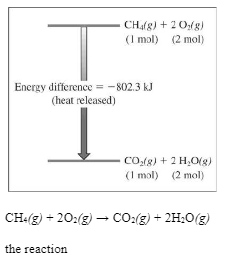
EXOTHERMIC.
400
1.4kJ of energy is applied to an aluminum rod of unknown mass. Its temperature goes from 20C to 45C. What is the mass of the rod?
caluminum=0.900 J/g∘C
62.22g
400
Using the values in the above table of standard enthalpies of formation, calculate the ΔHreaction for the formation of NO2(g).
2NO(g)+O2(g)⇋2NO2(g)
- NO(g): 90.25 kJ/mol
- NO2(g): 33.18 kJ/mol
- O2(g): 0 kJ/mol
ΔHreaction=−114.1kJ
400
Describe a subduction zone between an ocean plate and a continental plate.
The ocean plate is denser than a continental plate. The ocean plate sinks further into the mantle than the continental plate.
400
Read the passage.
As tectonic plates move apart, mantle pressure decreases and magma wells up from Earth's interior. A volcano is then created.
How is the volcano created?
The volcano is formed by divergent boundaries.
400
Relate convection currents and density.
You may use water or plate tectonics as an example.
Lighter(less dense) rises while heavier (more dense) cool materials sink. This movement creates circulation patterns known as convection currents.
As it moves farther from the heat source, the water cools(becomes denser) and sinks back toward the bottom of the pan. As the cooler water moves toward the heat source, it becomes warmer(becomes less dense) and rises to the surface again. The motion of water in this pan is called a convection current.
500
10.0 g of steam at 120 °C is converted to ice at -20°C.
What is the total energy needed to convert steam to ice?
Heat of fusion = 334 J/g
C ice = 2.1 J/g°C
C water = 4.18 J/g°C
C steam = 1.9 J/g°C
Heat of Vaporization = 2260 J/g
Around -30920J
500
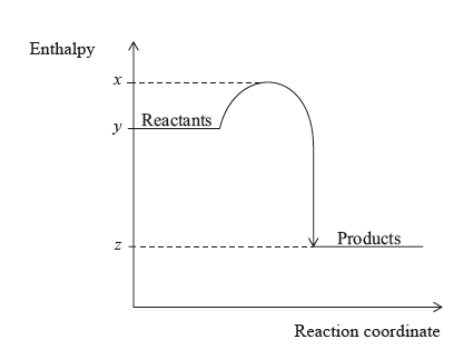 Only use x, y, or z.
How do you find ΔH for the exothermic reaction represented by the diagram below?
Z-Y
500
The compaction of a sedimentary rock or the added heat and pressure of an igneous rock is a...
Metamorphic Rock.
500
A geologist identifies location A to be a volcano. A student objects! They state that A is too far away from a plate boundary to the volcano.
Do you agree with the student? Why?
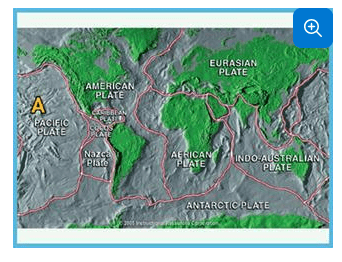
The student is wrong!
A volcano can be formed because it can form over a hotspot!
500
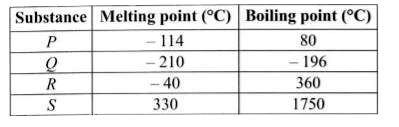
Pick the statement that are true about this data table.
(i) Substance P is in solid state at room temp (20C).
(ii) substance Q is in liquid state at room temperature (20C).
(iii) substance R is a gas at -150C and a solid at -220C
(iv) substance s is in a solid state at room temp(20C).
IV only.