Atomic Structure
Average Atomic Mass
Atomic Emission and Light
Electron Configuration
Valence Electrons and Ions
100
What are the 3 subatomic particles and their charges?
Protons --> positive charge
Neutrons --> neutral / no charge
Electrons --> negative charge
100
What is the formula you need to know to calculate the average atomic mass?
 or

100
Describe the electron transition that produces one line.
An electron starts in the ground state (lowest energy) and energy enters the atom in the form of light. This added energy excited the electron so it jumps up in energy levels to its excited state. Electrons are not going to stay in its excited state so the electron will fall back to the lower energy level. The energy isn’t going to disappear when this happens, instead the energy is released (or emitted) from the atom in the form of light.
100
What is the electron configuration of Carbon?
1s2 2s2 2p4
100
Elements in group 5A have how many valence electrons and form what charge?
5 valence electrons
-3 (gaining 3 negative electrons)
200
List the protons, neutrons, and electrons for a calcium-40 2+ ion. 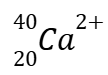
Protons: 20
Neutrons: 20
Electrons: 18
200
If the calculated average atomic mass is 28.0855 amu, what element is this mass about?
Silicon
200
Why do different elements produce distinct atomic emission (bright-line) spectra?
Each element has a unique arrangement of electrons and discrete energy levels. When electrons transition between these specific levels, they emit light at unique wavelengths, acting like a chemical "fingerprint".
200
What is the electron configuration of Arsenic?
1s2 2s2 2p6 3s3 3p6 4s2 3d10 4p3
200
Elements in group 2A have how many valence electrons and form what charge?
2 valence electrons
+2 charge (losing 2 negative electrons)
300
Identify the atomic number and mass number on the atomic nomenclature symbol:
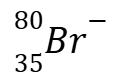
Atomic Number: 35
Mass Number: 80
300
Use this data to calculate the average atomic mass of Strontium.
83.91 amu, 0.56%
85.91 amu, 9.86%
86.91 amu, 7.00%
87.91 amu, 82.58%

= 87.62 amu
300
How can a chemist use the atomic emission spectrum of an unknown compound to determine exactly which specific metal elements are mixed inside it, even if the compound contains several different elements?
Chemists can identify the individual elements within a compound because each element has a unique atomic emission spectrum that acts exactly like a chemical "fingerprint." When elements are mixed together in a compound, their individual spectral lines do not blend or change; they simply overlap. By comparing the lines of the unknown compound against a database of known elements, you can match the lines to identify the elements in the unknown compound.
300
If the electron configuration is 1s2 2s2 2p6 3s3 3p5, what element is it?
Chlorine
300
Elements in group 4A have how many valence electrons and form what charge?
4 valence electrons
-4 or +4 (gain or lose 4 negative electrons)
400
Write the atomic nomenclature symbol based on the following information:
Protons: 29
Neutrons: 35
Electrons: 27
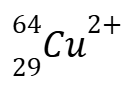
400
Use this data to calculate the average atomic mass of Zinc.
63.929 amu, 49.17%
65.93 amu, 27.73%
66.93 amu, 4.04%
67.92 amu, 18.45%
69.93 amu, 0.61%

= 65.38 amu
400
A specific type of medical curing light emits blue light with a wavelength of 450nm. What is the frequency of this blue light in hertz (Hz).
Use: c = 3.00 x 10⁸ m/s 1 m = 1 x 10⁹ nm
c = (wavelength)x(frequency)
6.67 x 10¹⁴ Hz
540nm = 5.40 x 10⁻⁷
(3.00 xx 10^8m/s)/(4.50xx10^-7m)=6.67 xx10^14Hz
400
Write the noble gas configuration for Strontium.
[Kr] 5s2
400
How many valence electrons does Helium have?
How does this differ from the rest of Group 8A?
What charge do elements in Group 8A form?
Helium has 2 valence electrons.
All the other noble gases have 8 valence electrons.
All noble gases (including helium) do not form a charge. So therefore, no charge or zero charge or neutral charge.
500
Write the atomic nomenclature symbol based on the following information:
Protons: 53
Neutrons: 74
Electrons: 54

500
A sample has two isotopes, Gallium-69 and Gallium-71. The average atomic mass of the sample is 69.60 amu. Gallium-69 has a mass of 68.93 amu. Gallium-71 has a mass of 70.92 amu.
Assume the abundances total 100%, find the percent abundance of Gallium-69 and the percent abundance of Gallium-71.
Gallium-69 is about 67% and Gallium-71 is about 33%.
Let x be the fractional abundance of Gallium-69. Then the fractional abundance of Gallium-71 is 1-x.
(68.93x) + 70.92(1-x) = 69.60
Algebra skills will allow you to solve for x
x = 0.67
Multiply by 100 to put as percent: 67%
Plug that value into 1-x to solve for other percent abundance
Gallium-69 is about 67% and Gallium-71 is about 33%.
500
A light has a frequency of 6.67 x 10¹⁴ Hz. What is the energy of a single photon of this light in Joules (J)?
Use: E = hf
h = 6.626 x 10⁻³⁴ (J)(s)
4.42 x 10⁻¹⁹ J
(6.626 xx 10^-34 J*s)xx(6.67 xx10^14 s^-1)=4.42xx10^-19J
500
Write the noble gas configuration for Xenon.
[Kr] 5s2 4d10 5p6
500
How many valence electrons are in the given electron configuration?
1s2 2s2 2p6 3s3 3p6 4s2 3d10 4p3
5 valence electrons
Look for the largest coefficient (4). Add s and p exponents.