Heat of formation
Bond enthalpy and Hess's law
Phase changes
Heat of reaction with stoichiometry
specific heat and calorimetry
100
Define standard enthalpy of formation (ΔHf°)
The enthalpy change for the formation of 1 mole of a compound from its elements in their standard states
100
What is a bond enthalpy (bond energy)?
The average energy required to break one mole of a specified type of bond in gas-phase molecules, typically given in kJ/mol.
100
what is the triple point of water?
Where all three phases are present at the same time
100
What does ΔH°rxn represent for a balanced chemical equation?
The enthalpy change when the reaction as written (with its stoichiometric coefficients)
100
Define specific heat capacity (c). Include typical units.
Specific heat capacity is the amount of heat required to raise the temperature of 1 gram of a substance by 1 °C; units: J/(g·°C).
200
Given ΔHf°(CO2(g)) = -393.5 kJ/mol and ΔHf°(H2O(l)) = -285.8 kJ/mol, write the formation reaction for CO2(g) and for H2O(l).
- CO2(g): C(graphite) + O2(g) → CO2(g)
- H2O(l): 1/2 O2(g) + H2(g) → H2O(l)
CO2(g): -393.5kJ/mol
H2O(l): -285.8 kJ/mol
200
Estimate ΔH for CH4 + Cl2 → CH3Cl + HCl using average bond enthalpies: C–H = 413 kJ/mol,
Cl–Cl = 243 kJ/mol, C–Cl = 338 kJ/mol,
H–Cl = 431 kJ/mol. Show steps.
Bonds broken: one C–H (413) + Cl–Cl (243) = 656 kJ Bonds formed: one C–Cl (338) + one H–Cl (431) = 769 kJ ΔH ≈ 656 − 769 = −113 kJ
200
Label the main regions on a phase diagram (solid, liquid, gas)
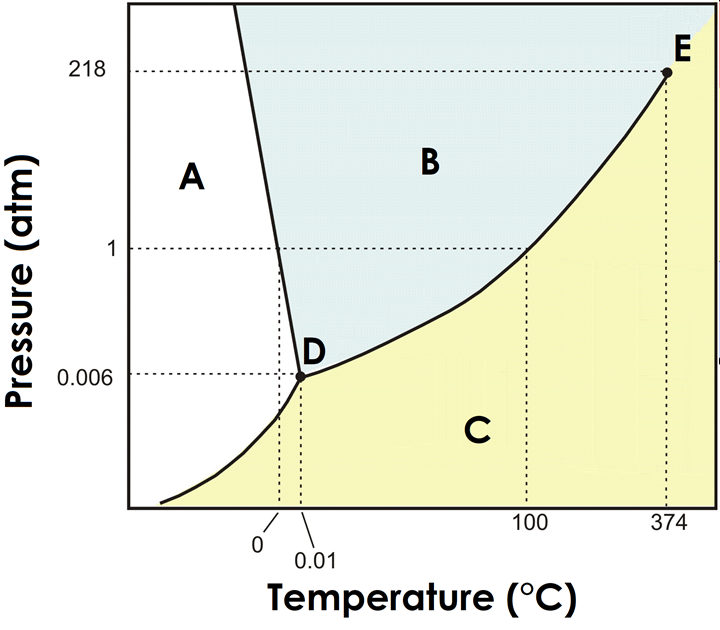
A= solid
B=liquid
C= gas
200
If the reaction A → B has ΔH = −120 kJ per mole of A, what is the enthalpy change when 2.5 mol of A reacts completely? Show the calculation.
ΔHtotal = (−120 kJ/mol) × 2.5 mol = −300 kJ
200
If energy is moves from the system to the surroundings, is the heat of the system positive or negative? explain why.
negative; heat was released
300
True or false: The ΔHf° of an element in its standard state is zero.
True
300
Use average bond enthalpies to estimate ΔH for
H2 + Cl2 → 2 HCl.
(H–H = 436 kJ/mol, Cl–Cl = 243 kJ/mol, H–Cl = 431 kJ/mol.)
ΔH= −183 kJ
300
On a heating curve for water, explain what happens to the temperature during a plateau (flat section) and why energy doesn't raise temperature at that segment.
Added heat energy does not raise the temperature because it is used exclusively to break intermolecular forces (potential energy) to change the state rather than increase molecular motion (kinetic energy).
300
The reaction: 2 NO(g) + O2(g) → 2 NO2(g) has ΔH° = −114 kJ
How much heat is released when 3.0 mol of NO2 is formed? Is this reaction endothermic or exothermic?
−171 kJ released; exothermic
300
Calculate the heat required to raise the temperature of 150.0 g of aluminum from 25.0 °C to 85.0 °C. Use c(Al) = 0.897 J/g·°C. Show formula and result.
q = m c ΔT
8073 J
400
Calculate ΔH°f for the reaction:
C(graphite) + 2 H2(g) → CH4(g)
using ΔHf° values: ΔHf°(CH4) = -74.8 kJ/mol,
ΔHf°(C(graphite)) = 0, ΔHf°(H2) = 0.
ΔH°rxn = −74.8 kJ/mol
400
Given: C(s) + O2 → CO2 ΔH = −393.5 kJ;
and 2 CO + O2 → 2 CO2 ΔH = −566.0 kJ.
Use Hess’s Law to find ΔH for: 2C(s) + O2 → 2 CO(g).
So ΔH = −110.5 kJ for 2 C + O2 → 2 CO
400
What is it called when a phase changed from a gas to a solid?
deposition
400
Given ΔH°f values: C6H12O6(s) = −1274 kJ/mol, CO2(g) = −393.5 kJ/mol, H2O(l) = −285.8 kJ/mol.
Calculate ΔH°rxn for:
C6H12O6(s) + 6 O2(g) → 6 CO2(g) + 6 H2O(l).
Products- Reactants
−2801.8 kJ
400
What does a coffee cup calorimeter measure?
The amount of heat energy transfer between two substances.
500
Use standard enthalpies of formation to calculate ΔH°rxn for:
4 NH3(g) + 3 O2(g) → 2 N2(g) + 6 H2O(l).
(Assume ΔHf°: NH3(g) = −45.9 kJ/mol; H2O(l) = −285.8 kJ/mol; elements = 0.)
ΔH°rxn= −765.6 kJ/mol
500
Provide a short step-by-step method (3–4 steps) for solving Hess’s Law problems when given multiple reactions with their ΔH values.
- Write target equation and list given equations with ΔH.
- Multiply or reverse given equations so their sum equals the target; when reversing change sign of ΔH; when multiplying scale ΔH by same factor.
- Add the adjusted equations and add the adjusted ΔH values.
- Cancel identical species that appear on both sides; result is ΔH for target reaction.
500
Which state is more dense for water, solid or liquid?
What direction will the solid/liquid equilibrium curve slant?
liquid; left
500
Use standard enthalpies of formation to calculate ΔH°rxn for: 2 NH3(g) + 1.5 O2(g) → N2(g) + 3 H2O(l).
(Assume ΔHf°: NH3(g) = −45.9 kJ/mol;
H2O(l) = −285.8 kJ/mol; elements = 0.)
−765.6 kJ
500
A 50.0 g sample of metal at 100.0 °C is dropped into 150.0 g of water at 22.0 °C. Final temperature is 26.0 °C. Assuming no heat loss and c(water) = 4.184 J/g·°C, calculate the specific heat capacity of the metal.
0.679 J/g·°C