Toxicology
Solid Waste
Legislation
Pathogens
Math Practice
100
the dose of a chemical that is lethal to 50% of a test population
LD50
100
This is the single largest component of Municipal Solid Waste (MSW) in the United States by weight
paper
100
This convention restricts the international movement of hazardous waste, particularly from developed to developing nations
Basel Convention
100
This infectious disease is caused by a parasite transmitted through the bite of an infected Anopheles mosquito, making it a prominent example of a vector-borne pathogen
Malaria
100
LD50 of caffeine in rabbits = 224 mg/kg; assume same LD50 for humans. A human has a mass of 70 kg. What is the lethal dose for this human?
15,680 mg
(70x224)
200
Pollutants the damage genetic material and interfere with normal metabolic processes of calls are called
Carcinogens
200
This liquid, often high in pollutants, is created when water moves through a landfill and must be collected and treated.
leachate
200
This 1980 act, often called "Superfund," was designed to clean up abandoned or inactive hazardous waste sites. (abbreviations accepted)
x2 Name the location of the first Superfund site
Comprehensive Environmental Response, Compensation, and Liability Act (CERCLA)
Love Canal
200
An average of 1 of these types of infectious diseases, like Ebola or Bird Flu, have arisen each year since 1970. These are disease have either not been seen before or have been absent for 20+ years. They can mutate and move rapidly from person to person, or even animal to person.
Emergent infectious diseases
200
If the United States produces approximately 40 million tons of hazardous waste annually and approximately 2 million tons are recycled, what percent of waste must be disposed of?
95%
1-(2/40) x 100%
300
These effects appear only after repeated exposure or a long duration of time
Chronic
300
This gas is a primary byproduct of anaerobic decomposition in landfills and can be captured for use as a fuel source.
Methane (CH4)
300
This international agreement focused on restricting a list of twelve highly persistent chemicals known as the "dirty dozen."
x2 Name TWO of the 12 persistent organic pollutants on this list.
Stockholm Convention
aldrin, chlordane, dichlorodiphenyl trichloroethane (DDT), dieldrin, endrin, heptachlor, hexachlorobenzene, mirex (dechlorane), toxaphene, polychlorinated biphenyls (PCBs), polychlorinated dibenzo-p-dioxins(dioxins), polychlorinated dibenzofurans (furans)
300
This respiratory infection, which can be exacerbated by malnutrition, remains one of the world's most deadly chronic diseases.
Tuberculosis
300
A landfill has a surface area of 10,000m2 and receives 60cm of rain. If 20% of that water infiltrates, calculate the annual volume of leachate in cubic meters
1200 m3
(10000 x .6 x .2)
400
This book, written by Rachel Carson, was instrumental in shifting public attitudes toward pesticide toxicity and federal legislation
Silent Spring
400
This recycling process involves turning a product into the same type of product, such as an aluminum can becoming a new aluminum can
x2 The mining of this ore (the primary source of aluminum) has immense environmental, health, and socio-economic impacts.
closed-loop recycling
bauxite
400
This legislation regulates the "cradle-to-grave" tracking of hazardous waste within the United States.
Resource Conservation and Recovery Act (RCRA)
400
This infectious disease is characterized by high fever, internal bleeding, and a high mortality rate; it famously jumped from animals to humans.
Ebola
400
Put the following in order from most toxic to least toxic (by dose): disodium EDTA (detergents) 2000 mg/kg; glucose 30 g/kg; malic acid (sour candy) 1600 mg/kg; propylene glycol (moisturizer) 2.1 g/kg; ethanol (alcohol) 7060 mg/kg
Malic Acid (1.6 g/kg), detergents (2 g/kg), moisturizer (2.1 g/kg), ethanal (7.07 g/kg), glucose 30 (g/kg)
500
These types of chemicals, including Ethanol, Benzene, and PCBs, specifically interfere with the normal development of embryos or fetuses, often leading to birth defects
Teratogens
500
This evaluation technique looks at all the costs of an item, from production to disposal, including the amount of energy needed to transport the item to a waste site, the amount of raw material needed to produce the item, tipping fees to dispose of the item, and the toxic aspect of the item once it becomes waste.
Life-cycle analysis
500
This law requires the EPA to regulate and screen chemicals used in manufacturing, excluding pesticides and food.
Toxic Substances Control Act (TSCA)
500
This type of study monitors a population that has been exposed to a chemical in the past to see what effects have occurred
Retrospective Study
500
What is the LD50 of the MORE toxic chemical? What is the approximate threshold for Chemical Y? 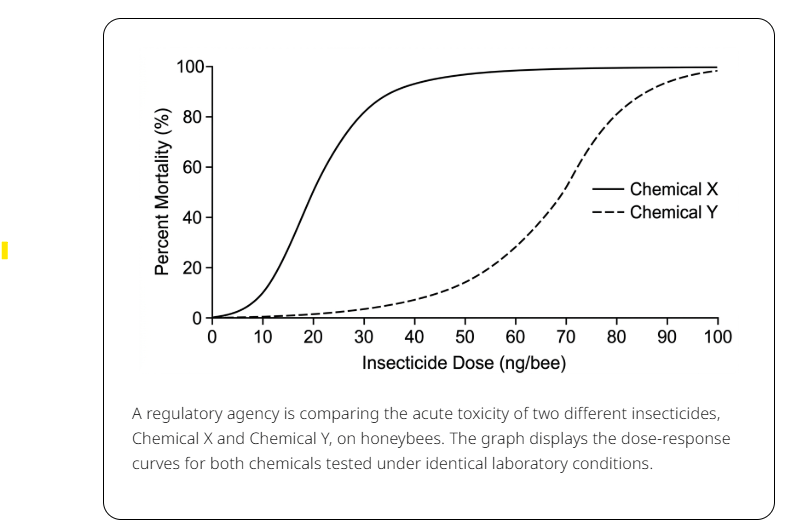
20 ng/bee (chemical x) (range: 19-21)
11 ng/bee (range: 10-12)