Organelles
Types of Cells
Osmosis
Active vs. Passive Transport
Membrane Transport
100
What organelle is primarily responsible for producing ATP?
Mitochondria
100
Give an example of a prokaryotic and eukaryotic cells
Prokaryotic - Bacteria
Eukaryotic - Animal and/or Plant
100
Definition of Osmosis, and determine if ATP is needed for this type of transport
Movement of water, no ATP is required
100
Which section(s) shown below are passive transport? How do you know?
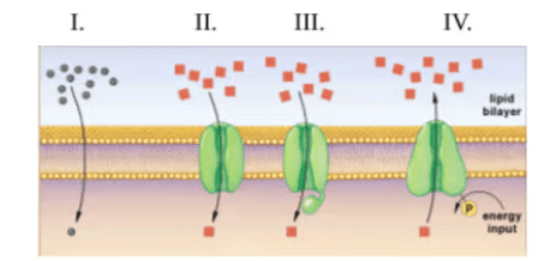
I, II, & II, going from high to low concentration and no ATP is being used.
100
Which type of molecules use passive transport?
Nonpolar
200
A cell specializes in producing large amounts of proteins that will be secreted from the cell. Which organelle would you expect to be especially abundant in this cell?"
Rough ER or Ribosomes
200
What is one major structural difference between prokaryotic and eukaryotic cells?
Prokaryotic cells do not have membrane bound organelles, while eukaryotic cells do
200
How does water move, according to Osmosis?
Water will always move to an area of higher solute concentration
200
Give 2 differences between active & passive transport
Active - uses ATP and goes against a concentration gradient
Passive - doesn't use ATP and goes down a concentration gradient
200
Which type of molecules use active transport?
Polar
300
A liver cell is specialized for detoxifying drugs and other chemicals. Which organelle would you expect to be especially abundant?
Smooth ER
300
A scientist observes a cell that contains DNA, ribosomes, and a cell wall but no nucleus. Is it more likely prokaryotic or eukaryotic? Explain.
Prokaryotic; these types of cell do not have a nucleus
300
A cell is placed in a solution with a higher solute concentration than the inside of the cell. Is the solution hypotonic, isotonic, or hypertonic? What will happen to the cell?
Hypertonic; the cell will shrivel and get smaller.
300
Give the difference between simple diffusion and facilitated diffusion
Simple diffusion - no transport protein
Facilitated diffusion - uses a transport protein
300
Which section(s) will nonpolar molecules use to cross the cell membrane?
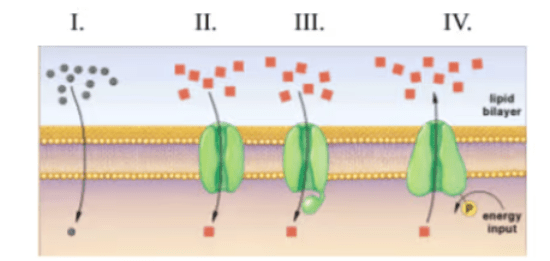
I, II, & III
400
A scientist discovers a cell with unusually large numbers of ribosomes. What can you infer about the cell's function?
It most likely makes proteins (ribosomes make proteins)
400
Both prokaryotic and eukaryotic cells contain ribosomes. Why would finding ribosomes NOT be enough to identify a cell as eukaryotic?
Both types of cells contain ribosomes
400
A red blood cell is placed in distilled water. Predict what will happen to the cell and explain why.
The cell would expand due to the higher solute concentration on the inside of the cell (hypotonic)
400
A scientist blocks ATP production in a cell. Predict what will happen to active transport, facilitated diffusion, and simple diffusion.
Active transport would not occur, since active transport requires ATP
Simple diffusion & facilitated diffusion would still occur since both of these types of transports do not require ATP
400
Which section(s) will polar molecules use to cross the cell membrane?
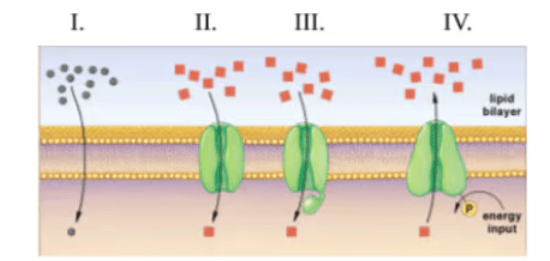
IV only
500
A mutation causes a cell to accumulate large amounts of undigested material. Which organelle is most likely malfunctioning?
Lysosomes
500
You examine an unknown cell and find mitochondria, an endoplasmic reticulum, and a nucleus. What type of cell must this be?
Eukaryotic cell
500
Two solutions are separated by a membrane that allows water to cross but does not allow solutes to cross. Side A has 2% solute and Side B has 8% solute. Which direction will water move? Explain.
Water will move to side B due to the higher solute concentration
500
Which transports shown in the picture would be inhibited if no ATP was available?
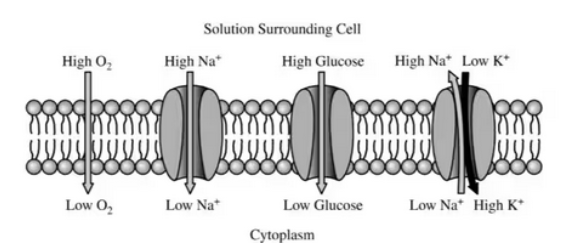
K+, and Na+ going out of the cell
500
Molecule X is small and nonpolar. Molecule Y is large and polar. Which molecule will cross the membrane more easily? Explain.
Molecule X, since it doesn't need a transport protein or ATP to cross the cell membrane