Cell Transport
Photosynthesis & Cellular Respiration
DNA & Protein Synthesis
Cell Cycle
Reproduction
100
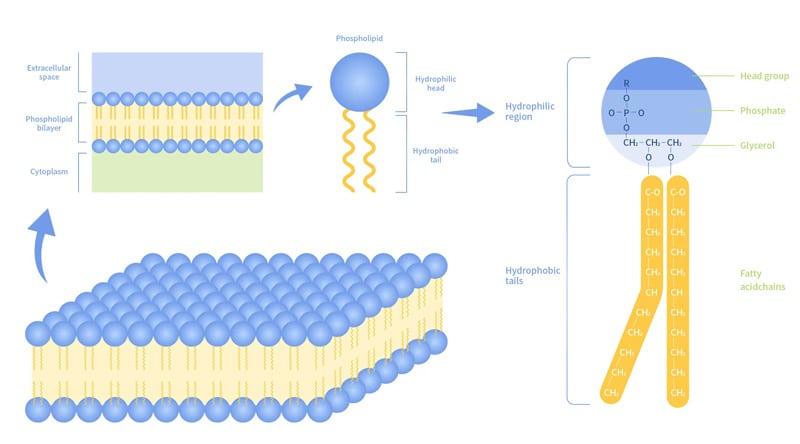
The blue and yellow structure is a ________ which make up the cell organelle known as the ________
phospholipids
Cell membrane
100
Photosynthesis happens in the __________ while cellular respiration happens in the ____________
chloroplast
mitochondria
100
Identify the mistake in the list below comparing DNA and RNA:
DNA: deoxyribose sugar, A, T, G, C, Single Stranded
RNA: ribose sugar, A, U, G, C, Double Stranded
DNA is double stranded and RNA is single stranded
100
What is the correct order of the cell cycle?
Interphase (G1, S, G2)
Mitosis (PMAT)
Cytokinesis
100
___________ requires 1 parent and ____________requires 2 parents
asexual
sexual
200
This type of cell transport moves molecules from high to low concentration without the use of energy.
Passive Transport
200
The purpose of photosynthesis is to make _______while the purpose of cellular respiration is to make ________
Sugar/glucose/food
ATP/energy
200
Transcribe the following DNA sequence:
ATG CCT GTG AAT
UAC GGA CAC UUA
200
Identify the phase of mitosis
metaphase
200
What type of asexual reproduction is shown?
Asexual reproduction
300
This is a type of passive transport known as_____
Facilitated diffusion
300
All three steps of cellular respiration is performed by these types of cells: _______________
Eukaryotes
300
During protein synthesis, transcription occurs in the _______ while translation occurs in the ________
Nucleus
Ribosome
300
Before a cell can divide what process must happen during interphase?
DNA replication
300
Scenario:
A population of lizards lives in a temperate forest. A new, deadly virus sweeps through the area, targeting the respiratory system of the lizards. Which group is more likely to survive the viral outbreak, and why?
- Group A reproduces asexually
- Group B reproduces sexually
Group B because they more genetic variation
400
1 2 3
Identify the tonicity of the solution in each beaker.
1. isotonic
2. hypertonic
3. hypotonic
400
Which inputs of photosynthesis are the outputs of cellular respiration?
Carbon dioxide and water
400
Identify N, X, P, and Q
N: mRNA
X: codon
P: amino acid
Q: tRNA
400
Mutations to the genes that control the cell cycle can cause cells to divide when they are not needed. This results in ____________
tumors/cancer
400
Commercial banana plants are cloned using vegetative propagation to produce seedless fruit. What is one disadvantage associated with this type of reproduction?
a. the crop will be more susceptible to disease
b. it takes too long to for them to reproduce this way
c. it could result in a mutation
d. it requires finding the perfect mate for each plant
a. the crop will be more susceptible to disease
500
Your small intestine pulls the last bits of sugar from your digested food into your bloodstream, even when the sugar concentration is higher in your bloodstream than in your intestine cells.
Which category of transport would this be and example of?
Active Transport
500
Bromothymol blue is a liquid chemical that turns blue in the presence of low carbon dioxide, yellow in the presence of high carbon dioxide, and green in neutral pH conditions.
If an aquatic plant is placed in a test tube in a sunny location and bromothymol blue is added, what color would you expect the solution to turn AND why?
BLUE because photosynthesis uses carbon dioxide creating a low CO2 environment
500
Describe the role of each molecule during protein synthesis:
DNA
mRNA
tRNA
DNA: stores all the directions/codes
mRNA: copies the code and travels to ribosome
tRNA: brings amino acids to the ribosome
500
Which type of mutation is shown below:
Original DNA: ATC GGA CCG ATA
Mutated DNA: ATG GAC CGA TAC
Deletion/Frameshift
500
Below is a graph showing the populations of two species. One reproduces sexually and the other one reproduces asexually. At some point, a disease swept through one of the populations. Identify which species reproduces sexually and which reproduces asexually.
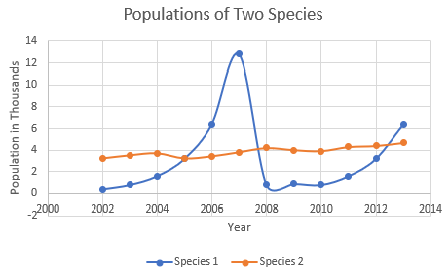
Species 1 (blue line): Asexual
Species 2 (orange line): Sexual