Congress 1
Congress 2
Bills
Vocabulary
100
How many seats are there in the House of Representatives? How many seats in the Senate?
435 seats in the House (California has the most with 52, other states, like Wyoming, have only 1).
100 seats in the Senate, 2 for each State.
100
How long are the terms for Members of the House? How long for members of the Senate?
2 Year Terms for the House to keep it more responsive to the people.
6 Year Terms for the Senate to allow it to get more done over time.
100
Which house of Congress do bills have to start in?
Bills can be introduced in either house, but must eventually be approved and passed by both.
100
What does it mean that the Congress is bicameral?
Bicameral means that it is made of two parts. The House of Representatives and the Senate together make up the Legislative Branch of our Federal Government. Most state governments (except for Nebraska) also use this system.
200
Name one special power of the House and one special power of the Senate.
House: Power to draft bills that have anything to do with taxes.
Power to choose the President in the event of an electoral college tie.
Power to impeach federal officials.
Senate: Power to approve treaties with foreign powers.
Power to approve all supreme court judges and cabinet members appointed by the executive office.
Power to hold trial and convict any federal official charged with impeachment.
200
Who is the leader of the House? Who is the leader of the Senate?
The House leader is the Speaker of the House. The Speaker presides over important votes and debates and is a key influence in what legislation is considered in committees, what gets voted on, and generally leads the majority vote for that session.
The Senate leader is the President of the Senate. The Constitution names the Vice President as the President of the Senate, who is replaced by a President Pro Tempore when he is absent. In general, the Vice President forgoes this duty, leaving it to the Pro Tem. In practice, the position of President of the Senate is more honorary and has little actual power.
200
What is the difference between an Authorization Bill and an Appropriation Bill?
An Authorization Bill establishes or continues a government program.
An Appropriation Bill establishes how much and where the funds will be acquired for the government program.
200
What is impeachment?
The power of Congress, specifically the House of Representatives, to accuse a federal official of a crime. Contrary to common usage of the word, impeachment is not the same as conviction and removal.
300
Who voted for the Senate members before the 17th Amendment?
Before the 17th Amendment allowed for citizens to directly vote for Senators they were chosen by State legislatures. This was because the upper house was thought of as the more esteemed or important lawmaking body of the two, and thus required more governmental oversight, particularly by state officials, in choosing candidates well.
300
Who are the current 8th District Representative and two Senators that represent the people of our area in Congress?
Representative Pete Stauber. Former Police Officer. Currently up for re-election, he has served four terms (8 years).
Senator Amy Klobuchar. Currently running for MN Governor. She is two years into her fourth term (20 years of service), if she wins a special election will select a temporary Senator in 2027.

Senator Tina Smith. After being selected to fill Senator Al Franken's seat when he resigned due to allegation of sexual misconduct she served out the rest of his term (2 years) and was then re-elected for an additional term (8 years total). She officially retired this year and is not re-running. Peggy Flanagan (D) a MN State House member and Michele Tafoya (R) an award winning sports anchor are the main candidates running for her seat.
300
What are the Presidents three options when he receives a bill from Congress?
He can sign the bill into law.
He can veto the bill, sending it back to Congress where they will have to pass it with a two-thirds majority for it to become a law, which is rare.
He can do nothing, called a pocket veto, expressing his indirect disapproval of it. If the Congress remains in session for ten days the unsigned bill automatically becomes law.
300
What is gerrymandering?
The practice of redrawing congressional district lines (dictating the boundaries for the territories overseen by House of Representative members) in a manner that gives one political party an advantage over another.
Named after Governor Elbridge Gerry of MA for his infamous agreement to some particularly heinous redistricting that a political cartoon lampooned as resembling a monster.
400
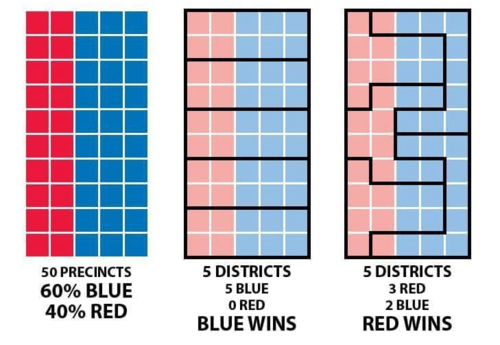
How can redrawing congressional district lines give someone a political advantage?
Cracking: By separating communities that would oppose a majority party into several districts, the minority voice is diminished and suppressed, resulting in an overwhelming majority.
Packing: By concentrating as many of the minority voters as possible in a single district, their voice is again diminished and suppressed.
400
What are four things Congress cannot do?
Ban the Slave Trade Before 1808 - A concession made to slave holding states to convince them to sign the Constitution, allowing the importation of slaves from Africa to continue in the United States until 1808.
Suspend Writs of Habeas Corpus - Except in situations of rebellion, a person cannot be denied their right to be told what crime they are accused of.
Pass a Bill of Attainder - A law cannot be created which declares someone guilty without a fair trial.
Pass and Ex Post Facto Law - A law cannot declare an act illegal in order to convict someone of a crime that was committed before the law was put in place.
Impose a Direct Tax Except Based on Census - The government could only impose indirect taxes, such as those placed on goods and imports, which would then be indirectly transferred to the citizens. After the 16th Amendment direct taxes could be levied, thus the income tax and property tax were born.
Titles of Nobility cannot be granted by the US government.
400
What are the steps for a bill to become a law.
A bill must be introduced in either the House or Senate.
The bill goes to committee for mark-up. Many bills don't make it past this point, so they are said to have "died in committee".
The bill is voted on and if passed, the bill will then be given to the other house of Congress for the process to proceed again as above.
If both houses pass the bill it will then be received by the President who has the option to sign the bill into law.
400
What are the whips in Congress?
In either the House or Senate, there is usually always a Majority and Minority Party present. Both parties traditionally vote for a leader and a secondary leader. This second-in-command figure is called the "whip". Thus both Houses each have a Majority Whip and a Minority Whip. These whips try to influence members of their party to vote for legislation that matches the party line.
500
What is the committee system?
Since thousands of bills and other pieces of legislation can be introduced during any one session of Congress, it is impossible for every member of Congress to read every single bill. Instead, each of the two bodies of Congress are broken up into twenty or so committees. These committees are made up of small groups of Congress members with particular interest (Agriculture, Energy, Education, Technology, Military, Foreign Relations etc). These committees receive relevant bills, study them, and help make suggestions, adjustments, or call for assistance for another committee or subcommittee. Both the House and Senate have similar, though not identical, committees, allowing for a proposed bill to be studied again by a small group of people and approved in both Houses.
500
What does the process of removing a federal official from office look like?
Which Presidents were removed in this process?
First, the House of Representatives takes a vote on the articles of impeachment that charge the official with, per the Constitution, "Treason, Bribery, or other High Crimes and Misdemeanors", and can impeach that official, given a simple majority.
Next, the case goes to trial, during which the Senate sits as jury. If the president is the official being tried, the Chief Justice of the Supreme Court presides as judge. The Senate needs a two-thirds majority vote to convict the official, thus removing them from office.
Over the last 250 years, this process has only begun 64 times. Of these only 21 have actually been impeached by the House. Of these only 8 have actually been tried and convicted. All 8 were federal judges. Only 3 presidents have been impeached: Andrew Johnson, Bill Clinton, and Donald Trump (Twice!). Richard Nixon resigned before he could be impeached.
500
What is the filibuster and how has it been justified as a political tool?
The filibuster is when a senator opposes a bill in the Senate (which has no rules about the length of debates, unlike the House where the rules on time limits are stricter) and proceeds to monologue as long as he is able, detaining the vote on said bill. The usual dynamic is that the majority party is about to pass legislation that the minority party opposes. The filibuster is an opportunity for the minority party to stall legislation in the hopes of deterring the vote and providing the minority party more time to negotiate with the majority party to change, reconsider, or abandon the legislation.
Defenders of the filibuster point to the fact that a majority party rarely holds a two-thirds majority of the senate, meaning that both parties have to work together to pass legislation. The filibuster helps prevent the majority party from attempting to bully the minority party, a kind of check and balance measure that ensures that majority legislation will usually attempt to appease the minority as well, in order to avoid a filibuster.
500
What is the difference between a bill, joint resolution, concurrent resolution, and simple resolution?
A bill is a common proposal for regulating and spending money, creating programs, changing the law, or any other legislative act that will otherwise go into effect as federal law.
A joint resolution specifies the allocation of money needed to run the government, authorizes declarations of war, and approves constitutional amendments.
A concurrent resolution is used to address the internal operations of how the Congress functions, as well as to express the joint opinion of both houses, and does not need a presidential signature.
A simple resolution does the same, but only for one of the houses and also does not need a presidential signature.