Trophic Levels
Measuring Populations
Population Ecology
Ecology Extras
100
What is tertiary consumer?
An organism that eats a secondary consumer.
100
How do you calculate population density?
Number of organisms per area
# of organisms/area
100
Define population
A group of the same species that live in the same place at the same time
100
A multi-chained diagram that shows how energy in ecosystems flows from one organism to another
Food web
200
Identify the producer in the food web.

A
200
What type of population growth occurs when a population levels off? (S curve)
Logistic growth
200
Define carrying capacity
The max number of organisms that an ecosystem can support
200
Which type of growth is shown in this graph?
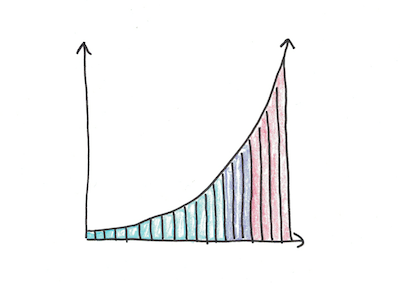
Exponential
300
If an organism eats both plants and animals, what are they called?
Omnivore
300
What are two general ways a population can increase in size?
increased births or immigration
300
What is called when organisms move out of an area?
emigration
300
Give one characteristic of a k-selected species.
One of the following:
Live around carrying capacity
low birth number
good survival
Late sexual maturity
Large body size
Can reproduce more than once in their lifetime
400
These organisms are responsible for releasing the nitrogen in dead organisms and recycling it back into the ecosystem
Decomposers
400
The overall term for a biotic or abiotic factor that causes populations to decrease
limiting factor
400
Give an example of a density-independent factor.
Answers:
Weather
Natural disasters
Human Acitivities
400
Give one characteristic of an r-selected species.
One of the following:
High birth number
Bad survival
Early sexual maturity
Small body size
Can reproduce once in their lifetime
500
Why is the number of trophic levels limited?
Energy is lost at each level so there is typically not enough energy left to support more than 4-5 levels.
500
What happens when the birth rate and death rate are equal?
The population levels off and would not be increasing or decreasing
500
Competition, predation, and parasitism are all examples of ___________ because they limit the growth of more dense populations?
Density-dependent factors
500
Which of these would be least likely to be affected by a density dependent factor?
A. a small, scattered population
B. a population with many organisms near each other
C. a school
A