Energy
Types
Types
Energy in light
Radiant Energy
What types of energy are at the start and end of this scenario?
:max_bytes(150000):strip_icc()/155770744-56a778355f9b58b7d0eac1c5.jpg)
GPE --> Kinetic Energy
What does the Law of Conservation of Energy say?
Energy is never created or destroyed.
How much work is done to move a 20N force 5m?
W = Fd
100J
What is the most common type of inefficient energy transformation?
Thermal energy.
Energy in things that are located above the ground
Gravitational Potential Energy
What types of energy are at the start and end of this scenario?

Radiant energy --> Electric energy
If the ball has 100 J of KE at point B, how much energy does it have at point D?
100 J
GPE = mgh, g = 9.8m/s2
GPE = 235.2J
Where is there energy inefficiency when you bounce a bouncy ball?
Some of the energy inefficiency is due to vibrational energy from the sound the ball makes when hitting the ground. MOST of the energy inefficiency is due to thermal energy which happens when the ball rubs against air molecules as it's moving.
Energy stored when something is bent or compressed
Elastic Energy
What types of energy are present in this scenario?
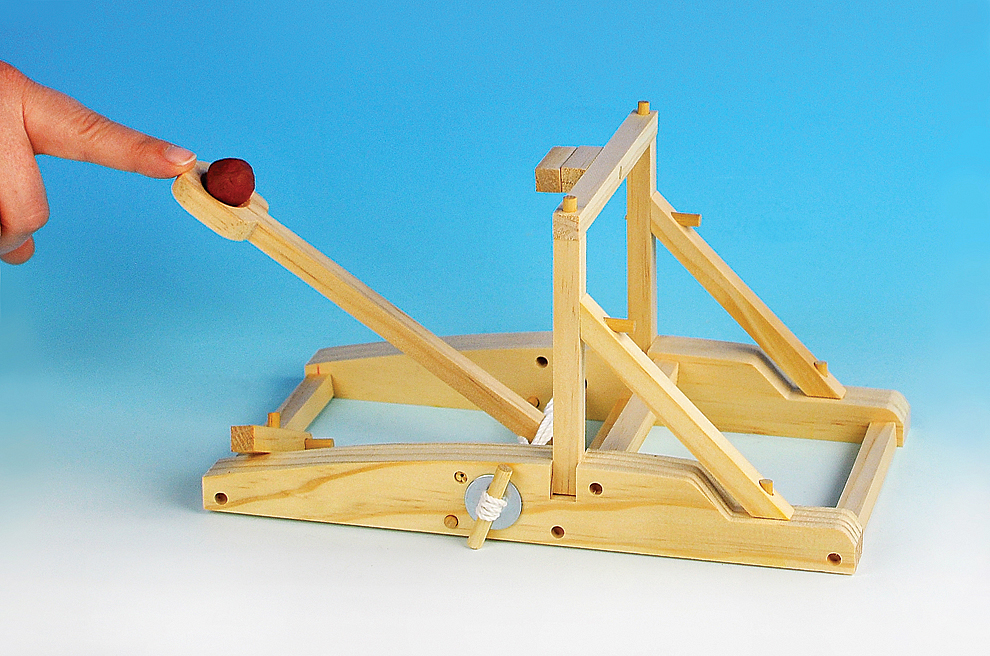
Elastic energy
Kinetic energy
GPE
If the GPE is 50 J at point A, what is the total amount of energy at point C?
50 J
How much power is needed to do 75 J of work in 5 seconds?
P = W/t
P = 15W
Where is there energy inefficiency when skateboarders are riding up and down a skateboarding ramp?
Some of the energy transforms into thermal energy because of the the skateboarding rubbing against the track and the air molecules. The thermal energy isn't being used to help the skateboarder go up and down the track.
Energy in electricity
Electric Energy
Draw an energy flowchart for this scenario: You are in a roller coaster car. You are slowly pulled up to the top of the hill. Then your car reaches the top and races down the track on the other side.
Types of energy: chemical energy, kinetic energy, GPE, thermal energy
(Draw flow chart on the board.)
What type(s) of energy does the ball has at points A, B, C and D?
A- GPE
B- KE
C- GPE and KE
D- GPE
How much kinetic energy does a 1800kg car have when is it moving at 25m/s?
KE = 1/2 mv2
KE = 562500J
You are babysitting at the park. You put the baby in a swing and lift the swing up to start it going. Is it possible for the swing to swing up higher than the first starting point? Why or why not?
The swing cannot swing up higher than the first starting point because the total amount of energy in the system will stay constant, it will be impossible for the swing to go up higher unless you add more energy by giving another push.
Energy in paper before you burn it
Chemical energy
Draw an energy flowchart for this scenario: You blow up a balloon with your mouth and then let go so it flies all around while a loud balloon deflating noise.
Types of energy: kinetic, elastic, GPE, vibrational, thermal
(draw flow chart on board)
If the ball is initially lifted to point A, is it possible for it to rise about point A on its next swing? Why or why not?
No, the law of conservation of energy say that energy is never created or destroyed. So the total amount of energy in the system will stay constant-- meaning the ball will not gain any new energy that it would need in order to swing higher.
A 0.3kg bouncy ball has a velocity of 4m/s after it hits the ground. How high will it go up?
KE = 0.5 * 0.3 * 42 = 2.4 J
GPE = 2.4 J = 0.3 * 9.8 * h
h =0.82 m
When you drop a bouncy ball, why doesn't it continue bouncing forever?
When the bouncy ball bounces, kinetic energy is transformed into GPE and then back into kinetic.
But as the ball moves through the air some of the kinetic energy is also transformed into thermal energy. Eventually, all of the energy will be transformed into thermal energy and the ball will no longer have energy to bounce.