Matching
Stories of the Old Testament - Moses
Sin and Freedom
The Ten Commandments
Covenants
100
What are the three specific conditions that must be met for a sin to be considered valid?
1. Knowledge: You have to know what you’re doing is bad
2. Free will: You have to have full control over your actions
3. Grave matter: Causes serious evil to myself or another person
100
List any three of the Ten Commandments.
I am the Lord your God: you shall not have strange Gods before me.
You shall not take the name of the Lord your God in vain.
Remember to keep holy the Lord's Day.
Honour your father and your mother.
You shall not kill.
You shall not commit adultery.
You shall not steal.
You shall not bear false witness against your neighbour.
You shall not covet your neighbour's wife.
You shall not covet your neighbour's goods.
200
Define the following and provide two examples of each:
Venial Sin:
Social Sin:
Venial Sin: This is a less serious matter that offends and wounds charity in the heart but does not completely destroy it. It is a failure to follow the moral law in less serious matters or even in grave matters when one does not have full knowledge or complete consent.
Example 1: Telling a "white lie" to avoid a minor inconvenience.
Example 2: Minor impatience or irritability with a family member.
Social Sin: This refers to structures of sin within society that result from personal sins, creating unjust social situations or institutions that go against the divine goodness. It involves the collective behavior of a group that causes harm to others.
Example 1: Systemic poverty or economic policies that unfairly disadvantage the poor.
Example 2: Environmental pollution or the failure to care for creation, which impacts the global community.
200
Choose one commandment and explain how it specifically applies to the life of a Grade 9 student today. (2 marks)
Answers will vary.
Ex:
Commandment: You shall not bear false witness against your neighbor.
For a Grade 9 student, this commandment specifically applies to the avoidance of gossip and cyberbullying.
300
Describe the call of Moses. Who appeared to him, in what form, and what was the specific mission he was given? (3 marks)
Answers will vary.
- God calls to Moses in the form of a burning bush.
- Mission was to lead the Israelites out of Egypt and to the Promised Land
300
Briefly explain one of the 7 Social Sins and how it impacts modern society.
Answers will vary.
Politics of fear, hate, or exclusion. (Ex. of impact on modern society: Politicians spreading hate towards an opposing party or group.)
Abuse of creation
Society without love
Acquisition or retention of unjust wealth
Commerce or industry without morality
Science without humanity
Perpetuation of ignorance
400
Explain the importance of the Passover event. Why did the Israelites perform this ritual, and what did it signify for their future? (3 marks)
Answers will vary.
The Passover was a pivotal event in the Old Testament where God spared the firstborn sons of the Israelites from the final plague sent upon Egypt.
Why the Israelites Performed the Ritual
Protection from the Final Plague: The Israelites were instructed to mark their doorposts with the blood of a sacrificed lamb.
Obedience to God: This act served as a sign of their faith and obedience to God’s commands delivered through Moses.
The "Passing Over": When the Angel of Death saw the blood, it would "pass over" those homes, leaving the inhabitants unharmed while the firstborn of the Egyptians perished.
What it Signified for Their Future
Freedom from Slavery: The Passover was the immediate catalyst that convinced Pharaoh to release the Israelites, marking the beginning of their Exodus from Egypt.
Identity as God’s People: It established a permanent communal identity for the Israelites as a people specifically chosen and protected by God.
A Perpetual Memorial: It became a central religious feast, signified as a lasting "testament" or covenant to be celebrated annually to remind future generations of God’s deliverance.
The Path to the Promised Land: It served as the starting point for their journey toward Canaan, the land promised to them in the Mosaic Covenant
400
Compare and contrast Internal Freedom and External Freedom. Provide one example of a threat to each.
Internal
- Freedom over your own thoughts and actions
- Threats
Bad influences
Lack of information
Psych-altering substances
External
- Freedom from outside control
- Threats
Oppression from government
Injustice
Prejudice
400
Name the 5 Major Covenants of the Bible.
1. NOAHIC COVENANT
2. ABRAHAMIC COVENANT
3. MOSAIC COVENANT
4. DAVIDIC COVENANT
5. NEW COVENANT
500
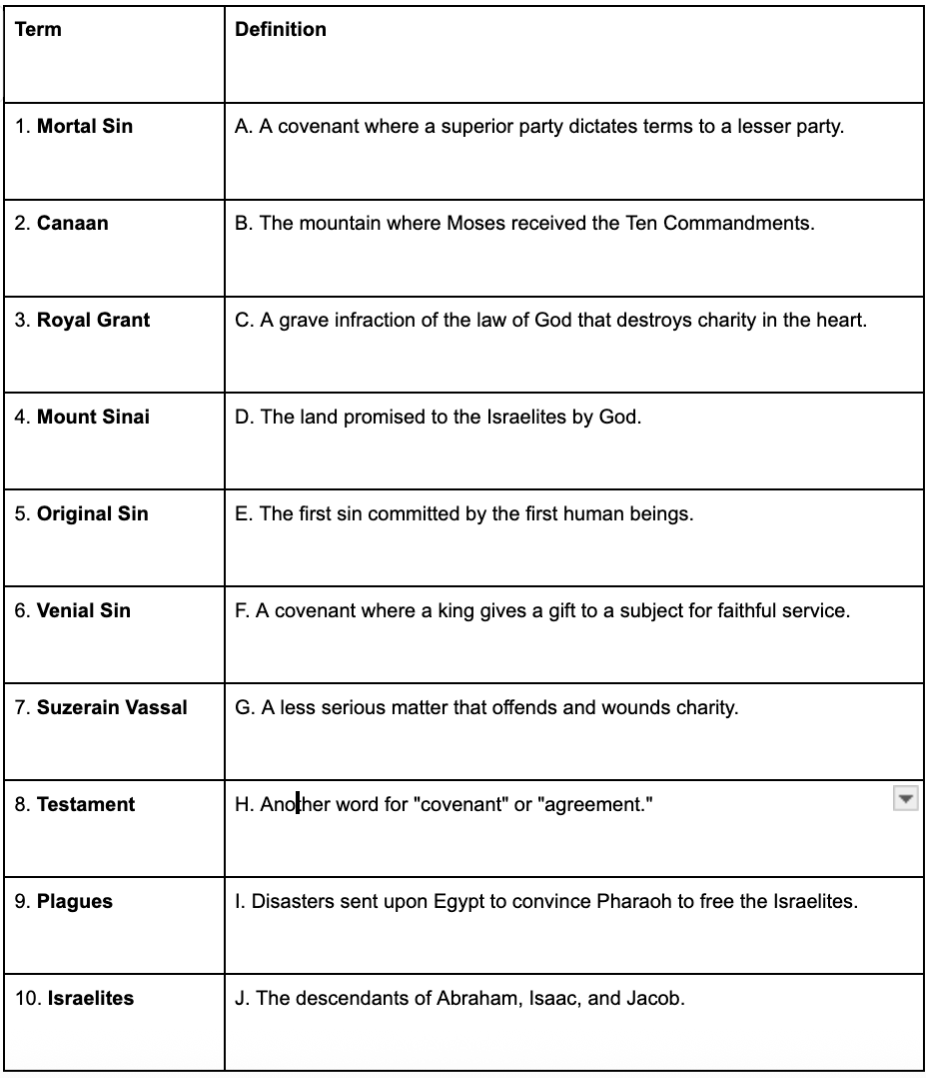
1-C, 2-D, 3-F, 4-B, 5-E, 6-G, 7-A, 8-H, 9-I, 10-J.
500
Identify two key characters involved in the story of the Exodus (other than Moses and God) and explain their significance in the narrative. (4 marks)
Answers will vary.
In the story of the Exodus, two key characters who play vital roles alongside Moses and God are Aaron and Pharaoh.
Aaron: As the brother of Moses, Aaron served as his "spokesman" because Moses was hesitant about his own speaking abilities when confronting the Egyptian authorities. Aaron was instrumental in performing signs and wonders before Pharaoh and later became the first High Priest of the Israelites, representing the religious leadership of the people during their journey.
Pharaoh: He serves as the primary antagonist of the narrative. Pharaoh’s refusal to release the Israelites from slavery, despite the series of devastating plagues sent upon Egypt, demonstrates the theme of "hardness of heart". His eventual defeat after the final plague allowed for the liberation of the Israelites and the fulfillment of God’s promise to lead them to Canaan.
500
(5 Marks) Explain the Mosaic Covenant. Where did it take place, what was the "sign" of this covenant, and what was the core "agreement" between God and the Israelites?
The Mosaic Covenant is a defining moment in the Old Testament where God formalizes His relationship with the Israelites.
Here are the specific details regarding this covenant:
Location: The covenant took place at Mount Sinai.
The Sign: The physical sign of this covenant is the Ten Commandments inscribed on stone tablets.
The Core Agreement: It was a conditional agreement where God promised to be the protector and God of the Israelites, while the Israelites committed to being His "Chosen People" by following His laws and staying faithful to Him. This is often summarized by the phrase: "I will be your God, and you will be my people."