Macromolecules I
Macromolecules II
Macromolecules III
Cells I
Cells II
100
The following are a mix between disaccharides and polysaccharides, which is the only monosaccharide?
A. Glucose
B. Glycogen
C. Maltose
D. Cellulose
A. Glucose
100
A ____________ reaction joins two molecules together, while a ____________ reaction breaks them apart
A. Hydrophobic, Hydrophilic
B. Hydrolysis, Dehydration
C. Dehydration, Hydrolysis
D. Hydrophilic, Hydrophobic
C. Dehydration, Hydrolysis
100
______ + ______ makes lactose.
Glucose and Galactose
100
This is the site in which ribosomes are assembled
A. Nucleus
B. Nucleolus
C. Nucleoid Region
D. Nuclear envelope
B. Nucleolus
100
Which of these structures is not surrounded by a phospholipid bilayer?
A. Mitochondria
B. Endoplasmic Reticulum
C. Golgi Apparatus
D. Ribosomes
D. Ribosomes
200
All polysaccharides and disaccharides are held together by this type of bond
A. Peptide
B. Ionic
C. Glycosidic
D. Hydrogen
C. Glycosidic
200
These make up most of the cell membrane
A. Phospholipids
B. Proteins
C. Triglycerides
D. Cholesterol
A. Phospholipids
200
Complete the other DNA sequence: 5' AGTGGCTA 3'
A. 3' UCACCGAU 5'
B. 5' UCACCGAU 3'
C. 3' TCACCGAT 5'
D. 5' TCACCGAT 3'
C. 3' TCACCGAT 5'
200
Select all the structures that make up the endomembrane system:
A. Nuclear envelope
B. Ribosomes
C. Golgi apparatus
D. Lysosomes
E. Peroxisomes
F. Chloroplasts
G. Plasma Membrane
A. Nuclear envelope
C. Golgi apparatus
D. Lysosomes
G. Plasma Membrane
200
The cell is undergoing cell division, it needs to lengthen so that it has room to grow & then quickly shorten once it is split into two cells. Which type of fiber would the cell use?
A. Intermediate Filaments
B. Microtubules
C. Microfilaments
D. Actin
B. Microtubules
300
Which of the following are examples of disaccharides? Select all that apply:
A. Lactose
B. Glycogen
C. Glucose
D. Sucrose
E. Fructose
F. Maltose
G. Cellulose
A. Lactose
D. Sucrose
F. Maltose
300
Name me all the beta glucose.
Name me all the alpha glucose.
What is the difference between beta and alpha glucose
Alpha Glucose: Starch, Glycogen
Beta Glucose: Cellulose, Chitin, Peptidoglycan.
300
Is this amino acid polar or nonpolar? Is it hydrophilic or hydrophobic? How can you tell?
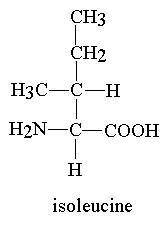
Nonpolar, hydrophobic, You look at the R group (at the top)
300
You decide to drown your sorrows after the test by drinking some alcohol. Which organelle in the cell will be responsible for breaking down the toxin?
A. Golgi Apparatus
B. Ribosome
C. Rough Endoplasmic Reticulum
D. Smooth Endoplasmic Reticulum
D. Smooth Endoplasmic Reticulum
300
What are the proofs of cell theory?
1.
2.
3.
1. All cells are derived by existing cells
2. Cells are the block of all living things.
3. Cells are the smallest living unit that preform vital functions.
400
A triglyceride contains what?
A. Hydrocarbon only
B. Four fused rings
C. Fatty acids, glycerol, polar group
D. A glycerol with three fatty acids
D. A glycerol with three fatty acids
400
What are the three components of a nucleotide?
Base
Phosphate
Sugar
400
What are the four components of an amino acid?
Amino Group, Central Hydrocarbon, Carboxyl Group, R Group
400
What are the 3 proteins that make up the cytoskeleton and what do they make?
Actin, Keratin, and Tubulin.
Actin makes microfilaments
Keratin makes intermediate filaments
Tubulin make microtubules
400
Steroids are hydrophobic or hydrophilic.
Hydrophobic
500
Name the three polysaccharides & briefly describe what they are used for & for who
Glycogen - animals, short term energy storage
Starch - plants, short term energy storage
Cellulose - plants, structural for the plant cell wall
500
Describe the steps of protein folding and the type of bonds that are associated with each.
Primary structure- Chain of polypeptides, Peptide bond
Secondary structure- Alpha helix and Beta pleaded sheets within backbone, Hydrogen bonds
Tertiary Structure- Using R group to make 3D shape of the protein, can be finished
Quaternary- 2 or more polypeptides example: Hemoglobin
500
What is the monomer of nucleic acids?
What is the structure of that monomer?
What are the polymers of nucleic acids?
What are the 2 examples of polymers of nucleic acids?
What is their structure?
What is their function?
Monomer:
-Nucleotide
Structure:
-Base, phosphate, sugar
Polymer:
-Polynucleotides: DNA & RNA
Structure:
-DNA has deoxyribose, phosphate, base
-RNA has ribose, phosphate, base
Function:
-DNA stores genetic information
-RNA transmits genic information from DNA to ribosomes
500
Explain what the endosymbiotic theory is and tell me what proofs there are for it.
That mitochondria and chloroplasts were prokaryotes.
1. They have double membranes
2. They have circular chromosomes
3. They have 70s ribosomes
500
Which organelles/structures are found in plant cells, but not animal cells
Central Vacuole
Chloroplasts
Cell wall