Classifying Matter
Separating Matter
Classifying Energy
Heat
Physical or Chemical
100
What is the smallest unit of matter?
Accept: Element
Correct Answer: Atom - DISCUSS WHY
100
If a substance floats in water, what can be said of it's density?
density is less than 1
100
What is the unit we measure heat with?
Joule
100
What is the specific heat of water, and where can you find it?
4.18 J/g C (Reference Table B)
100
Is reactivity a physical or chemical property?
chemical
200
What are the diatomic elements?
Br2I2N2Cl2H2O2F2
Bromine, Iodine, Nitrogen, Chlorine, Hydrogen, Oxygen, Florine
200
what is the density formula and where can it be found?
D=m/v (Table T)
200
What is the difference between heat and temperature?
Heat is energy, temperature is a way of measuring that energy
[AWARD DOUBLE POINTS IF GROUP MENTIONED TEMPERATURE MEASURES KINETIC ENERGY]
200
A 10 gram sample of water is heated 20 degrees. How much heat was added?
836 Joules
200
What is the scientific term for melting?
fusion
300
Draw a particle diagram of a heterogenous mixture
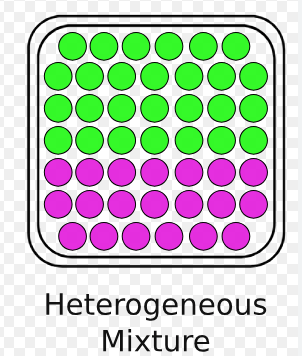
300
What separation technique can separate matter by boiling point?
distillation
300
A substance is undergoing condensation. What is happening to it's potential energy, kinetic energy, and temperature?
Potential Energy: DECREASES
Kinetic Energy: CONSTANT
Temperature (measurement of KE): CONSTANT
300
A sample of water is heated by 10 degrees and gains 100 joules of heat. How much did the substance weigh?
2.39 grams
300
If a substance sublimes, was this process endothermic or exothermic?
endothermic
400
What is a pure substance. Name the two types of matter that can exist as a pure substance in your response.
A pure substance is a "pure" sample consisting of only one type of thing. A sample of an element or compound can be considered "pure", because it is only consistent of that type of substance.
400
What separation technique separates mixtures by solubility?
Chromatography
400
What happens to the distance between molecules as the potential energy increases?
The distance increases (Phase change)
400
What does specific heat mean?
Specific heat is the heat needed to increase the temperature of a 1 gram substance by 1 degree
400
If a gummy bear was burned to a crisp, was the burning of the gummy bear endothermic or exothermic?
exothermic
500
What is the law of definite proportions, and why does it not apply to mixtures? (Look at 2.1 notes)
The law of definite proportions states that compounds are bonded to each other in definite proportions. It does not apply to mixtures because the parentages in a mixtures component can vary.
500
What separation technique can separate mixtures by particle size?
filtration
500
How can you tell if kinetic energy is increasing?
You are adding heat and the phase doesn't change OR the temperature is increasing
500
An unknown substance is warmed by 30 degrees, in which time it gains 238.0 Joules of heat. The mass of the substance was 5.0 grams.
1) What is the substance's specific heat?
2) Was the substance water?
1) 1.59 j/g C
2) No, the substance is not water because the specific heat was not 4.18 j/g C
500
What is the difference between a physical and chemical change?
A physical change changes the state of matter but not the identity of the substance, a chemical change breaks and forms new bonds, therefore it changes the identity of the substance.