Stop Time & Force
Momentum
Kinetic Energy
Design Solutions
100
A car of mass 100 kg going 10 m/s comes to a complete stop due to a brake force of 10N. How long does the car take to stop?
200 seconds
100
Complete the sentence
Momentum is conserved in __________ collisions.
all
100
Complete the sentence.
Kinetic energy is conserved in ___________ collisions.
elastic
100
Name and explain the physics phenomenon that allows seatbelts to protect passengers in a collision.
Inertia.
The person's body remains in motion even though the car stops moving (due to the external force from the brake) because the person's body has intertia. The seatbelt provides an external force to counter the intertia, making them stop.
200
A kid on a skateboard (combined mass of 60kg) is travelling at 10m/s and applies a brake force by dragging her foot on the road. If it takes her 50 seconds to come to a complete stop, how much force did her foot apply?
12N
200
Calculate the momentum of a 300 kg car reversing at 4 m/s
sign and units for points
-1200 kgm/s
200
Calculate the kinetic energy of a 5 kg exercise ball travelling at -1 m/s.
Sign and units for points.
+ 2.5 J
200
Name and explain the physics principle that allows airbags to protect passengers in a collision.
Impulse.
The impulse of a collision remains the same.
Extending the time of the collision with an airbag reduces its force.
300
A motorcycle with a mass of 300 kg is travelling at 12 m/s and needs to slow down to go around a bend in the road. Assuming that it takes the motorcycle 90 seconds to slow down to a new velocity of 6 m/s, calculate the brake force applied.
20N
300
A marble with a mass 0.4 kg going at 3 m/s collides with a 0.2kg marble going -2m/s.
Calculate the total momentum after the collision. Units and sign
+ 0.8 kg m/s
300
Is kinetic energy conserved or transformed in this collision? How do you know?
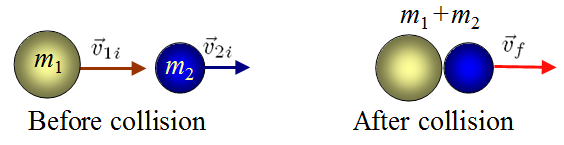
Transformed.
Inelastic collision
300
Name and explain the physics principle that allows bumpers to protect passengers in a collision.
Bumpers make the collision more elastic.
This means more KE is conserved and less is transformed, causing less harm to the cars and people.
400
A rolling ball with a mass of 0.5 kg is going at 2m/s. A sports player applies a force of 0.3N, bringing its velocity down to 0.5 m/s. How long does this process take?
2.5 seconds
400
A 40-kg sled sliding east at 5.0 m/s collides inelastically with a 10-kg block of snow that is at rest. The sled and snow stick together and keep sliding. Find their velocity after they collide and stick together.
+4 m/s
400
A 5kg child running forward at 3m/s bumps into a 2kg toddler running backward at -6 m/s. After the collision, the 5kg child has a velocity of -3 m/s and the 2kg child has a velocity of +6 m/s. Is their collision elastic or inelastic?
Elastic. KE before and after = 58.5 J
400
Name and explain the physics principle that allows crumple zones to protect passengers in a collision.
Impulse.
The impulse of a collision remains the same.
Extending the time of the collision with a crumple zone reduces its force.
500
If the force applied to change the momentum of a baseball by 24 kgm/s is 6N, calculate the time needed to make that change.
3 seconds
500
A ball of mass 5 kg going forward at 3 m/s collides elastically with a ball of mass 2 kg going backward at 6 m/s. Given that after the collision, the 5 kg ball now has a velocity of 3 m/s backwards, find the final velocity of the 2 kg ball.
+9 m/s
500
A 1kg skateboard going 3m/s collides with a 3kg bike going -3m/s. Calculate their combined total kinetic energy.
18 J
500
Name 3 ways to reduce the risk of a collision.
1. Faster reaction time
2. Less mass to get a faster stopping time
3. Less initial velocity to get a faster stopping time