Atomic adventures
Water wonders
Polymer puzzles
Chemical contests
Life's building blocks
100
What is the smallest unit of matter?
Atom
100
What allows some organisms to walk on water?
Surface tension
100
What are the small individual molecules that make up polymers called?
Monomers
100
What are the substances that start chemical reactions?
Reactants/substrates
100
What are the monomers of carbohydrates?
Monosaccharides
200
What surrounds every atom and holds electrons?
Electron shells
200
What forms between slightly positive hydrogen and slightly negative oxygen in water?
Hydrogen bonds
200
What do we call large molecules made of many smaller ones?
Polymers
200
What are the substances produced at the end of a reaction called?
Products
200
What are the building blocks of nucleic acids?
Nucleotides
300
What is the term for when atoms share electrons?
Bonding
300
What is the tendency of water to stick to itself called?
Cohesion
300
What reaction occurs to form polymers by removing water?
Dehydration synthesis
300
What is the energy needed to initiate a chemical reaction?
Activation energy
300
What type of nucleic acid stores genetic information in organisms?
DNA
400
What describes an atom's negative charge due to its electrons?
Electronegativity
400
What allows water to move upward, like in plant roots?
Capillary action
400
What reaction involves adding water to break down polymers?
Hydrolysis
400
Do enzymes increase or decrease the rate of reactions?
Increase
400
What food has nucleic acids in it?
None!
500
What is the difference in electronegativity between atoms in a molecule called?
Polarity
500
What term describes water's ability to dissolve polar and ionic substances?
Universal solvent
500
Which reaction is this?
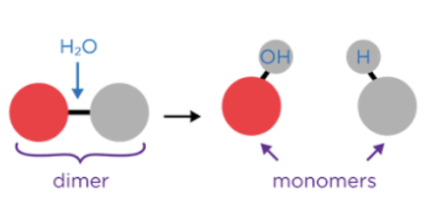
Hydrolysis
500
Which macromolecule is an enzyme?
Protein
500
What happens to an enzyme when it is not in ideal conditions?
It is denatured