Federalism
Government Powers
Comparing Constitutions
Constitutional Amendments
Government Obligations & Services
100
Which statement BEST describes federalism?
A. Power is divided among the three branches of government.
B. Power is divided between the national and state governments.
C. Citizens vote for representatives to make government decisions.
D. The judicial branch determines whether laws are constitutional.
B. Power is shared between the national and state governments.
100
Which statement BEST describes enumerated powers?
A. Powers shared by the federal and state governments.
B. Powers reserved for state governments by the 10th Amendment.
C. Powers specifically listed in the U.S. Constitution and given to the federal government.
D. Powers divided among the three branches of government.
C. Powers specifically listed in the U.S. Constitution and given to the federal government.
100
Who leads the executive branch of government in the U.S. Constitution and the Florida Constitution?
A. U.S. is led by a Governor and Florida by the President
B. U.S. is led by Congress and Florida by the Legislature
C. U.S. is led by the President and Florida by a Governor
D. U.S. is led by the Supreme Court and Florida by the Legislature
C. U.S. is led by the President and Florida by a Governor
100
What does it mean to RATIFY a constitutional amendment?
A. To suggest a change or addition to the Constitution.
B. To officially approve a change or addition to the Constitution.
C. To remove the Constitution
D. To create a new branch of government in the Constitution
B. To officially approve a change or addition to the Constitution.
100
Which service is MOST likely provided by a local government?
A. Maintaining state highways
B. Issuing driver's licenses
C. Managing trash and recycling
D. Regulating trade with other countries
C. Managing trash and recycling
200
How does the 10th Amendment limit the power of the federal government?
A. It allows state governments to ignore federal laws.
B. It gives the president authority over state governors.
C. It prevents states from creating their own laws.
D. It reserves certain powers for the states or the people.
D. It reserves certain powers for the states or the people.
200
Which government action is an example of a reserved power?
A. Establishing post offices
B. Issuing driver's licenses
C. Declaring war on another country
D. Regulating trade with foreign countries
B. Issuing driver's licenses
200
Which feature is found in BOTH the U.S. Constitution and the Florida Constitution?
A. A preamble, articles, and amendments
B. A requirement to provide public education
C. A president who leads the executive branch
D. A requirement that amendments receive 60% voter approval
A. A preamble, articles, and amendments
200
What is the most common FIRST step in amending the U.S. Constitution?
A. The president approves the amendment.
B. Three-fourths (3/4) of the states ratify the amendment.
C. Two-thirds (2/3) of both houses of Congress propose the amendment.
D. At least 60% of U.S. voters approve the amendment.
C. Two-thirds (2/3) of both houses of Congress propose the amendment.
200
Which pair of government responsibilities is primarily handled by Florida's STATE government?
A. Delivering mail and regulating foreign trade
B. Issuing driver's licenses and managing public schools
C. Maintaining city parks and collecting trash and recycling
D. Declaring war and maintaining an armed force
B. Issuing driver's licenses and managing public schools
300
A state government passes a law that conflicts with a valid federal law.
According to the U.S. Constitution, what happens when these laws conflict?
A. The state law takes priority because states have reserved powers.
B. Both laws are canceled until the Supreme Court makes a decision.
C. The federal law takes priority because of the Supremacy Clause.
D. The state governor decides which law should be followed.
C. The federal law takes priority because of the Supremacy Clause.
300
The federal government AND state governments can both collect taxes, establish courts, and enforce laws.
Which type of government power is demonstrated by these examples?
A. Reserved powers
B. Enumerated powers
C. Delegated powers
D. Concurrent powers
D. Concurrent powers
300
The U.S. Constitution includes a Bill of Rights, while the Florida Constitution includes a Declaration of Rights.
What is the MAIN purpose of these sections?
A. To explain how the government collects taxes
B. To establish the qualifications for elected officials
C. To describe how amendments are proposed
D. To protect individual rights and limit government power
D. To protect individual rights and limit government power
300
How is Florida's constitutional amendment process DIFFERENT from the U.S. process?
A. Florida amendments require approval from three-fourths (3/4) of the states.
B. Florida amendments must be signed by the governor.
C. Florida amendments are approved by the U.S. Congress.
D. Florida amendments require approval from at least 60% of voters.
D. Florida amendments require approval from at least 60% of voters.
300
Residents discover that a damaged traffic signal on a city-owned road is causing accidents. They want the problem repaired to improve public safety.
Which level of government is primarily responsible for addressing this issue?
A. State government
B. Federal government
C. Regional government
D. Local government
D. Local government
400
The following excerpt is from Article VI of the U.S. Constitution:
"This Constitution, and the Laws of the United States which shall be made in Pursuance thereof... shall be the supreme Law of the Land."
Based on this excerpt, which statement BEST explains the relationship between federal and state governments?
A. States may choose which federal laws they want to follow.
B. The federal government has unlimited authority to create laws.
C. Valid federal laws take priority when they conflict with state laws.
D. State governments lose their reserved powers whenever Congress passes a law.
C. Valid federal laws take priority when they conflict with state laws.
400
The chart below shows powers exercised by different levels of government.
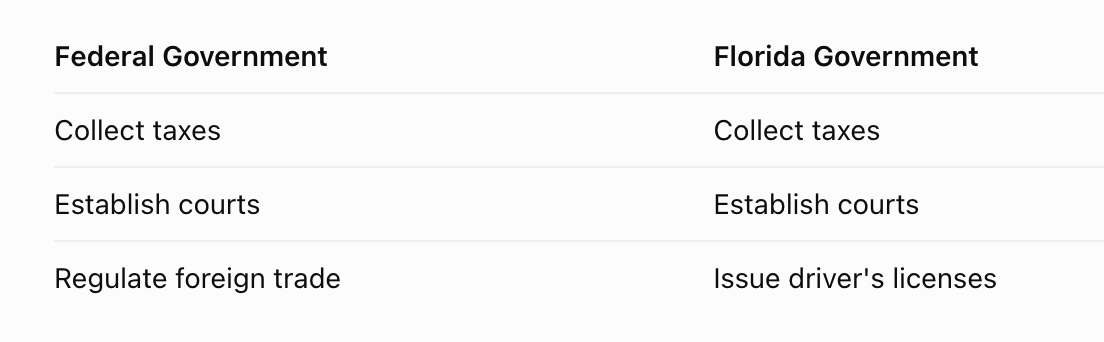
Which conclusion is BEST supported by the chart?
A. All government powers are shared equally between federal & state governments.
B. Federal & state governments share some powers, while other powers belong to only one level.
C. The federal government must approve every power exercised by state governments.
D. State governments have the same enumerated powers as the federal government.
B. Federal & state governments share some powers, while other powers belong to only one level.
400
The chart below compares the U.S. and Florida Constitutions.
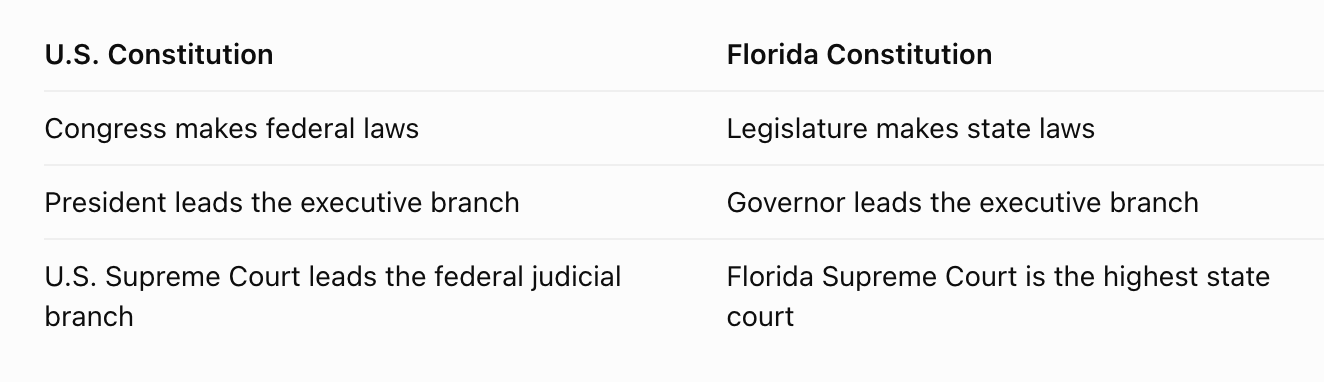
Which conclusion is BEST supported by the chart?
A. Florida's government has fewer branches than the federal government.
B. Both constitutions establish a similar structure for their governments.
C. The Florida Constitution gives the governor more power than Congress.
D. Both constitutions require state governments to follow the president's decisions.
B. Both constitutions establish a similar structure for their governments.
400
Congress approves a proposed amendment to the U.S. Constitution with a two-thirds (2/3) vote in both houses. However, the amendment has not been ratified by the states.
Why has the amendment NOT become part of the Constitution?
A. The president must sign the amendment before it becomes law.
B. The amendment must also be ratified by three-fourths (3/4) of the states.
C. The Supreme Court must decide whether the amendment is necessary.
D. At least 60% of voters must approve the amendment in a national election.
B. The amendment must also be ratified by three-fourths (3/4) of the states.
400
Below are services provided by three levels of government.
Government 1: Trash collection, city parks
Government 2: State highways, driver's licenses
Government 3: Postal service, national defense
Which conclusion is BEST supported by the chart?
A. Government 1 handles local needs, 2 handles statewide needs, and 3 handles national needs.
B. Government 1 has authority over 2 and 3 because local services directly affect citizens.
C. Government 2 is responsible for services at all three levels when public safety is involved.
D. Government 3 must directly manage all state and local services under the Supremacy Clause.
A. Government 1 handles local needs, 2 handles statewide needs, and 3 handles national needs.
500
Florida has the power to establish policies for its public schools. However, a Florida school policy conflicts with a valid federal law protecting students' constitutional rights.
Which statement BEST explains how federalism applies to this situation?
A. Florida's reserved powers allow it to ignore federal laws involving education.
B. The federal law takes priority, but Florida keeps authority over school policies that do not conflict with federal law.
C. Congress gains complete control over Florida's public schools because federal laws are supreme.
D. Both governments must give up their authority over public schools until the conflict is resolved.
B. The federal law takes priority, but Florida keeps authority over school policies that do not conflict with federal law.
500
Three government actions are described below:
Action 1: Florida establishes requirements for educators to receive teaching licenses.
Action 2: Congress passes a law regulating trade between the United States and Canada.
Action 3: Both the federal government and state governments establish courts to handle legal disputes.
Which answer correctly classifies ALL THREE government powers?
A. Action 1: Concurrent; Action 2: Enumerated; Action 3: Reserved
B. Action 1: Reserved; Action 2: Concurrent; Action 3: Enumerated
C. Action 1: Reserved; Action 2: Enumerated; Action 3: Concurrent
D. Action 1: Enumerated; Action 2: Reserved; Action 3: Concurrent
C. Action 1: Reserved; Action 2: Enumerated; Action 3: Concurrent
500
Florida's Constitution can provide greater protections for individual rights than the U.S. Constitution. How is this possible?
A. State constitutions have more authority than the U.S. Constitution and can ignore federal protections.
B. The 10th Amendment allows states to ignore federal protections listed in the U.S. Constitution.
C. States can expand individual rights but cannot remove rights protected by the U.S. Constitution.
D. Federal constitutional rights only apply when states approve them.
C. States can expand individual rights but cannot remove rights protected by the U.S. Constitution.
500
A proposed U.S. amendment is ratified by 25 of the 50 states. A separate Florida amendment receives 64% voter approval.
Which conclusion is correct?
A. Both amendments pass because each received majority support.
B. The U.S. amendment passes, but Florida's amendment fails.
C. Florida's amendment passes, but the U.S. amendment fails.
D. Both amendments fail because neither received enough approval.
C. Florida's amendment passes, but the U.S. amendment fails.
500
A Florida county wants to improve public transportation. County officials plan new bus routes, but the project also requires improvements to a state highway.
Which statement BEST explains how government responsibilities apply to this situation?
A. The federal government must manage the entire project because transportation involves public safety.
B. The county may operate local transportation services, but state officials have responsibilities involving the state highway.
C. The county can make all decisions about the state highway because it passes through county boundaries.
D. Florida must transfer authority over the highway to the county before any transportation improvements can begin.
B. The county may operate local transportation services, but state officials have responsibilities involving the state highway.