Maps
North Africa
West Africa
Central Africa
South Africa
100
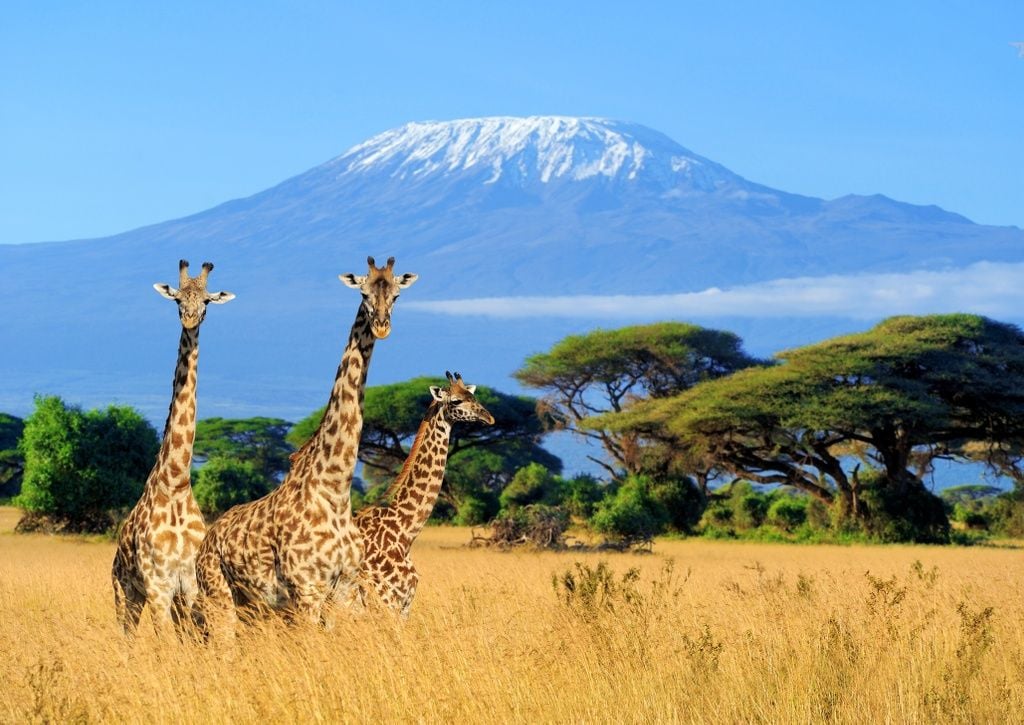
What is the name of Africa's tallest mountain?
BONUS: Where is it located?
Mount Kilimanjaro
In north-east Tanzania, on the border of Kenya.
100
What Muslim Turk joined the Ottoman Empire's navy after his brother was killed by the Spanish, and was eventually made the admiral by Sultan Suleyman after he captured the city of Algiers in 1529?
Barbarossa
His true name was Khayr al-Din, but was given his pirate nickname by the Italians for his "Red Beard".
100
What country is dominated by a single river, has an economy almost entirely dependent on groundnuts (peanuts), has had three presidents and two coups in the last sixty years, is the location for a yearly Roots Homecoming Festival, celebrating the African heritage of those whose ancestors were formerly captured as slaves, and is the home of pygmy hippos, the giant pouched rat, and over 500 species of bird?
The Gambia
100
What deadly disease originated in the Democratic Republic of Congo and has resulted in tens of thousands of deaths in the region?
The Ebola Virus
100
Who were "Afrikaners" in South Africa?
The minority white population descended from Dutch and English settlers. The name comes from the variation on the Dutch language that came to be spoken there, called Afrikaans.
200
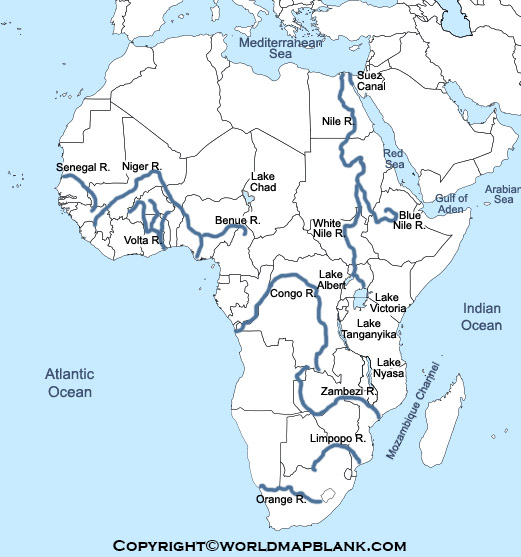
What are the names of the two longest rivers in Africa?
The Nile and the Congo
200
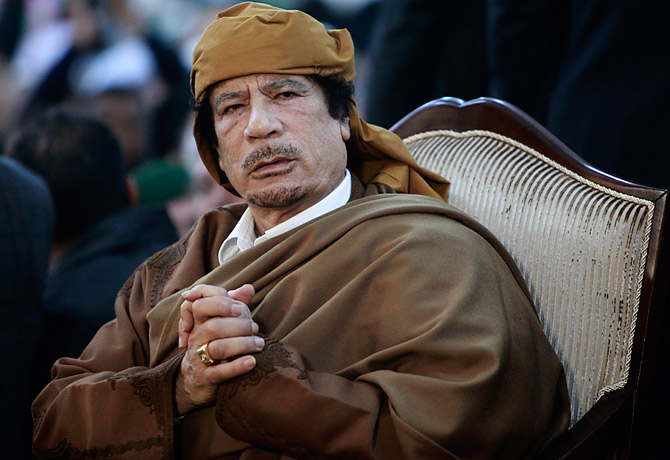
What dictator ruled over Libya with a unique form of Islamic Socialism from 1969 to 2011?
Muammar Gaddafi
While his rule created a relatively (compared to other dicatorial Islamic states) stable and economically prosperous country, his constant corruption and human rights violations resulted in his assassination in 2011. Libya has since fallen into a state of constant civil war, greatly decreasing the quality of life for Libyans.
200
What ancient African civilization left behind remains of terracotta figures in elaborate poses, found in Nigeria?
The Nok Culture

200
What two ethnic groups were locked in a devastating conflict in Rwanda that culminated in mass murder in 1994?
The Hutu and the Tutsi
Belgian Colonists first instigated racial segregation of the country by forcing people to carry racial identity cards that determined how you would be served, where you could go, and whether you could hold positions of authority. The Tutsi were privileged above the Hutu and given most positions of authority. After the country gained independence in the 1960s, the Hutus staged a revolution and drove the Tutsi people into exile in Uganda. When Tutsi militia groups tried to return, the Hutu government responded with widespread violence, fueled by state funded propaganda over the radio, finally culminated in mass murders of half a million Tutsi people.
200
What was the name of the country of Eswatini until 2018?
Swaziland
Both names are derived from the name of their 19th century King Mswati II (Eswatini just means "Land of the Swazi")
The name change was made to recognize the country's fiftieth anniversary of independence and to make it distinct from similar sounding Switzerland.
300
What are the names of the three large geographical features that dominate Africa and that separate it into three distinct regions.
The Sahara Desert in the North
The Congo in the Center
The Kalihari Desert/Savannah in the South

300
Algeria was once the central home of what famous criminal organization?
BONUS: What American War was fought here?
From the 1500s to the 1800s Algeria, particularly the city of Algiers, was the capital city of the Barbary Pirates, who were the scourge of the Mediterranean.
The Barbary Wars from 1785 to 1815. After America gained independence from Britain, they ceased to have the special amnesty from piracy that Britain had gained from the Barbary Pirates. Algerian pirates seized American ships, prompting George Washington's administration to build the first six ships of America's navy, and later for President James Madison to declare war on Algiers, during which American and Dutch ships bombarded the city of Algiers until it surrendered.
300
What is the main source of revenue for Cote d'Ivoire?
Once called "The Ivory Coast" by the French, elephants in the area were hunted nearly to extinction and the sale of ivory was banned worldwide in 1989.
The country now produces over 30% of the world's cocoa. Women and children do the majority of the work, often laboring in harsh conditions and long hours, but receive very little of the revenue.
300
Who was Ota Benga and what happened to him?
Ota Benga was an Mbuti person, an ethnicity notable for their small stature and often called "pygmies". He was captured as a slave and sold to an American exhibitionist who had him displayed in the St. Louis World Fair of 1904 and later in the Bronx Zoo in New York, where he was housed with the apes. His harrowing and inhuman treatment is both a testament to racist human cruelty, and the damage of social darwinism during the early 20th century. Ota Benga was later rescued by an African-American Orphans Asylum in Brooklyn, where he learned English and worked at a tobacco plant. When he was prevented from returning to Africa by WW1, he committed suicide in 1914.
300
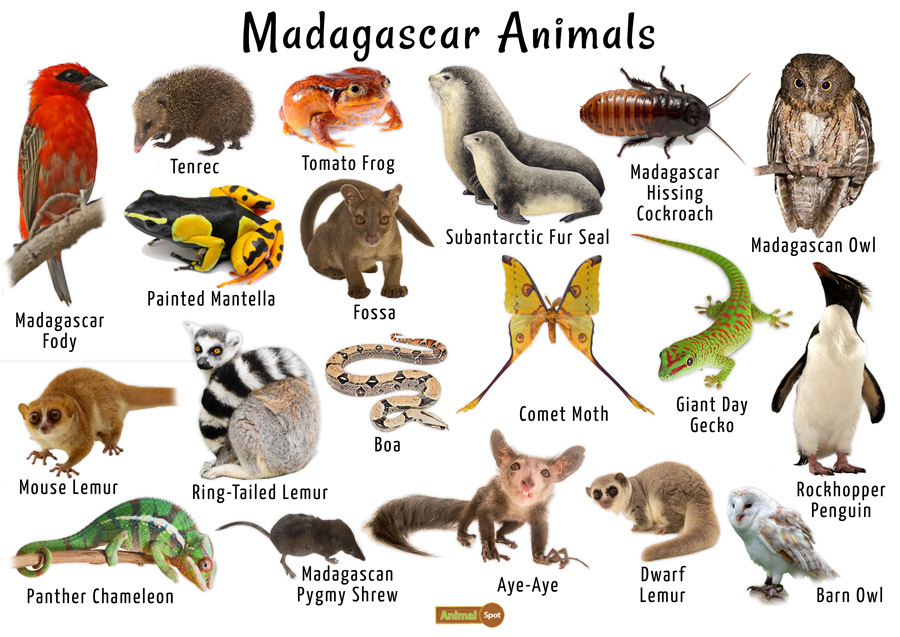
What South African island is known for its unique biodiversity, with 90% of its wildlife found no where else on earth?
Madagascar
400
What is the geographical significance of Tunisia?
As the northernmost point of Africa, in the center of the Mediterranean Sea, Tunisia, and primarily its capital city Tunis, have been instrumental in both African and European history for power in the Sea and region, beginning in ancient times when the Phoenicians built the city of Carthage there. Barbary Pirates, Ottoman Turks, and later the French would all occupy the area as a strategic point of influence.
400
What conflict zone involves a country that was invaded by its neighbor in 1975 and has remained occupied, but contested territory since, has produced a nationalist liberation movement with little to no power, representing the local inhabitants, whose governmental center is located in a different sympathetic country, and as recently as 2020 seen further developments when President Trump endorsed the colonization in return for the colonizers support of Israel?
The Morocco/Western Sahara border conflict.
Morocco controls a majority of the country and has erected a 1600 mile berm between the contested territories.
Morocco thus controls Western Sahara's many valuable resources, including the world's largest phosphate deposits, as well as vast off-shore oil reserves.
400
Why are there three countries with the word "Guinea" in West Africa?
The term comes from the name given by Europeans to the Western coast of Africa under the hump. The Guinea Coast reportedly gets its name from a Portuguese loan word from the local Berber language, meaning "black" or "burnt".
The coast was highly contested by several European nations for its riches, particularly ivory, gold, and slave labor. In particular Portugal, Spain, France, and Britain carved up the coast among themselves. Later, these regions gained independence, but kept the name Guinea. Guinea is former French Guinea, Guinea Bissau is former Portuguese Guinea, and Equatorial Guinea is former Spanish Guinea. Countries like The Gambia, Sierra Leone, Liberia, and Ghana (formerly the Pepper Coast and Gold Coast) had been colonized by Britain, but did not retain the Guinea name.
400
Describe the political situation in Cameroon.
The area that is today called Cameroon was once overseen by Germany, who ceded control over to France and Britain after it lost its overseas territories in WW1. The majority of the area was given to France, and thus the majority became French speakers, while a smaller English speaking region emerged from the area given to Britain. When the country achieved independence, a single party system was quickly arranged by the French speaking majority, shutting out English speaking residents. Only two presidents have served in the last 65 years, despite elections every seven years, both from the same party. Opposition has resulted in stricter treatment of English speakers, and an increase in corrupt powers for the leading authorities.
400
How many people were captured as victims of the Trans-Atlantic Slave Trade, what kind of conditions did they have to endure, and where were most of the survivors taken?
Over 12.5 million people were taken over the course of three centuries.
These people were forcibly removed from their homes and separated from their families. They would be beaten, raped, mutilated, and tortured at the whim of their captors, and killed if they resisted. They would be sold in dehumanizing markets, treated like animals, loaded in the hundred onto ships and literally stacked on top of each other like cargo. The conditions were unsanitary and dangerous. Many died of starvation and disease, being murdered by their captors, or fell victim to bad weather or piracy during the long voyage. They were brought primarily to European owned plantations in the Caribbean to perform hard labor, while many others were brought to Spanish South America and to the British Colonies in the North, while yet others were taken to colonies all over the globe.
500
What is the geographical significance of South Africa?
The ownership of South Africa became key to many European empires in a race to own the valuable trade routes to Asia. Competition for the area was one of the reasons the existence of the America's were realized by Europeans, as Colombus' mission was to seek a competitive alternative to the long South African route. The British Empire fought and won a war with the Dutch over the area in 1899 in order to secure their hold over India, Pakistan and the city of Hong Kong, as well as their holdings in Papau New Guinea, Australia, and New Zealand among others.
500
What was Arab Spring?
In 2010 a man named Mohamed Bouazizi burned himself alive in front of a government administration building in a city outside Tunis, Tunisia, protesting the corruption that kept him from providing the basic needs for his impoverished family.
This event spread over social media and ignited a series of demonstrations and protests in Tunisia, called the Jasmine Revolution. These protests resulted in the resignation of the president, and the institution of a new government, new constitution, and free elections with relative stability and peace.
Further spread over the internet to other Muslim nations who felt their countries had become corrupt and unliveable, young Muslims took to the streets over the course of the next few years in Egypt, Yemen, Libya, Bahrain, Syria, Morocco, Algeria, Jordan, Oman, Iran, Saudi Arabia, And the UAE. Some of the demonstrations ended peacefully, but others erupted into violence, with their governments using police brutality to deter and even kill protesters.
500
What people group live at the base of the Bandiagara Escarpment in Mali, and what kind of challenges do they face?
The Dogon people.
Living a simple agricultural village life, the Dogon people are animists, believing in the cohabitation of people and spirits, performing elaborate dance ceremonies involving ritual masks and dress.
The Dogon are threatened by the increase in tourism to the people, bringing modern technologies and ideas to complicate and change their village lifestyle. Aggressive collection of Dogon masks and other artifacts has created a black market for the theft and sale of these items. Militant Islamic extremist groups vying for control of Mali also present a danger. Ninety-five Dogon were left dead after an attack in 2019.
500
Explain the current Somalian Immigration Crisis.
As with many African nations, after gaining independence from Italian and British colonizers, the country fell into a series of civil wars, resulting in a large exodus of people in 1991.
Many Somalians fled to the United States, where they were given refugee status, and settled in cities all over the continent. In particular, because of the lucrative social programs and available jobs, Minneapolis, Minnesota became the central hub for Somalian Immigration.
Somalis now total over 100,000 in Minnesota, around two-thirds of which were born in the US.
Recently, a scandal was uncovered showing that certain social programs were being exploited fraudulently, particularly by a group of Somali people, who were allegedly sending funds back to families in Somalia, and potentially falling into the hands of al-Shabab, a Somalian Islamic terrorist group.
Following this discovery, the Trump administration, in late November of 2025, revoked the special residential status of Somalis in the United States, with reported plans to forcibly remove them from the country as illegal immigrants.
500
What was South African Apartheid and how did it end?
Due to its colonial past, South Africa had a white majority that owned most of the wealth, business, and land, and held most of the positions of power in government. In the 1960s the government took away the rights of the majority black population, revoking their right to vote and instituting racist segregation policies similar to the American South during the same time period.
Much like the civil rights movement in the United States, black South Africans stage large demonstrations in protest, which were often met with violent backlash.
The international community pressured South Africa economically to stop apartheid, which the white government eventually acceded to. Black South Africans were allowed to vote for the first time in 1994 and elected the first Black President of the nation, Nelson Mandela, who had been a leader in the national movement to end apartheid and been arrested in 1962.