Translations
Reflections
Rotations
Triangle Congruence
Wild Card
100
(2, 3) moves 5 units right, 5 units up
(7, 8)
100
Reflect (2, 3) over the x-axis
(2, -3)
100
This clockwise rotation is the same as rotating 90o counterclockwise.
270 clockwise
100
Are the following triangles congruent if so by which method?
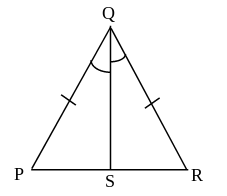
SAS
100
Solve for X.
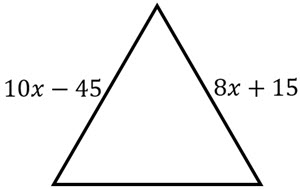
What is X=30?
200
(-7, -1) moves 3 units left, 1 unit down
(-10, -2)
200
Reflect (-3, 2) over the x-axis
(-3, -2)
200
A (-7,-1) Rotated 90 CW find the new image
rule (y,-x) A' (-1,7)
200
Are these 2 triangles congruent if so by which method?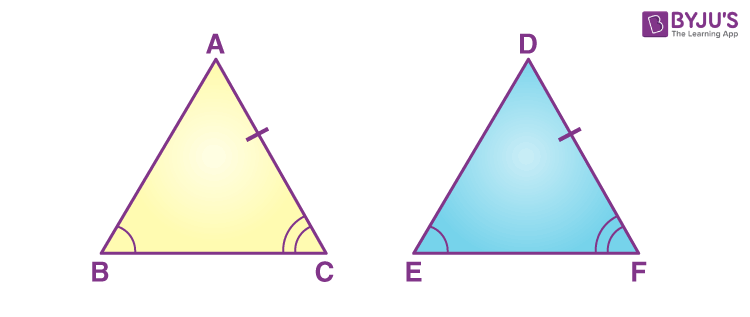
AAS
200
Are these triangles congruent and if so how?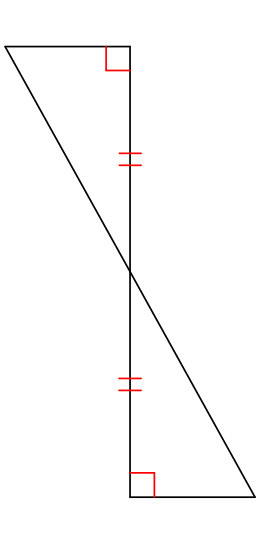
Yes ASA
300
The graph depicts a rigid transformation.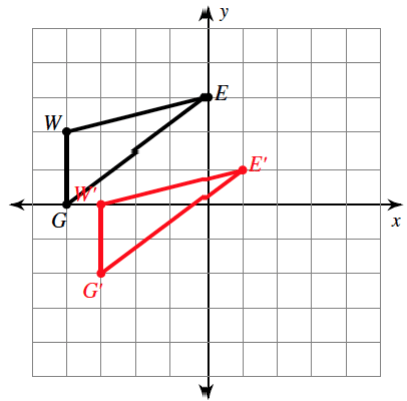
What is a translation 1 unit right 2 units down? (x,y)->(x+1,y-2)
300
Identify the Transformation & explain how you know?
A ( -5, 6) ---> A' (-5, -6)
B (4, 6) ---> B' (4, -6)
C (3, 2) ---> C' (3, -2)
X axis reflection because only the y values changed.
300
A (2,3) Rotated 270 CW
(-y,x) A' (-3,2)
300
Are these triangles congruent and if so how?
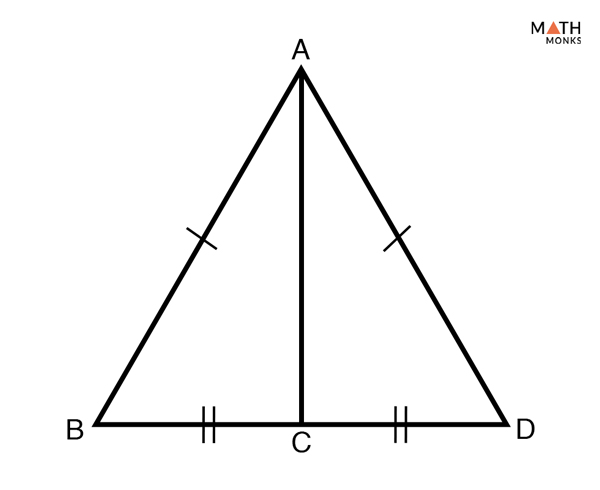
What is SSS?
300
(-4, -4) turns into (4, 4)... name the rotation
180 degrees in any direction
400
The given graph depicts a rigid transformation.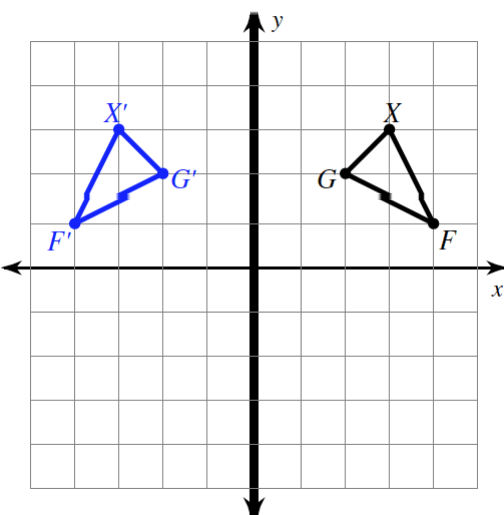
Y axis reflection which changes x values
Rule (-x,y)
400
Are these triangles congruent, if so how?
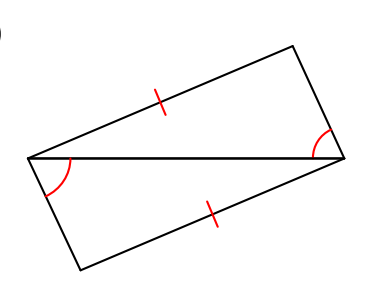
Not congruent
400
2 triangles are translated and then reflected. How do the corresponding side lengths and angle measures change?
They do not change. Both the angle measure and the side lengths are preserved.
500
If point A (-2,-5) is reflected over the line y=x
Create the rule? and find A'?
(y,x) A' (-5,-2)
500
Are these triangles congruent if so how?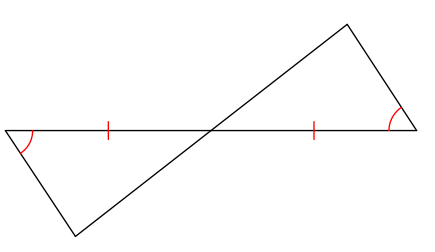
Yes ASA
500
After a reflection and translation what is the relationship of the corresponding segments that are parallel?
Parallel segments remain preserved. That is since translations produce parallel segments when connecting points pre-image to image