True/False
Fill in the Blank
Original Proof
Propositions
100
No obtuse triangles are also isosceles.
False
100
If _____ be added to _______ then the whole is equal.
equals, equals
100
G: ABC is isosceles, with legs AB and AC. AD bisects <BAC.
TP: < ADB is right
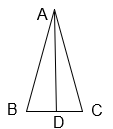
What information do we know because the triangle given is isosceles (by its definition)?
AB = AC
100
To construct an equilateral triangle on a given finite straight line.
Proposition 1
200
The converse of a statement may in some cases only be able to be proved indirectly.
True
200
If two triangles have two pairs of corresponding sides equal and the _____________ equal then the triangles are equal.
included angle
200
G: ABC is isosceles, with legs AB and AC. AD bisects <BAC.
TP: < ADB is right

What information do we know because the triangle given is isosceles (from a proposition)?
<ABD = < ACD
200
How do we prove proposition 1?
Given finite straight line AB, draw two circles with centers A and B with radius AB. Circles interesect at point C. Then AB = AC since they are both radius of circle centered at A. And AB = BC since they are both radius of circle centered at B. So, CA = AB = BC.
300
If two rectilineal fingures are equal, the they can be made to coincide.
True
300
The __________ is the part of the proposition that states in general terms what is to be done.
Enunciation
300
G: ABC is isosceles, with legs AB and AC. AD bisects <BAC.
TP: < ADB is right
What information do we know because <BAC is bisected ?
BD=CD
300
If two triangles have two sides equal to two sides respectively, and have the angles contained by the equal straight lines equal, then they also have the base equal to the base, the triangle equals the triangle, and the remaining angles equal the remaining angles respectively, namely those opposite the equal sides.
Proposition 4. SAS.
400
In this course, we have four valid methods for proving triangles congruent.
False
400
If _____, then _____. But _____, thus _____.
If __P___, then __Q___. But __not Q___, thus __not P___.
400
G: ABC is isosceles, with legs AB and AC. AD bisects <BAC.
TP: < ADB is right
By what congruence theorem are triangles BAD and ACD proven congruent?
SAS
400
What does proposition 5 say?
In isosceles triangles the angles at the base equal one another, and, if the equal straight lines are produced further, then the angles under the base equal one another.
500
Given: If the teacher is late to class, then he will get a raise.
Is the converse statement: If the teacher gets a raise, then he was not late to class?
False.
500
If two lines are _____________________, then they create adjacent angles which are equal.
perpendicular
500
G: ABC is isosceles, with legs AB and AC. AD bisects <BAC.
TP: < ADB is right
Since triangle BAD and CAD have been proven congruent, how do we know <ADB is right?
<ADB = <ADC [CPCTC]
<ADB is right [Definition of a right angle]
500
State Proposition 8.
If two triangles have the two sides equal to two sides respectively, and also have the base equal to the base, then they also have the angles equal which are contained by the equal straight lines.