Atomic Models Through History
Electron Configuration
Ions
Subatomic Particles
Isotopes/Atomic Mass
Ground and Excited States
100
This very early model of the atom shows them as simple spheres or balls.
Dalton Model (or Particle Diagram)
100
State the electron configuration of Sodium.
2-8-1
100
An atom with 6 valence electrons will gain this many electrons to become stable.
2 electrons gained
100
This subatomic particle has a mass of 1 u and a charge of +1
proton
100
How many protons are in the element Tungsten?
74 protons (the atomic number is 74).
100
State the electron configuration of Nitrogen in the ground state.
2-5
200
Thomson used a cathode ray tube to discover this negatively charged subatomic particle.
The electron.
200
State the number of valence electrons around an atom of Strontium.
2 valence electrons
200
This is the charge of an ion when it lost 2 electrons.
The charge is +2
200
The center of the atom where neutrons and protons reside.
nucleus
200
How many neutrons are present in K-40?
21 u
mass - protons = neutrons
40 u - 19 u = 21 u
200
State one possible electron configuration for the excited state of Neon.
There are many answers!
2-7-1, 1-8-1, 1-9, etc.
300
The Gold Foil Experiment was done by Rutherford to discover this part of the atom.
The Nucleus (or Protons)
300
State the number of electrons that an atom must have in its valence shell to be stable.
Eight (8)
300
An atom with an electron configuration of 2-8-3 needs to do this to become stable.
Lose 3 electrons.
2-8-3 --> lose 3 electrons --> 2-8 (stable)
300
Moves around the nucleus of an atom in an orbital/shell.
electron
300
Based on the number of protons and neutrons, this is why C-12, C-13, and C-14 are isotopes of each other.
Same number of protons, different number of neutrons.
300
Which gases are present in the mixture?
A and D
400
This model of the atom puts electrons into orbitals, or electron shells, at different levels
Bohr Model
400
State the number of electrons in the 3rd electron shell of Rubidium
18
(The configuration is 2-8-18-8-1)
400
An atom of Phosphorus needs to do this to become stable.
Gain 3 electrons
2-8-5 -- gain 3 electrons --> 2-8-8 (stable)
400
This subatomic particle has the same mass as a proton but a different charge.
Neutron
400
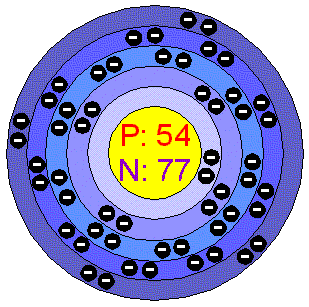
Write down the symbol and mass of this compound
(Example: He-4, C-14, K-42)
Xe-131
400
What happens to the energy of the electron when it moves from the ground state to a higher orbital (excited state)?
The amount of energy of the electron increases.
500
This model of the atom requires highly complex calculus and quantum mechanics to predict where an electron is located within a cloud of probability.
Wave-Mechanical Model (or Quantum Model)
500
State the full electron configuration of Lead.
2-8-18-32-18-4
*denotes the presence of 2-8 for elements above 72.
500
Atoms in this group cannot form ions because they are already stable.
Group 18 elements (noble gases).
500
This subatomic particle has an extremely small mass compared to a proton (0.05% the mass)
electron
(we don't even calculate the mass of an electron when we find atomic mass)
500
Show a correct numerical setup to find the average atomic mass.
He-4 --> 99%
He-3 --> 1%
((4*99%)+(3*1%))/(100)
500
What happens (aside from energy decreasing) when an atom moves from the excited state to the ground state?
A photon (light) is emitted