Enzymes
Energy pathways
Energy Pathways cont.
Still Energy Pathways
Miscellaneous
100
Label the Graph Below
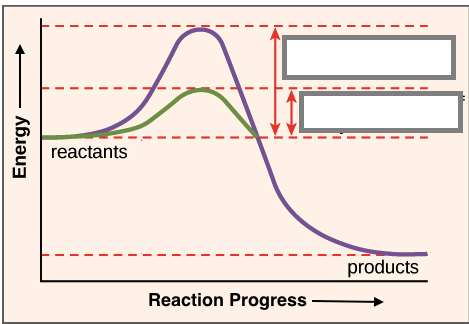
Purple Line (Activation energy without a catalyst)
Green Line (Activation energy with a catalyst)
The enzyme lowers the activation energy (energy required to start a reaction).
100
This cycle releases CO₂ and builds NADH and FADH₂ while finishing glucose breakdown.
What is the Krebs Cycle/Citric acid cycle?
100
This molecule accepts electrons at the end of the ETC to become water.
What is Oxygen?
100
This gas is consumed by plants but produced by animals during cellular respiration.
What is CO₂?
100
This process that occurs specifically in the stroma uses CO₂ to produce glucose.
What is the Calvin Cycle?
200
The region of an enzyme that binds specifically to a substrate.
What is the active site?
200
This type of chemical reaction dominates Krebs by removing electrons from carbon-based molecules and transferring them to carriers.
What is oxidation Oxidation (redox)?
200
The intermembrane space becomes positively charged because of this particle in aerobic mitochondria.
What is Proton (H⁺)?
200
This pigment absorbs light and reflects green wavelengths.
What is Chlorophyll?
200
Why are photosynthesis and cellular respiration considered complementary?
What is because photosynthesis produces oxygen and glucose, which are used in cellular respiration, and cellular respiration releases carbon dioxide and water, which are used in photosynthesis?
300
When heat or pH breaks an enzyme’s 3D structure, this occurs.
What is Denaturation?
300
In the citric acid cycle, most harvested energy is temporarily stored in these high-energy electron carriers, not ATP itself.
What are NADH & FADH₂?
300
From one molecule of glucose, the total NADH formed in the Krebs cycle.
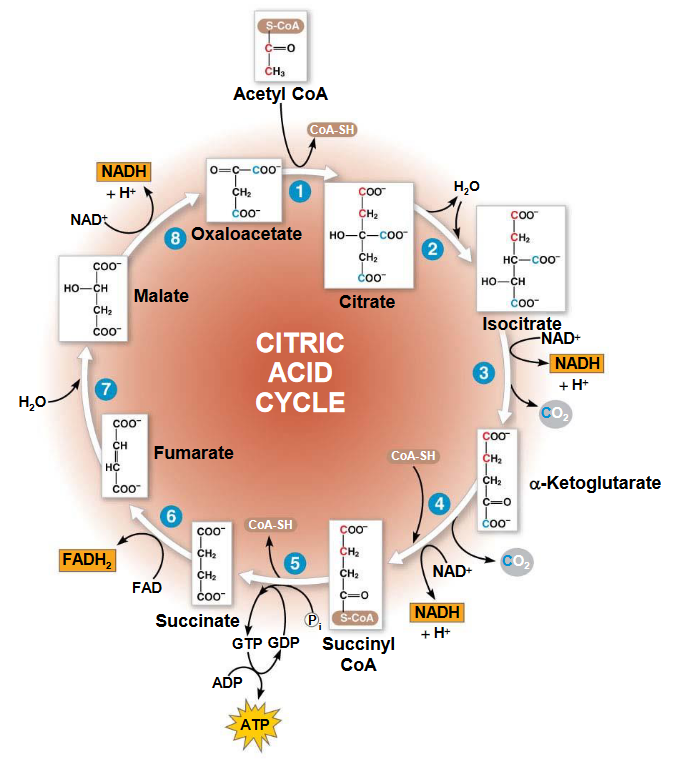
What are 6 NADH?
300
The site inside the chloroplast where the Calvin Cycle occurs.
What is the Stroma?
300
The 1st stage of cellular respiration
What is glycolysis?
400
This inhibition type blocks substrates by binding to the active site.
What is competitive inhibition?
400
Krebs alone yields only 2 ATP per glucose, but remains essential because it generates molecules that power this later ATP-producing process.
What is Oxidative phosphorylation?
400
Enzyme that uses the proton gradient to phosphorylate ADP into ATP.
What is ATP Synthase?
400
This type of metabolism occurs without oxygen.
What is anaerobic respiration (fermentation)?
400
Which stage of aerobic respiration produces the most ATP?
What oxidative phosphorylation/ETC?
500
Enzyme regulation method where end products shut down earlier pathway steps.
What is feedback inhibition?
500
Daily Double: Even though intermediate molecules change, this 2-carbon compound must form to connect glycolysis to mitochondrial energy harvest.
What is Acetyl CoA?
500
Daily Double: The carbon molecule that enters Krebs after acetyl CoA combines with oxaloacetate.
What is Citrate?
500
Daily Double: These complexes use light to “boost” electrons during the light reactions phase.
What are Photosystem I and Phostosystem II?
500
Write out the equation for photosynthesis and cellular respiration.
Cellular Respiration
C6H12O6+6O2→6CO2+6H2O+Energy (ATP)
Photosynthesis
6CO2+6H2O+Light Energy→C6H12O6+6O2