Vocabulary
Food Chains and Food Webs
Energy Calculations
Oxygen and Carbon Cycle
Mr. David Fun Facts
100
This level of consumers eat trophic level 2/herbivores.
Tertiary Consumers/Carnivores.
100
The first part of the food chain
Producers
100
Where does all energy originate from on Earth?
Sun
100
What is the most common state of matter for Carbon?
Gas
100
Which store does Mr. David not shop at?
Target!
100
These are animals that consume both meat and plants.
Omnivores.
100
Why are decomposers important for ecosystems?
Decomposers return nutrients back into the food web and/or release CO2 back into the atmosphere.
100
How does sunlight get turned into usable energy?
Photosynthesis
100
How do humans create more carbon gas in the atmosphere (Not cellular respiration)?
Carbon emissions (fuel, factories, engines)
100
What is Mr. David's fastest mile time?
6:20 minutes
100
This is the method in which carbon is recycled throughout the Earth.
Carbon Cycle.
100
If multiple predator species rely on this species of prey in a food web, the prey can be best described as
Keystone Prey.
100
What is the theoretical amount of energy that is moved up between each trophic level?
10%
100
How do most animals provide carbon dioxide for the atmosphere?
Cellular Respiration
100
What is Mr. David's favorite Disney movie
Wall-E
100
This vocab word describes the method in which toxins build up in an INDIVIDUAL organism
Bioaccumulation.
100
A grasshopper is a great example of what type of consumer?
Herbivore/primary consumer
100
If a mouse has 1250 J of energy that loses 900 J to growth and 300 J to metabolism, how much energy is remaining?
50 J of energy
100
How does oxygen usually get reintroduced back into the atmosphere?
Photosynthesis
100
What is Mr. David's favorite animal?
Hermit Crab
100
This type of predator usually has the lowest population density
Apex Predator
100
Where does all toxins end up in a food chain?
The apex predator/tertiary consumer.
100
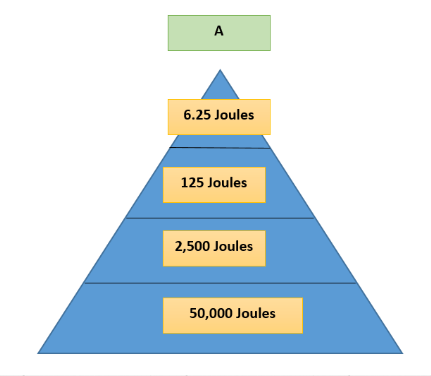 What is the percentage of energy transferred between trophic level 2 and trophic level 3?
5% is actually transferred.
100
Which produces more oxygen in general, grass or trees?
Trees
100
What is Mr. David's favorite desert?
Cheesecake