Allergies
Pathogens
Second Line
Third Line
BONUS
100
State a communicable and non communicable disease
Communicable: COVID, Shingles
Non-communicable: Cancer, diabetes
100
State a non-cellular pathogen
Virus, prions, viroids
100
TRUE OR FALSE: Tinia (athletes foot) is a fungal infection
TRUE
100
Differentiate between MHC I and MHC II markers
MHC I on all nucelated cells, MHC II on APCs
100
Name a physical, chemical and microbial barrier in humans
Intact keratinised skin, Lysozymes, Gut microbiota
200
Name 2 types of granulocytes and the chemicals they release
Mast cells: histamines, Eosinophils: cytotoxic chemicals
200
Describe how a prion infects and spreads
Prions are misfolded proteins that misfild other proteins
200
State the 3 classes of cells in the second line of defence and an example of each
Inflammatory (mast cells), Phagocytic (macrophages) and Cytotoxic (NK cells)
200
State where lymph nodes are in the body
BONUS: How does lymph get there?
Neck, armpits and groin
Locomotion/contraction of muscles
200
Describe 2 types of vaccines
Live attentuated: Genetically weakened pathogen
Subunit: Part of a pathogen
DNA/RNA: Genetic component of virus used
300
Describe how allergies are formed
An excess of IgE antibodies on mast cells that increase sensitivities to allergens
300
Draw the structure of a virus

300
Discuss the function of compliment proteins and where they function
Circulate in the blood and target bacterial cells: creating MAC, opsonise
300
Compare the second line and third line of defence
Similarity: Both fight pathogens and protect the body
Difference: Second line is non specific, third line is specific
300
Name the system and fluid that that transports pathogens and antigen fragments
Lymphatic system and interstitial fluid
400
Justify whether allergens can be considered antigens
No, allergens do not cause disease for all individuals hence are not antigens
400
Outline the different functions of pathogenic bacteria and normal flora
Pathogenic bacteria: cause infections, Normal flora: protects humans, outcompetes pathogenic bacteria, digest and ferment
400
Compare Neutrophils and Macrophages
Both cells engulf and digest pathogens but macrophages are an APC while neutophils are not
400
State where T cells and B cells are produced and matured
Both produced in bone marrow, T cells mature in THYMUS and B cells mature in BONE MARROW
400
State an example of each type of immunity.
Differentiate between active and passive immunity.
Getting sick, breastfeeding, antivenom, vaccinations
Active = making own antibodies, passive = antibodies given
500
Explain how prior exposure to peanut protein can result in such a rapid and potentially severe response following subsequent exposure.
- First exposure → B cell activation and differentiation into plasma cells, production of peanut-specific IgE
- IgE binds to receptors on mast cells, sensitising them
- Subsequent exposure → peanut allergen cross-links IgE on mast cells.
- Mast cells degranulate → histamine release → vasodilation, increased vascular permeability and producing allergy symptoms
500
Define antigenic shift and it's consequences
A pathogen has a high mutation rate and its surface antigens frequently change, making it difficult to provide long-term protection.
500
Outline the inflammatory response
1 - Initiation: Mast cells detect damage and release histamines
2 - Vasodilation: increase blood flow to site of infection
3 - Increased permeability and chemoattractant for more immune cells to site of infection
500
Draw the antibody exposure graph to a pathogen and label the 4 key points

500
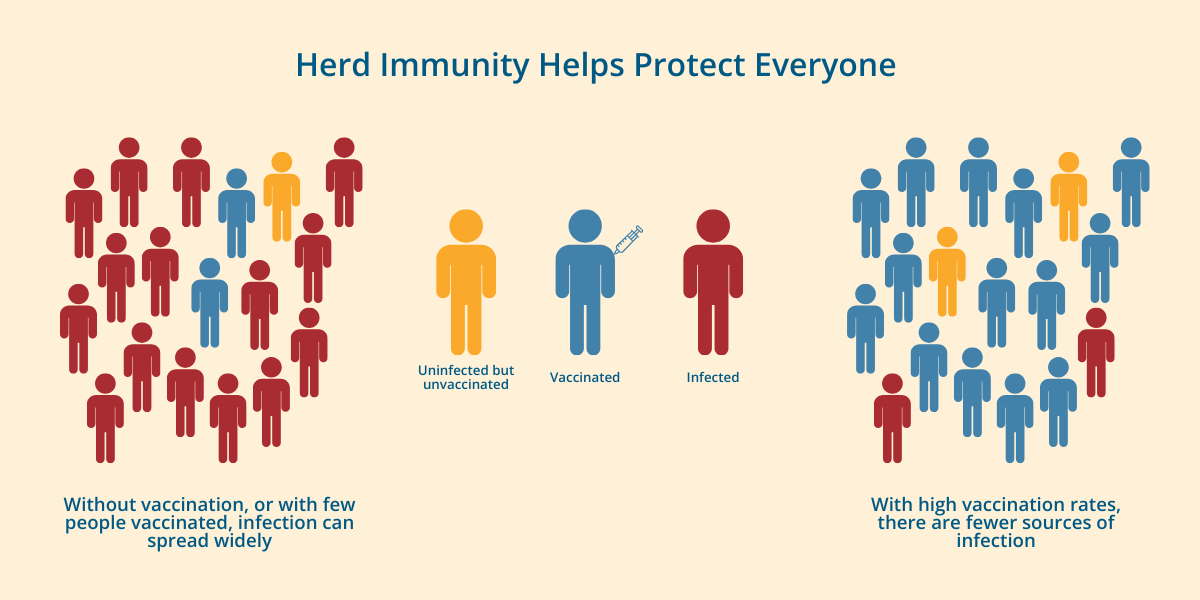
Define herd immunity and draw a diagram demonstrating how it protects the immunocompromised
A high proportion of the population being immunised and developing immunity to a pathogen