On point
All in the Family
Around the Corner
Call the Medic
Mixed Bag
100
The instantaneous velocity at
t=4
when a particle moves along a line so that it's position s at any time
t>=0
is given by
s(t)=t^3-4t^2+t+3
where s is measured in meters and t is measured in seconds.
What is 17 m/sec ?
100
The sides of the rectangle below increase in such a way that dz/dt=1, and dx/dt=3dy/dt, at the instant that x=4 and y=3, what is the value of dx/dt? [note" z is the diagonal and x & y are the length and width.]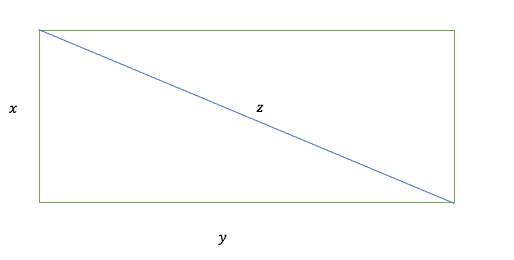
What is dx/dt=1
100
The slope of the line tangent to the graph of
y=ln(x/2)
at x=4
What is 1/4
100
lim_(x->0)(sin 4x)/(2x)
What is 2
100
Find the rate at which the area of a circle is changing when the radius is 3 and is increasing at a rate of 3/2 inches per second.
What is
9pi
in2/sec
200
The acceleration of the particle at
t=4
when a particle moves along a line so that it's position s at any time
t>=0
is given by
s(t)=t^3-4t^2+t+3
where s is measured in meters and t is measured in seconds.
What is 16m/sec2
200
The volume of a cone of radius r and height h is given by
V=1/3pir^2h
If the radius and the height both increase at a constant rate of 1/2 cm/sec, at what rate is cm3/sec is the volume increasing when the height is 9 cm and the radius is 6 cm?
What is
24pi cm^3 per sec
200
An equation of the line tangent to the graph of
f(x)=x(1-2x)^3
at the point (1,-1)
What is
y=-7x+6
or
y+1=-7(x-1)
200
lim_(x->0) xsin(1/x)
What is 0
200
Estimate the velocity at t=1.8 seconds of a particle whose position is given at various points in the table below.
What is 9 ft/sec
300
t=__ is (are) where a change in direction occurs for a particle that moves along a line so that it's position s at any time
t>=0
is given by
s(t)=t^3-9t^2+15t-4
where s is measured in meters and t is measured in seconds.
What are t=1, t=5 ?
300
The area of a circular region is increasing at a rate of
96pi
square meters per second. When the area of the region is
64pi
square meters, how fast in meters per second is the radius of the region increasing?
What is 6 m/sec
300
The equation of the line tangent to the graph of
y=cos(2x)
at
x=pi/4
What is
y=-2(x-pi/4)
300
lim_(x->0) (sqrt(4-x^2)-2)/(x)
What is 0
300
The point on the graph of
y=1/2x^2
is the tangent line parallel to the line
2x-4y=3
What is
(1/2,1/8)
400
The speed of a particle whose velocity at time t seconds, when
t>=0
is given by
v(t)=5t^3-12t^2-12t+4
each time its acceleration is zero.
What is 28 m/sec ?
400
The radius of a sphere is increasing at a uniform rate of 0.3 inches per second. At the moment that the surface area S becomes
100pi
square inches what is the rate of increase in cubic inches per second in the volume V?
[S=4pir^2 and V=4/3 pir^3]
What is
30 pi
cubic inches per second.
400
The tangent line equation for
f(x)=tan^2x
at
(pi/4,1)
What is
y-1=4(x-pi/4)
400
lim_(x->2)(e^(x^2)-e^4)/(x-2)
What is
4e^4
400
The total distance traveled over the interval t=1 to t=2, of a point which moves in a straight line so that the distance at time t from a fixed point of the line is 8t-3t2.
What is
5/3
500
The interval where the particle speeds up whose position is given by
x(t)=2t^3-14t^2+22t-5
where t is measured in seconds,
t>=0
and x is measured in meters.
What is
(0,1)uu(11/3,oo)
500
A person 2 meters tall walks directly away from a streetlight that is 8 meters above the ground. If the person is walking at a constant rate and the person's shadow is lengthening at the rate of 4/9 meters per second at what rate in meters per second, is the person walking?
What is
4/3
m/sec
500
Approximate the value f(2.1) on the curve of
f(x)=1/3xsqrt(x^2+5)
given the tangent line equation at (2,2), and state whether it is an over or under approximation.
What is 2.2 this is an underestimate
500
lim_(x->pi/2)(tan3x)/(tan5x)
What is
5/3
500
Find
lim_(x->0)(sin^-1x)/(xcos^-1x)
What is
2/pi