Continental Clues
Boundary Detectives
Fossil Forensics
Rock Movers
Volcano & Rock Lab
100
The supercontinent that explains matching Mesosaurus fossils on South America and Africa.
What is Pangea?
100
On the Age of Oceanic Lithosphere map, what do the dark dotted lines between continents mark?
Tectonic plate boundaries
100
The Mesosaurus fossil distribution is evidence for what past process?
Plate tectonics / past plate motion
100
In Figure 4 (coastal photo), which letter labels the beach material?
C
100
What type of rock forms when molten magma or lava cools and solidifies?
What is igneous rock?
200
The mesosaurus could only swim short distances in water. Finding its fossils on separate continents supports this theory of Earth's pase.
What is the continental drift theory or theory of plate tectonics?
200
Where is the youngest oceanic crust found according to Figure 1 and Figure 2?
At mid-ocean ridges / divergent boundaries
200
Why is Mesosaurus fossil distribution especially convincing evidence that continents were once joined?
It was a freshwater swimmer that couldn't cross oceans, so matching fossils on separated continents imply those lands were joined
200
What process most likely moved material from mountains (D) to the beach (C)? *Name the process AND the agent(s)*
Weathering and erosion by water/waves
200
Which rock type is formed from compacted and cemented sediments?
Sedimentary
300
From the fossil evidence map - these two continents fit together pretty well like puzzle pieces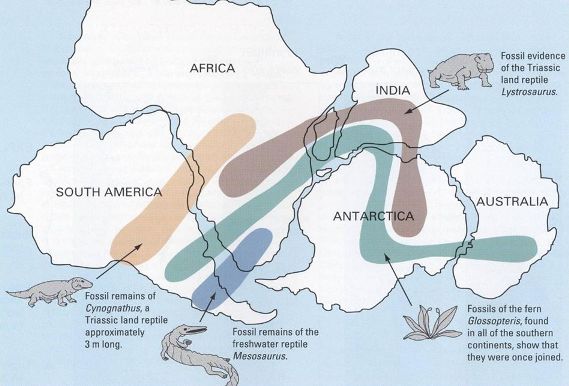
What is South America/Africa, Africa/India, Antarctica/Australia, Africa/Antarctica?
300
Which plate boundary type recycles oceanic crust into the mantle at trenches?
Convergent boundary / subduction
300
Fill in the blanks from the assessment: The Mesosaurus fossils can be found on many continents because of __1___; when you fit South America and ___2__ together, the places where the ___3__ were found match up
1. plate tectonics
2. Africa
3. fossils
300
According to Figure 4 (coastal photo), how long did it likely take for mountain rock (D) to become beach sediment (C)?
Between thousands and millions of years
300
According to Figure 5 and the rock cycle, how does heat from Earth's interior produce magma that can erupt at Yellowstone?
Heat from the mantle melts crustal rock forming magma that can rise to the surface
400
Matching rock types and coastlines help to support that the continents were once connected in what way?
Regions of continents share similar types of rocks and fit together, showing that they were once attached.
400
On the ocean lithosphere age map, which color (lighter or darker) represents younger sea floor near ridges?
Lighter color represents younger sea floor at ridges
400
Give one specific reason (from the test language) why fossils and fitting continental coastlines are used together as evidence of past plate motion.
They show that places where fossils were found match up when continents are fit together, indicating they were once attached
400
What process turns loose beach sediment into sedimentary rock?
Deposition, compaction, and cementation / lithification
400
Which answer best explains why Yellowstone eruptions are examples of rapid catastrophic events?
The eruption of a supervolcano like Yellowstone releases massive energy and leads to sudden, dramatic changes
500
Using the fossil evidence map and age of oceanic lithosphere map, these two pieces of evidence show that show continents separated over time (be specific).
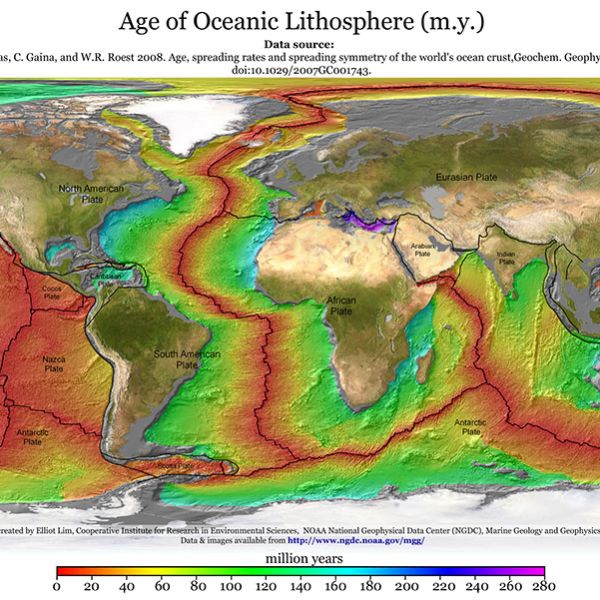
What are matching fossils found in continents; seafloor age shows new crust formation that pushed the plates apart over millions of years?
500
Explain why there is very little oceanic crust older than ~280 million years using the oceanic lithosphere map?
Oceanic crust is recycled at ocean trenches (subduction), so old crust is consumed and replaced by new crust at ridges
500
Using the Fossil Evidence Map, describe how fossil distribution and seafloor age together provide both biological and physical evidence for past plate movement.
Fossils show organisms lived across connected landmasses; seafloor age shows mechanism (new crust at ridges) and timing for how plates separated
500
If beach material (C) were buried and exposed to heat and pressure, which rock type would it most likely become and why?
Metamorphic — because burial + heat/pressure change sedimentary rock into metamorphic rock
500
Using the rock cycle (Figure 6) and the Yellowstone example, describe how volcanic eruptions contribute to the cycling of matter through the rock cycle (be sure to mention igneous, sedimentary, and metamorphic outcomes).
Eruptions produce lava and ash that cool into igneous rock; ash and eroded volcanic material become sediment that can form sedimentary rocks; heat from magma and intrusions can metamorphose nearby rocks