Darwin
Evolution & Evidence
Effects of Evolution
Cell Transport
Review
100
In an attempt to explain the diversity of living things, Darwin's theory of natural selection
(1) proved evolution took place
(3) showed that only the largest animals survive
(2) described how mutations produced variations
(4) described how evolution could have occurred
(4) described how evolution could have occurred
100
Information that scientists are able to obtain from the fossil record includes
(1) confirmation that Earth is 4.5 million years old
(2) data supporting the hypothesis that animal species do not change over time
(3) the exact means by which life on Earth began
(4) evidence about past environments and the history of life
(4) evidence about past environments and the history of life
100
Geographic and reproductive isolation are most closely associated with
(1) speciation
(2) extinction
(3) overproduction
(4) competition
(1) speciation
100
A root hair cell may continue to absorb minerals
even though the cytoplasmic concentration of
these minerals is greater inside the cell than in
the soil. This absorption is accomplished chiefly
as a result of
(1) passive transport
(2) active transport
(3) diffusion
(4) osmosis
(2) active transport
100
The graph below represents the rate of a chemical reaction involving a particular human enzyme that breaks down starch.

The most likely reason the action of the enzyme decreases after 40°C is that
(1) the DNA in the enzyme mutates and can no longer break down the starch
(2) enzymes die after working for a long period of constant activity in the body
(3) the shape of the enzyme changes due to environmental conditions
(4) as the temperature of the enzyme rises, the pH of the environment changes, deactivating the enzyme
(4) as the temperature of the enzyme rises, the pH of the environment changes, deactivating the enzyme
200
Darwin was unable to explain completely his theory of evolution because he lacked knowlege of
(1) natural selection
(3) survival of the fittest
(2) overproduction
(4) the source of variations
(4) the source of variations
200
The term "evolution" is best described as
(1) a process of change in a population through time
(2) a process by which organisms become extinct
(3) the reproductive isolation of members of certain species
(4) the replacement of one community by another
(1) a process of change in a population through time
200
Over a long period of time the organisms on an island changed so that they could no longer interbreed with the organisms on a neighboring island. This inability to interbreed is known as
(1) hybridization
(2) reproductive isolation
(3) artificial selection
(4) survival of the fittest
(2) reproductive isolation
200
Since cyanide is a poison that limits a cell's
ability to manufacture ATP, a cell containing
cyanide is least likely to carry on the process of
mount?
(1) passive transport
(2) osmosis
(3) active transport
(4) diffusion
(3) active transport
200
The equation below summarizes the process that produces the flashing light of a firefly. The molecule luciferin is broken down, and energy is released in the form of heat and light. In this process, luciferase functions as

(1) a reactant
(2) a substrate
(3) an inorganic catalyst
(4) an enzyme
(4) an enzyme
300
Natural selection can best be defined as
(1) survival of the strongest organisms
(2) elimination of the smallest organisms by the largest organisms
(3) survival of those organisms genetically best adapted to the environment
(4) survival and reproduction of those organisms
that occupy the largest area in an environment
(3) survival of those organisms genetically best adapted to the environment
300
The theory that birds and reptiles share common ancestry is supported by the evidence that they both
(1) occupy similar niches
(2) have similar environmental requirements
(3) show structural similarities during their development
(4) have evolved as separate groups at about the same time
(3) show structural similarities during their development
300
The species of finches that Darwin found on the Galapagos Islands displayed different structural and behavioral adaptations. These adaptations differed among the species according to the birds' varying habitats. Such adaptations most likely evolved as a result of
(1) use and disuse
(2) transmission of acquired characteristics
(3) reproductive isolation
(4) geographic isolation
(4) geographic isolation
300
After a cookie has been digested, glucose
molecules enter the bloodstream by the process
of
(1) phagocytosis
(2) diffusion
(3) ingestion
(4) pinocytosis
(2) diffusion
300
Protein synthesis is accomplished primarily by the interaction of which two cell structures?
(1) vacuoles and mitochondria
(2) ribosomes and vacuoles
(3) nuclei and ribosomes
(4) nuclei and mitochondria
(3) nuclei and ribosomes
400
The diagram below represents a taxonomic tree showing the possible evolution of six species of finches 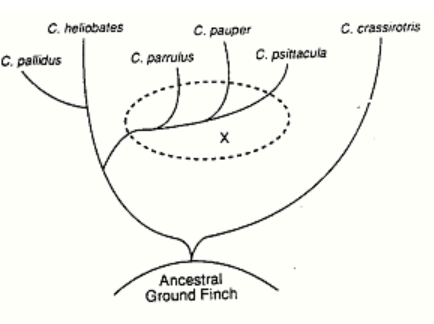
The most likely explanation for the branching pattern seen in the circled region labeled X is that
(1) environmental changes resulted in extinction
(3) no speciation occurred during this time
(2) speciation occurred as a result of inbreeding
(4) environmental changes influenced speciation
(4) environmental changes influenced speciation
400
tudies that reveal the similarities in the development that occurs in reptile eggs and bird eggs are often used to
trace possible pathways of evolution. These studies are part of the research in the field of comparative
(1) anatomy
(2) embryology
(3) biochemistry
(4) cytology
(2) embryology
400
Geographic isolation of a small population from a main group may contribute to the development of new species.
This speciation is more likely to happen if the members of the geographically isolated population, compared to
the members of the main group, have
(1) an inability to survive environmental conditions
(2) the ability to resist genetic mutations
(3) different environmental factors acting on them
(4) the same initial gene frequencies
(3) different environmental factors acting on them
400
Which statement best describes the plasma membrane of a living plant cell?
(1) It selectively regulates the passage of substances into and out of the cell.
(2) It is composed of proteins and carbohydrates only.
(3) It has the same permeability to all substances found inside or outside the cell.
(4) It is a double protein layer with floating lipid molecules.
(1) It selectively regulates the passage of substances into and out of the cell.
400
In a DNA molecule, if 38% of the molecular bases are C (cytosine), what percent of the bases are T (thymine)?
(1) 12 (3) 38
(2) 24 (4) 62
(1) 12
500
A new finch is found to have a diet of worms and caterpillars. Identify one finch from the diagram that would have a beak most similar to the new finch. Support your answer
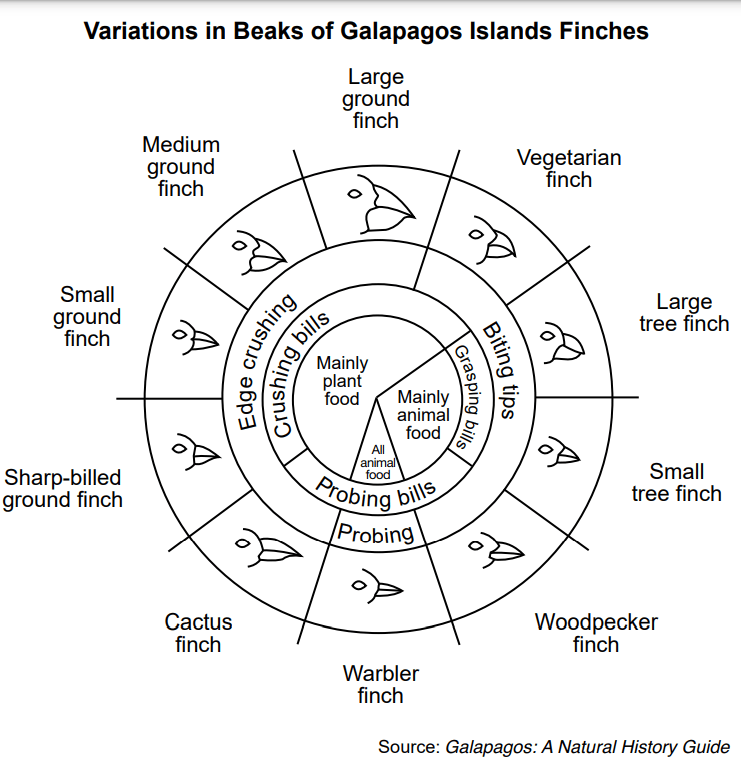
— warbler finch, because it eats all animal food
— small tree finch, because it eats mainly animal food
— large tree finch, because it has a biting/grasping beak that would allow it to pick up and crush caterpillars and worms
— woodpecker finch, because it eats mainly animal food
500
The diagram illustrates the evolution of tetrapods. A tetrapod is a four-footed animal.

The changes observed over time occurred as the organisms
(1) needed to change the habitat where they lived from land to water
(2) needed to change the habitat where they lived from water to land
(3) developed variations that made it possible for them to move from land to water
(4) developed variations that made it possible for them to move from water to land
(4) developed variations that made it possible for them to move from water to land
500
The American toad breeds earlier in the spring than the Fowler's toad does. Therefore, they do not interbreed,
even though they often live in the same habitat. Which conclusion can best be drawn from this information?
(1) The two species do not interbreed because of geographic isolation.
(2) The two species do not interbreed because of a form of reproductive isolation.
(3) Adaptive mutations occurred more often during the evolution of the American toad.
(4) Fowler's toad has a higher rate of survival than the American toad does
(2) The two species do not interbreed because of a form of reproductive isolation.
500
The diagram below illustrates the movement of glucose across a cell membrane

Which two processes are most directly represented in this diagram?
(1) ATP synthesis and the diffusion of water
(2) molecule transport and energy use
(3) homeostasis and ATP synthesis
(4) homeostasis and the diffusion of water
(2) molecule transport and energy use
500
Levels of organization in humans are represented below

Level X most likely represents
(1) molecules (3) tissues
(2) organelles (4) ribosomes
(3) tissues