Thinkers
Systems
Gilded Age
Progressive Era
Great Depression and New Deal
Tools and Policy
Real World Examples
100
Which economist argued that individuals acting in their own self-interest can benefit society as a whole?
Adam Smith
100
In which economic system do private individuals own and control production and prices are set by the market?
Capitalism
100
Which term refers to companies that dominate an entire industry and eliminate competition?
Monopoly
100
What was the name given to journalists who exposed corruption and social problems during the early 1900s?
Muckrakers
100
Which event triggered the worst economic downturn in U.S. history? (Bonus 100 pts for year)
The Stock Market Crash of 1929
100
What do we call the money a government, business, or person owes to others?
Debt(s)
100
Why is there often economic downturn post-war?
- Reduction in government spending
- Transition from wartime to peacetime production
- Returning soldiers
- Inflation or debt adjustments
- Global economic disruptions
- Structural economic and industry shifts
- Industries and workers to adapt to new types of production and jobs
200
Which economist believed governments should step in during economic downturns to stabilize the economy?
John Maynard Keynes
200
In which economic system does the government controls key industries to reduce inequality and provide basic services?
Socialism
200
Which societal trend brought millions of people to U.S. cities, increasing labor supply?
Urbanization
200
What word describes efforts to improve society and fix problems during the Progressive Era?
Reform
200
Which president believed in limited government intervention during the Great Depression?
Herbert Hoover
200
Which measurement tells us the total value of all goods and services produced in a country?
Gross Domestic Product (GDP)
200
Explain how rising housing prices in recent years demonstrate the effects of inflation
Rising housing prices show inflation because the cost of buying or renting a home increases over time. As demand for housing grows and/or supply is limited, prices go up, meaning people need more money to afford the same home.
For example, a house that cost $300,000 in 2019 might now cost $450,000 in 2024. The same house now costs more, so your dollar has less purchasing power and buys less than it did before.
300
Which economist is most closely associated with criticism of capitalism and the development of communism?
Karl Marx
300
In which theoretical system are there are no class distinctions and all property is publicly owned there are no class distinctions and all property is publicly owned?
Communism
300
What type of housing was overcrowded and commonly found in urban areas during the Gilded Age?
Tenement Housing (Tenements)
300
Which law aimed to break up monopolies and restore competition? (Bonus 100 pts for providing the year)
Sherman Antitrust Act (1890)
300
Which president introduced the New Deal to combat economic collapse?
FDR (Franklin Delano Roosevelt)
300
What is the formula for calculating GDP using a expenditure model? (bonus 50 pts for each correctly labeled letter (what do the letters stand for)?
GDP = C + I + G + NX
300
Explain how government stimulus or relief checks, like the COVID-19 stimulus payments, are an example of expansionary fiscal policy
Stimulus checks give people extra money to spend, boosting the economy. How much gets spent depends on the marginal propensity to consume (MPC). For example, if people spend 80% of the check, that money becomes income for others. This creates a multiplier effect, showing how government spending can increase overall economic activity.
400
Which concept explains how self-interest can unintentionally lead to positive outcomes for society?
The invisible hand
400
Which economic system is most closely aligned with the ideas of John Maynard Keynes?
Mixed Economy or Mixed-Market Economy
400
Name the noteworthy "robber barons"/tycoons of the Guilded Age and the industry they dominated
(50 points for each correct answer (8 total answers)
- John D. Rockefeller – Oil
- Andrew Carnegie – Steel
- Cornelius Vanderbilt – Railroads
- J.P. Morgan – Banking/Finance
400
During the Progressive Era, the 16th-19th constitutional amendments were passed. State the purpose of each amendment. (100pts each)
- 16th Amendment – Income Tax (1913)
- 17th Amendment – Direct election of U.S. Senators (1913)
- 18th Amendment – Prohibition of alcohol (1919–1933)
- 19th Amendment – Women’s right to vote (1920)
400
What do the three Rs of the New Deal stand for?
Relief, Recovery, Reform
400
What type of fiscal policy involves increasing government spending or cutting taxes?
Expansionary Fiscal Policy
400
Explain how raising taxes can be an example of contractionary fiscal policy and help slow inflation
Raising taxes means people spend less. With lower demand, prices do not rise as quickly and sometimes even fall, which helps slow inflation
500
Who was the first woman to serve in a U.S. presidential cabinet and helped create Social Security while improving labor protections during the New Deal?
Frances Perkins
500
What feature of capitalist economic systems allowed industrialists to accumulate enormous wealth during the Gilded Age?
Minimal/limited government regulation/intervention
500
What is it called when a company/corporation acquires or merges with direct competitors operating at the same production level in the same industry
Horizontal Integration
500
Which system/institution was created to help reduce the frequency of bank failures and financial panics during the Progressive Era
The Federal Reserve
500
What is the name of the concept popularized during the New Deal Era where one person’s spending becomes another person’s income?
The Multiplier Effect or Keynesian Multiplier
500
Label the business cycle:
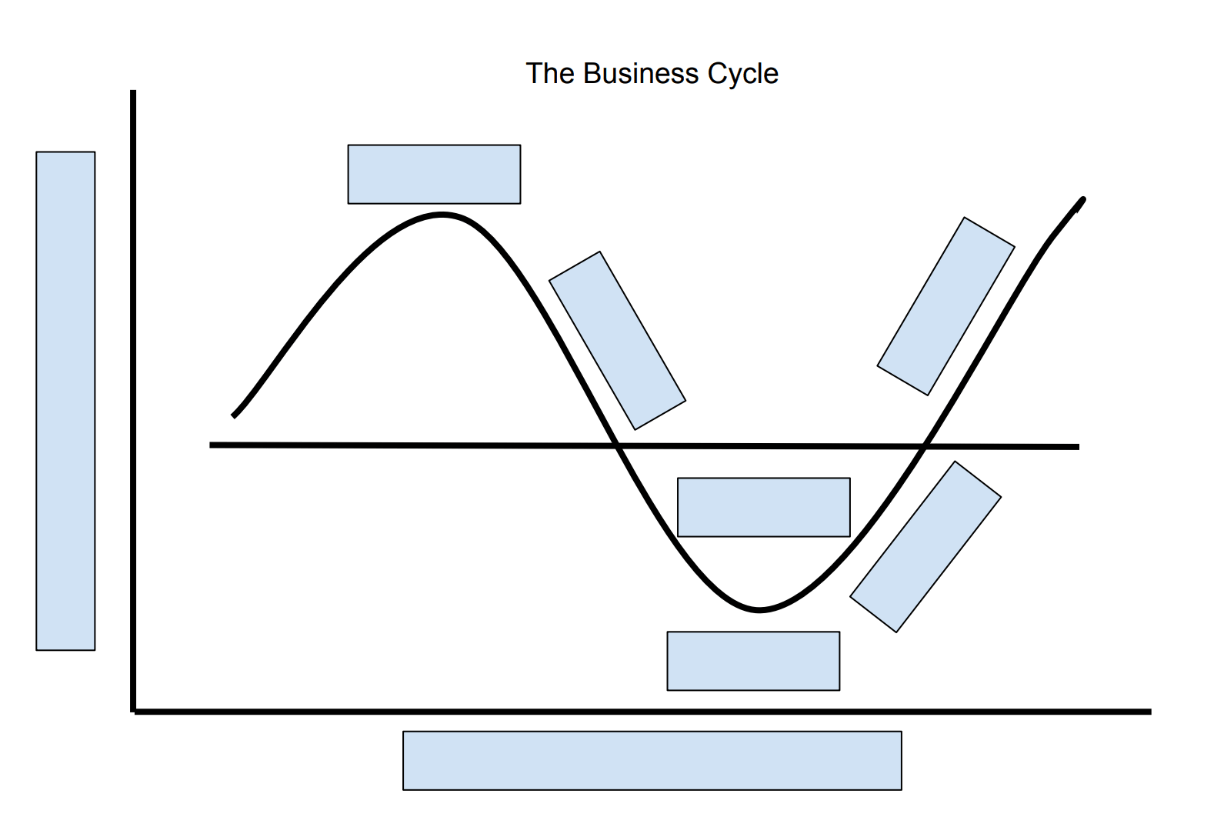
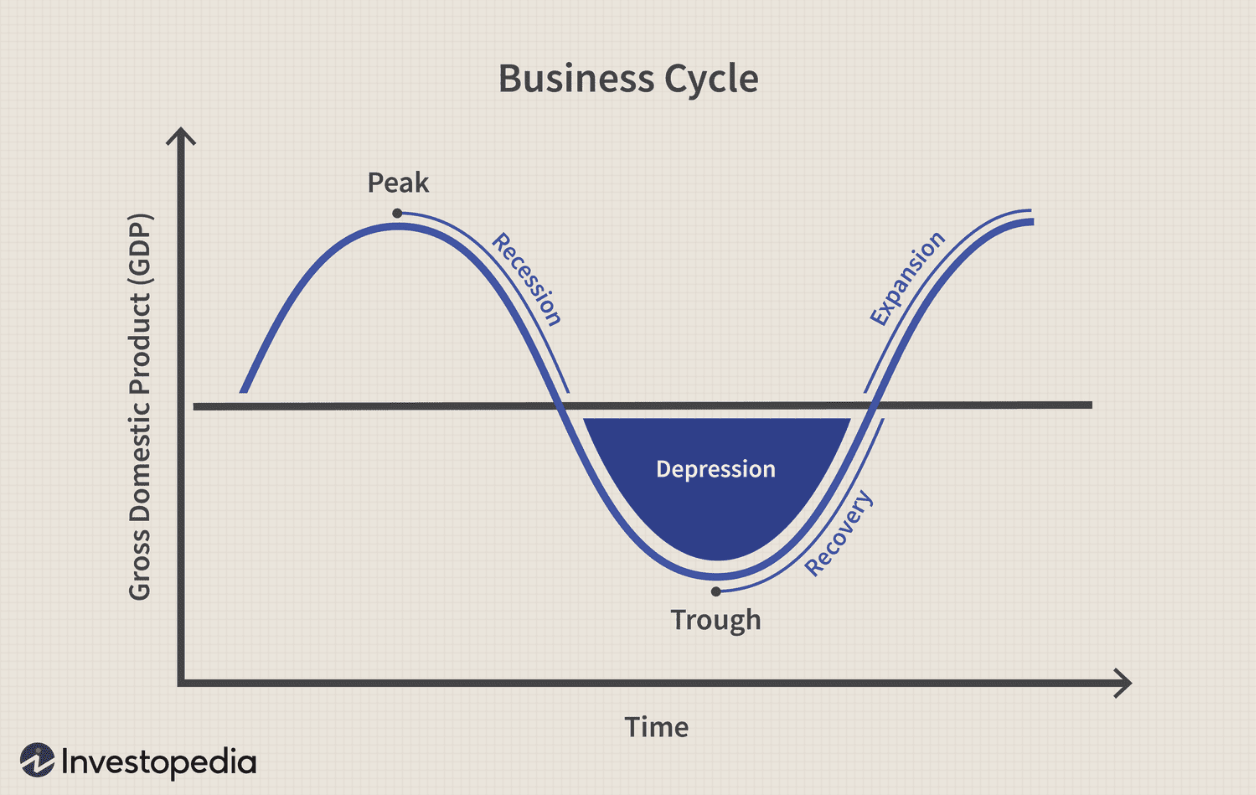
500
Even though the U.S. has developed antitrust laws, greater labor protections, and more government regulation, there is still immense wealth inequality. Provide two reasons as to why this is still the case
- Globalization and technology create huge profits for top companies, often benefiting executives and investors more than workers
- Tax policies sometimes favor the wealthy (lower capital gains, lower corporate taxes)
- Labor unions are smaller today, giving workers less bargaining power for higher wages.
- Some regulations and reforms have slowed but not reversed wealth concentration; money and investments still grow faster than wages for most people.