Mitosis
DNA Structure & Replication
Meiosis
Mendelian Genetics
100
Define the word genome.
The entire collection of DNA in an organisms cell.
100
What is complimentary base pairing?
Purines pair with pyrimidines (A-T, G-C)
100
What is the main evolutionary advantage of sexual reproduction?
Genetically unique offspring
100
Imagine that you are performing a cross involving seed color in garden pea plants. What traits would you expect to observe in the F1 offspring if you cross true-breeding parents with green seeds and yellow seeds? Yellow seed color is dominant over green.
only yellow seeds
200
Define the word Diploid.
Refers to an organism that has two sets of chromosomes.
200
Prokaryotes contain a ________chromosome, and eukaryotes contain ________ chromosomes.
double-stranded circular; double-stranded linear
200
In the diploid stage of the life cycle of animals, _________________ results in the formation of _________________.
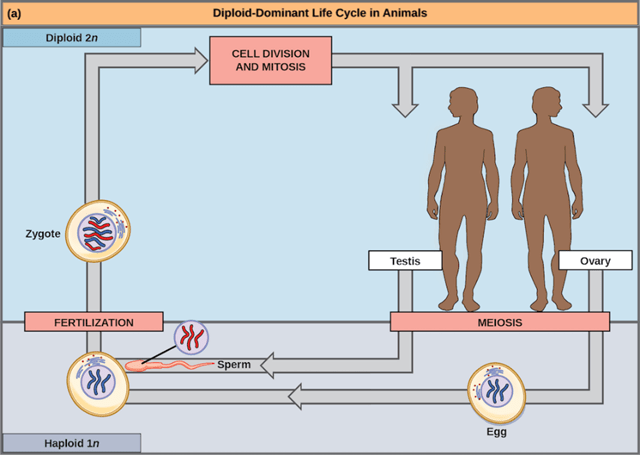
Mitosis, somatic cells
200
The observable traits expressed by an organism are described as its ________.
phenotype
300
What are homologous chromosomes?
The two sets of chromosomes found in a diploid individual.
300
DNA replicates by which of the following models?
semiconservative
300
In animals, the fusion of egg and sperm results in the formation of
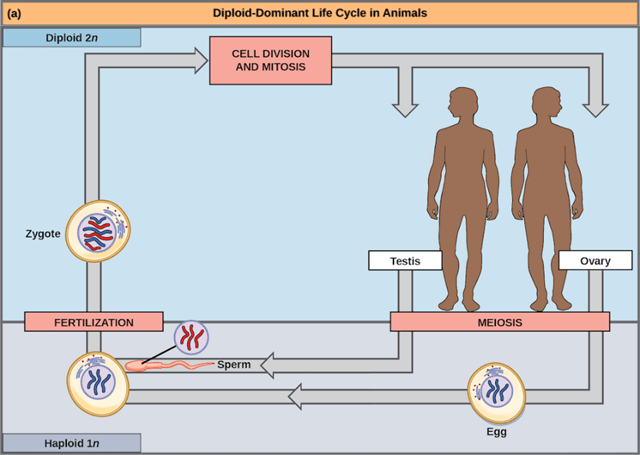
A diploid zygote
300
The genetic traits possessed by an organism are described as its ________.
genotype
400
What is a locus?
The specific location of a gene on a chromosome
400
With respect to the organization of eukaryotic chromosomes nucleosomes are ___________________.
DNA wrapped around proteins called histones
400
In the haploid dominant fungal lifecycle miosis happens within the _______________ and results in the formation of ___________________.
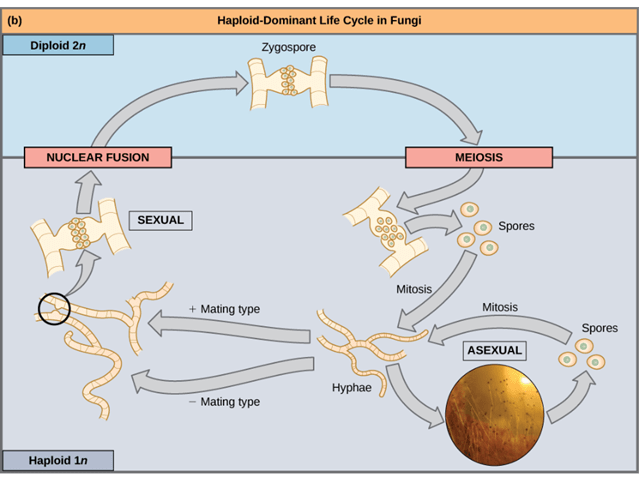
Zygospore, spores
400
What are the types of gametes that can be produced by an individual with the genotype AaBb?
AB, Ab, aB, ab
500
What is a chromosome?
A very long DNA molecule that is packaged for cell division.
500
With respect to DNA replication, why is one side of the origin of replication synthesized in fragments?
Because DNA polymerase can only synthesize DNA in the 5’ to 3’ direction.
500
The lifecycle of ferns is distinguished by_______________.
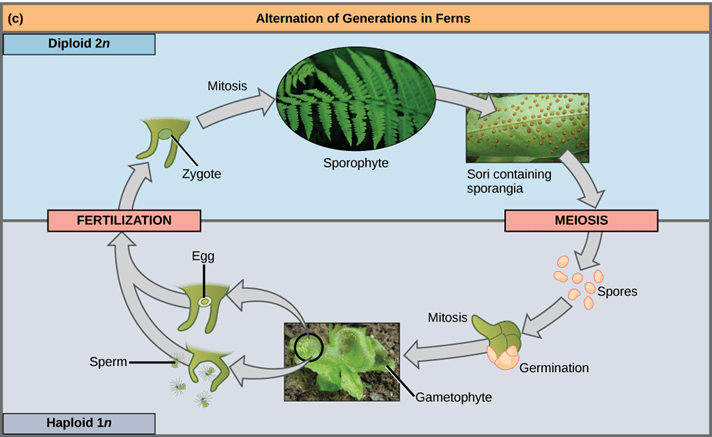
The alternation of diploid and haploid stages in two separate structures.
600
A pair of duplicated chromosomes joined by a centromere are called
sister chromatids
600
Is DNA always present in the form of chromosomes in the nucleus of a cell?
No, DNA is packaged into chromosomes in preparation for cell division
600
Name this meiotic stage: A cell has a haploid number of chromosomes, but each chromosome has two chromatids. The chromosomes are arranged singly at the center of the spindle.
Metaphase II
700
A diploid cell has ________ the number of chromosomes as a haploid cell.
twice
700
What aspect of DNA makes the semiconservative model of DNA replication possible?
Complimentary base pairing
700
Which type of life cycle has both a haploid and diploid multicellular stage?
alternation of generations
800
An organism’s traits are determined by the specific combination of inherited ________.
genes
800
What is the name of the primary enzyme that carries out the DNA replication process
DNA polymerase
800
Which event leads to a diploid cell in a life cycle?
fertilization
900
Chromosomes are duplicated during what portion of the cell cycle?
S phase
900
Meiosis produces ________ daughter cells.
four haploid
1000
Separation of the sister chromatids is a characteristic of which stage of mitosis?
anaphase
1000
At which stage of meiosis are sister chromatids separated from each other?
anaphase II
1100
The protein responsible for finalizing cytokinesis in prokaryotes.
FtsZ
1100
If a muscle cell of a typical organism has 32 chromosomes, how many chromosomes will be in a gamete of that same organism?
16