Society in the Middle Ages
The Church's Power
Christian West vs. Islamic World
Mix it up
100
Name the Three Orders of Society and explain the role of each group.
The clergy prayed and cared for spiritual needs,
Lords and knights protected society,
Peasants worked the land and produced food.
100
Name the two powers of the Church.
Spiritual Power & Temporal Power
100
Name three things the Islamic World progressed faster in during the Middle Ages?
Science, Medicine, Mathematics, Arabic Numerals, Literature, Astronomy
100
What mathematical advancement comes from the Islamic World in the Middle Ages that we still use today?
Arabic numerals (1, 2, 3...)
200
Why did the people in this time period believe the orders were necessary?
Each group had a different responsibility that helped society function. It was a system in which they all depended on one another (some for protection, others for support and loyalty), they felt that if one stopped doing their part it would fall apart.
200
Explain the difference between Spiritual and Temporal Power. Give clear examples of each of these powers.
Spiritual Power - everything related to religion and the soul.
- Promised salvation and eternal life.
- Controlled important religious ceremonies called sacraments (such as baptism and marriage).
- Could excommunicate people.
- Influenced how people lived their everyday lives (by fear of offending the Church and God)
Temporal Power - everything related to land, political influence, and wealth (money)
- Collected a tithe (tax representing 10% of earnings or harvest)
- Owned land (churches, monasteries, abbeys)
- Received donations from kings and nobles (land & wealth)
- Became a dominating force in terms of wealth (they were very rich)
200
What is one difference between learning in the Christian West and learning in the Islamic world?
One difference between learning in the Christian West and the Islamic world was that the Islamic world encouraged more scientific study and discovery. In the Christian West, ideas that conflicted with Church teachings were often rejected or discouraged.
200
How could the Church influence someone's daily life even outside of church services?
The Church could influence someone's daily life by teaching people how to live, what was right and wrong, and what rules they should follow. During the Middle Ages, the Church was involved in education, holidays, marriages, and community events. Because religion was an important part of everyday life, many people looked to the Church for guidance and decisions.
300
Which order had the most power? Give two reasons to support your answer.
Your answers may vary; you will get points as long as you have real evidence to support your answer.
Ex: Lords had the most power because they owned the land and had more than one person beneath him who supported him and was loyal to him, if one person breaks their feudal bond, others will continue to keep the system in check.
300
What is "excommunication"? Explain how the Church used this to their advantage.
Excommunication was a punishment used by the Church that excluded a person from important religious activities and membership in the Church.
The Church used excommunication to their advantage by making people obey its rules and teachings. Because religion was very important during the Middle Ages, people feared being excommunicated, so kings, nobles, and ordinary people were more likely to follow the Church's authority.
300
Name two ways Christianity spread and two ways Islam spread.
Christianity: missionaries; kings and rulers converting and spreading Christianity through their kingdoms; strong Church influence in daily life; sometimes conquest during the Middle Ages.
Islam: trade across large trading networks; missionaries; military conquest and expansion; cultural influence in regions that adopted Islam.
300
Explain how the Church and rulers depended on one another in the Middle Ages.
Kings needed the Church because -> The Church gave rulers legitimacy because people believed their authority came from God.
The Church needed Kings because -> Kings and nobles protected the Church and helped spread Christianity.
400
If a lord stopped protecting his vassals, how might the feudal system be affected?
Trust in the system (and the lord himself) would weaken and vassals might stop supporting the lord breaking the balance of the social structure.
400
The Church was organized with a clear hierarchy; show me the hierarchy.
Pope (leader of the Christian Church)
Cardinals
Regular Clergy -> Bishops
-> Priests
Secular Clergy -> Abbot (leader of the monastery)
-> Monks & Nuns
400
What is one similarity between Christianity and Islam during the Middle Ages?
Both spread through missionaries and influenced society, culture, and government. They both had an impact in the daily lives of people at that time.
400
How did the Church affect education in the Christian West? Why did the Church have so much power over learning and knowledge?
The Church influenced education in the Christian West because many monks and clergy were among the few people who could read and write. Monks copied ancient texts in monasteries, which helped preserve knowledge.
This gave the Church control over education, allowing them to teach ideas that matched Church beliefs and decide what knowledge was shared.
500
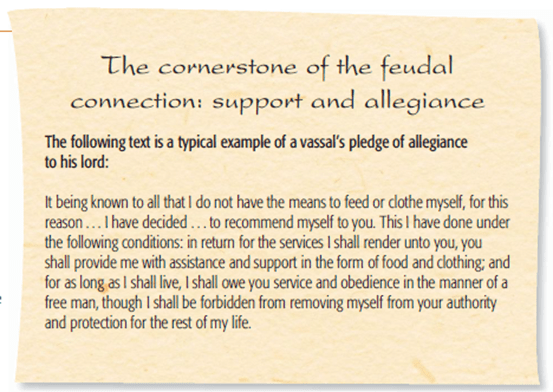
What is this? Explain what this historical document shows us.
This is an example of a Feudal bond; the agreement proposed by a vassal to a Lord in exchange for support and loyalty. It shows us how these agreements worked in the Middle ages and how feudalism worked in reality.
500
Which type of Church power—spiritual or temporal—was more important? Support your answer with evidence.
Spiritual power was more important because people believed the Church could help them get to heaven. This gave the Church influence over people's lives, which helped it gain more temporal (political and economic) power as well.
500
What were the Crusades?
The Crusades were a series of religious wars between Christians and Muslims. Christian armies from Europe tried to take control of the Holy Land, especially Jerusalem. Christians and Muslims fought for control of important religious sites.
500
List as many examples as you can of how ideas and practices from the Christian Church in the Middle Ages can still be seen in today’s society.
Examples may include:
- Churches and cathedrals
- Religious holidays such as Christmas and Easter
- Hospitals and schools founded by religious groups
- Christian values influencing laws and traditions
- Medieval architecture and art