Waves & Light
Electronic Structure
100
Describe the mathematical relationship of wavelength, frequency, and energy.
As wavelength increases, frequency and energy decrease
(wavelength is inversely proportional to frequency and energy)
(frequency and energy are proportional)
100
Draw the orbital diagram for oxygen
___ ___ ___ ___ ___
1s 2s 2p

200
When will an atom emit a photon?
When an electron moves from a higher energy level to a lower energy level (closer to the nucleus). The energy of the photon emitted will be equal to the difference in quantized energy levels the electron moved.
200
# of orbitals in the 3rd energy level (n=3)
9 orbitals (s contains 1, p contains 3, and d contains 5)
300
What is the difference between a continuous, emission, and absorption spectra?
continuous: whole spectrum of color (ROYGBIV)
emission: shows only the wavelengths (lines) of light emitted by an element/compound
absorption: Inverse of emission spectrum shows all colors except those emitted by the
300
Draw the shapes of the s, p, d, and f
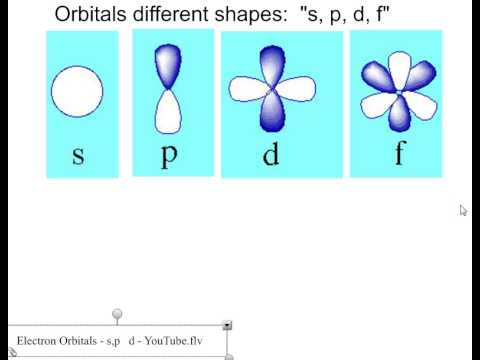
400
Lithium shows the photoelectric effect at a wavelength of 432 nm. What is the mass of this photon?
5.11x10-36 kg
400
The number of electrons in n=4 energy level
32 e- (2 from s, 6 from p, 10 from d, 14 from f)
there's an equation for this
500
If Harry and his Nimbus 2000 (combined mass = 75.0 kg) are flying at maximum speed (44.7 m/s), what would be its wavelength?
1.98x10-37 m
500
Provide the element name, period, group, and block for the following electron configuration:
[Kr]5s24d8
Element is Pd
period: 5
group: 10
block: d
600
What is the wavelength (in nm) and type of radiation of the photon emitted from a hydrogen atom when its one electron drops from the 4th energy level to the 1st energy level?
97.3 nm, UV radiation
600
Write the electron configurations (noble gas notation) for molybdenum and copper.
Mo: [Kr] 5s14d5
Cu: [Ar] 4s13d10