Radicals and Rational Exponents
Radical and Rational Equations
Radical Inequalities
Function Operations
Function Composition
100
Use the properties of rational exponents to simplify the expression.
(143)1/2
143/2
100
Solve the equation. Make sure to check for extraneous solutions!
9 = √p+7
p = 74
Check
9 = √74+7
9 = √81
9 = 9
100
Solve the inequality. Check your solution!
4√(x) + 3 ≤ 23
0 ≤ x ≤ 25
[0,25]
100
Perform the indicated operation to write the new function rule.
g(t) = −t + 3
h(t) = 3t − 4
Find (g ⋅ h)(t)
−3t2 + 13t − 12
100
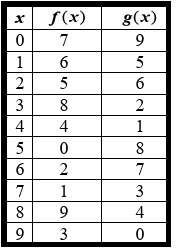
Find g(g(2))
7
200
Use the properties of rational exponents to simplify the expression.
(9-3/5 x 91/5)-1
92/5 or 34/5
200
Solve the equation. Remember to check for extraneous solutions!
√-6 - v = √v + 10
v = -8
Check
√-6 - (-8) = √-8 + 10
√-6 + 8 = √2
√2 = √2
200
Solve the inequality. Check your solution!
√(x+10) ≥ 6
x ≥ 26
[26,∞)
200
Perform the indicated operation to write the new function rule.
h(t) = 2t + 1
g(t) = 2t + 2
Find (h − g)(t)
-1
200
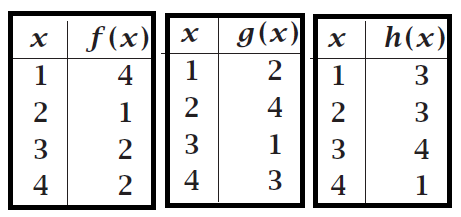 Find (f o g)(3)
4
300
Use the properties of rational exponents to simplify the expression.
255/9 x 257/9 / 54/3
54/3
300
Solve the equation. Check solution(s)
-2 + 4(3x - 36)3/2 = 106
x = 15
300
Solve the inequality. Check your solution!
√(2x+6) - 3 ≤ 1
-3 ≤ x ≤ 5
[-3,5]
300
Perform the indicated operation to write the new function rule.
g(n) = 3n + 2
f (n) = 2n2 + 5
Find g( f (2))
41
300
Find g(f(5))
9
400
Use the properties of radicals to simplify the expression.
√7/√700
1/10
400
Solve the equation. Check solution(s)
1276 = -4 + 5(8 - 4r)4/3
r = -14 and r = 18
400
Solve the inequality. Check your solution!
-3√(x+2) < 15
x ≥ -2
[-2,∞)
400
Perform the indicated operation to write the new function rule.
h(a) = 3a
g(a) = −a3 − 3
Find (h/g) (a)
3a / (−a3 − 3)
400
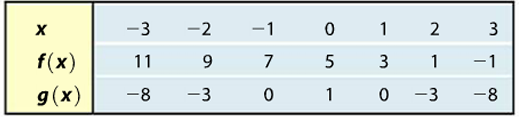
Find (f o f)(3)
7
500
Simplify the expression.
13 3√3 - 3√375
8 3√3
500
Solve the equation. Check your answer!
√(4x+7) + √(6x+6) = √(20x+26)
x = 1/2
500
Solve the inequality. Check your solution!
5 - √(20x +4) ≥ -3
-1/5 ≤ x ≤ 3
[-1/5,3]
500
Perform the indicated operation to write the new function rule.
h(x) = x2 − 2
g(x) = 4x + 1
Find (h o g)(x)
16x2 + 8x − 1
500
Find (h o g o f)(2)
3