Fossils
Relative Dating vs Absolute Dating
USA Style
Laws vs Theory
Trivia
100
Which of the following is the best way to describe a fossil?
A) a clue of a living organism such as a footprint or bone
B) the decomposing remains of a dead organism
C) the preserved remains of a previously living organism
D) the rock that surrounded a dead animal
C) the preserved remains of a previously living organism
100
What is the difference between absolute dating and relative dating?
Relative dating give the approximate age of geologic material based on its relationship to objects around it
Absolute Dating gives the exact age of geologic material based on analysis of isotopes.
100
Which of the following is the best way to measure the age of the Earth?
A) Test the rate of decay of specific elements in rock samples.
B) Examine rocks collected in my backyard.
C) Analyze maps of all known fossil sites in the United States.
D) Explore leaves embedded in ash from recent volcanic eruptions.
A) Test the rate of decay of specific elements in rock samples.
100
An explanation of why or how something in science occurs.
Scientific Theory
100
When was the Earth formed?
A) 3.6 bya
B) 4.6 bya
C) 2.7 bya
D) 4.6 mya
B) 4.6 bya
200
Jacque is hiking in the mountains and sees a very large and colorful rock layer. It looks different than the surrounding rock layers. What is the best way for Jacque to investigate what the environment was like when this rock layer was deposited?
A) Jacque could measure the height of the rock layer.
B) Jacque could check if the rock layer has fossils in it.
C) Jacque could look at the color of the surrounding rock layers.
D) Jacque could chip off a chunk of rock from the rock layer and smell it.
B) Jacque could check if the rock layer has fossils in it.
200
Which of the following is an example of absolute dating?
Ⓐ A sedimentary rock layer is between 10,000 and 10,500 years old.
Ⓑ A sedimentary rock layer is younger than the existing layer below it.
Ⓒ A sedimentary rock layer is 20,000 years old because it is a scientific law.
Ⓓ A sedimentary rock layer contains fish fossils, but the layers above and below it do not contain any fossils
Ⓐ A sedimentary rock layer is between 10,000 and 10,500 years old.
200
TRUE/FALSE:
Tilting changes the order in which the rocks are formed and thus also changes the relative ages of the rock layers.
FALSE
200
A prediction or statement describing something that occurs in science.
Scientific Law
200
What is the half-life of Carbon-14?
A) 30 years
B) 24000 years
C) 700 million years
D) 5750 years
D) 5750 years
300
Which of the following is needed in order for soft-bodied organisms to be preserved?
A) water
B) resin/tree sap
C) sediment
D) petroleum/tar
B) resin/tree sap
300
How much of the parent isotope would be remaining after 5 half-lives have passed?
A) 50%
B) 1.5625%
C) 3.125%
D) 6.25%
C) 3.125%
300
Two scientists found a fossil of an extinct plant. This plant once lived in a warm, tropical climate but the fossil is discovered under a sheet of thick ice. Which of the following statements most likely explains why the fossil is now extinct?
A) The extinction of the plant was caused by other plant species taking over their habitat after the climate changed.
B) The extinction of the plant was caused by the sheet of ice blocking the sun and the plant could not adapt to a colder climate.
C) The extinction of the plant was caused by the drifting of tectonic plates from warmer to much colder climates over a long period of time.
D) The extinction of the plant was caused by the plants shedding their seeds and being covered with snow and ice as the climate changed.
C) The extinction of the plant was caused by the drifting of tectonic plates from warmer to much colder climates over a long period of time.
300
Which of the following statements is most accurate as it relates to the Law of Superposition?
Ⓐ The Law of Superposition is an explanation relating to the sequence of disturbed rock layers.
Ⓑ The Law of Superposition is an observable fact relating to the sequence of undisturbed rock layers.
Ⓒ The Law of Superposition is a study of past events preserved in disturbed rock layers and their exceptions.
Ⓓ The Law of Superposition is a theory that may be replaced by an improved theory if new discoveries are made relating to the sequence of undisturbed rock layers
Ⓑ The Law of Superposition is an observable fact relating to the sequence of undisturbed rock layers
300
Which of the following is an isotope used in radioactive dating?
A) carbon-12
B) potassium-38
C) uranium-235
D) calcium-40
C) uranium-235
400
Which type of rock would you most likely find a fossil in?
A) Sandstone cliff
B) Granite Mountain
C) Marble strata on a cliff
D) Basalt and andesite formation near the base of a volcano
A) Sandstone cliff
400
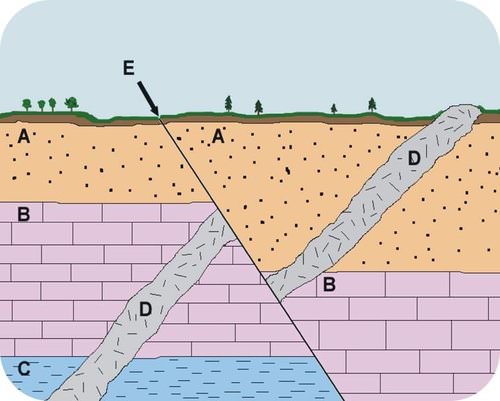
Layer D --> Layer A --> Layer B --> Layer C
400
Many inland areas around Florida contain extinct marine fossils. Which of the following statements best describes how this might have occurred?
A) Predatory birds carried prey to their inland nests and discarded the bones on the ground.
B) Some ancient marine organisms had the ability to walk on land and likely migrated inland.
C) Ocean levels were once much higher than they are today so inland areas were under water.
D) Strong winds carried marine organisms inland where they were buried and fossilized under layers of sediment
C) Ocean levels were once much higher than they are today so inland areas were under water.
400
Which of the following is a Scientific Theory?
A) Superposition
B) Gravity & Motion
C) Plate Tectonics
D) Cross-cutting
C) Plate Tectonics
400
What is the name of the marine organism that is a popular index fossil dating geologic material around it to the Cambrian Period, about 542 million years ago.
Trilobite
500
Give a brief description for each of the types of fossils below:
INDEX FOSSIL
TRACE FOSSIL
MACROFOSSIL
MICROFOSSIL
INDEX FOSSIL
fossils of organisms that were abundant & lived during a specific period of time before going completely extinct. Allows scientists to find the relative age of rock layers
TRACE FOSSIL
the remnants or small fragments of a previously living organism that was preserved and fossilized i.e. footprints, teeth, leaf prints, etc.
MACROFOSSIL
extremely large fossils
MICROFOSSIL
small fossils that need to be seen with magnification
500
Which of the following methods is least likely to help Alisha determine the age of sedimentary rock layers in her backyard?
Ⓐ Apply radiometric dating to determine the amount of radioactive isotopes in each rock layer.
Ⓑ Identify index fossils in sedimentary rock that have lived in a particular time in Earth’s history.
Ⓒ Analyze seismic diagrams to determine how radioactive elements break down into stable elements.
Ⓓ Use relative dating techniques to determine how individual fossil groups are related to specific rock layers.
Ⓒ Analyze seismic diagrams to determine how radioactive elements break down into stable elements.
500
A rock climbing group reached the top of Mount Everest in the Himalayan mountains. Mount Everest is about 29,000 feet above sea level and formed by the interaction of two tectonic plates. The group leader was surprised to find fossilized marine organisms on top of the mountain. Which of the following describes the geologic history of Mount Everest?
A) Two tectonic plates had different densities which caused the denser plate containing fossilized marine organisms to rise above the surface and form the Himalayan mountains.
B) Two tectonic plates had different densities which caused one plate to subduct into the ocean and the other one to rise causing marine organisms to fossilize on top of Mount Everest.
C) Two tectonic plates had the same density which caused one plate to subduct into a transform boundary that fossilized marine organisms before the Himalayan mountains were formed and uplifted.
D) Two tectonic plates had the same density and a collision of the plates pushed the advancing plate that contained fossilized marine organisms upward forming the Himalayan mountains and Mount Everest
D) Two tectonic plates had the same density and a collision of the plates pushed the advancing plate that contained fossilized marine organisms upward forming the Himalayan mountains and Mount Everest
500
Give a brief description or explanation to each of the following:
Law of Superposition
Theory of Plate Tectonics & Continental Drift
Law of Conservation of Energy
Law of Superposition
in an undisturbed rock layer, the youngest rock layer is at the top and the oldest rock layer is at the bottom
Theory of Plate Tectonics & Continental Drift
the earth's surface is layered with the lithosphere which is broken into pieces that are constantly moving. This movement causes changes in landmasses and landforms as well as earthquakes and volcanic eruptions.
Law of Conservation of Energy
Energy is not created or destroyed instead it is transformed from one form to the other.
500
What do geologists call Earth's current geologic era?
A) Mesozoic Era
B) Cenozoic Era
C) Paleozoic Era
D) Neocenozoic Era
B) Cenozoic Era